


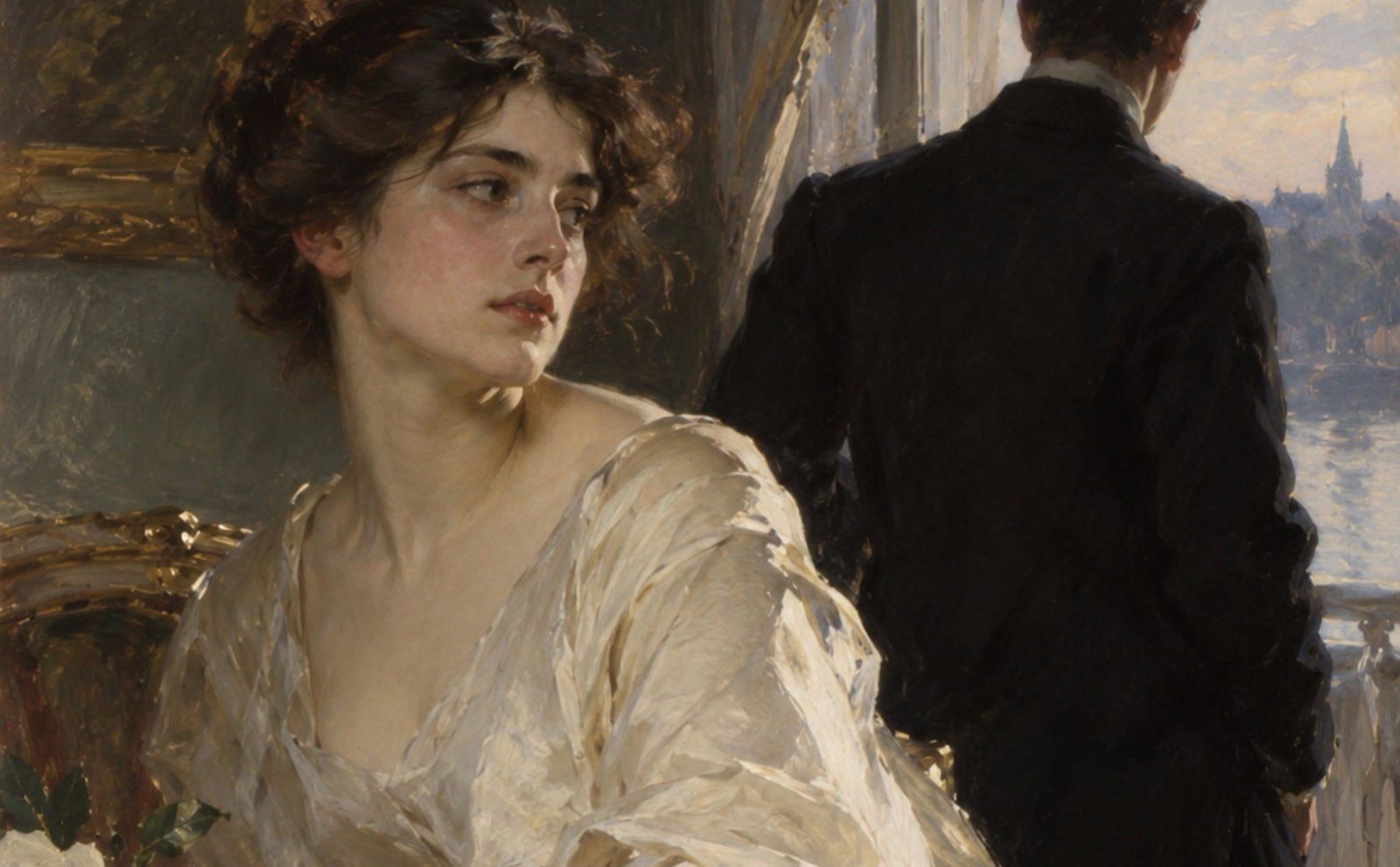
“Come,” he said, stepping gallantly between the two young ladies, and almost at the same moment offering each of them an arm.
Oh, how dark the orchard seemed to people coming out of the light! They had just left the house of the Rich Farmer of Crocke. There was no moon to be seen, and no one had thought to send a servant with a lantern as far as the end of the lane, or at least to the farm gate.
Still, they had enjoyed themselves. They had celebrated New Year’s Eve and eaten delicious waffles. It was only eleven o’clock.
“Isn’t it rather early to be going home on a night like this?”
“Yes, that’s true. And yet, you know, country people have to get up early to feed their animals and I don’t know what else—milk them, churn butter, perhaps.”
“Surely not on New Year’s Day!”
Such were the remarks the guests exchanged among themselves.
Gradually it seemed a little less dark. They could already make out the heavy bulk of the barn and stables; they could distinguish the tree trunks well enough to avoid walking into them.
Mayor Florisonne, who was ahead with his wife, had opened the barrier and was waiting for the others with her, warning them about a large puddle or mudhole at the entrance.
Mr. Hancq and his two companions came up giggling and joined them.
The watchdog, recognizing his own people, had growled and come out of his kennel, dragging his chain behind him, but had not barked. They all followed the alder hedge now, with thin little trees—newly planted—standing along the entire length of the lane. From time to time a foot still slipped into one of the wagon ruts; there would be a splash, then the sucking sound of a sole being pulled from the water, followed by laughter. Someone would stumble or skid now and then, but before long all five were safely on the slightly higher stone road.
Mr. Hancq still held both women’s arms in his, pressed close against him, while they all came naturally to a halt at the point where their ways parted.
The Rich Farmer’s farm stood within the territory of Crocke, but a long way from the built-up village. Vroden, which bordered that municipality, was only half an hour away.
The Mayor lived there on the so-called Plein, considerably closer still, since he could take a cross-country dirt road.
“You’ll excuse us, won’t you?”
“Yes, yes, of course,” all three replied cheerfully.
Hands were shaken, and someone laughingly asked whether they might already wish one another a Happy New Year. The answer was “no.”
“No getting out of the return visit.”
“Adieu, bonne nuit!”
“Goodbye, goodbye!”
“Ooh là là!” Hancq called mischievously once more, very loudly from a distance, though those who had gone their separate way either no longer heard him or at least did not answer.
And now, as he and his two companions followed the cobbled road through the bare fields, their black silhouettes stood out almost tangibly against the night sky: he was of medium height; one of the girls was short, the other tall.
They walked fairly quickly. It was far from warm.
The wind blew into their faces and rustled mysteriously through a small tree that had not yet shed its leaves, which they passed on their way. It stood entirely alone in desolate isolation.
“We’re at the IJzeren Eiksken,” said Georgine, the younger one, the tall one.
“At the Galgenveld!” said Marie. “Come on, let’s hurry so we can get past it quickly…”
Without realizing it, both had quickened their pace, so that their escort was now practically being pulled along.
“Are you really frightened?” he teased.
“Oh no, it’s too childish, really,” Marie replied, and, mastering herself, she almost came to a standstill.
This was the place where, in former times, the gallows had stood and the bodies of those who had been executed were laid upon the wheel as food for beasts of prey. People in the village still knew this; old people told the story in the evenings by the fireside, having heard it from their own ancestors.
“It’s strange, isn’t it?” said Marie. “How a place seems to retain something that can never quite be driven away, how something dreadful remains there from the scenes of blood that once took place.”
“Yes—or who knows, perhaps something real does remain,” Hancq said, “for it is remarkable that ravens still gather on this spot in greater numbers than anywhere else.”
Both girls had often seen large numbers of them there as well. The conversation now turned to fear in general, and they proved brave enough where anything supernatural was concerned, but admitted that they were extremely frightened of thieves and murderers.
“Just think of it: not a man in the house, only three women—we two and the maid. What would we do if someone broke in?”
It was Georgine who said this.
“Oh, you would have no trouble overpowering the bandits,” he replied, intending it as a compliment to her strong build. But immediately realizing that a young lady rarely cared to be credited with manly prowess, he dropped his teasing tone and asked seriously, almost anxiously:
“You do have a revolver, don’t you?”
“No, nothing. No weapons,” they both replied.
“Wouldn’t you dare shoot if you had to?”
“Perhaps I would,” said Marie.
“Yes, I would,” said Georgine, and her eyes already flashed with courage.
He seemed to be considering something.
“You absolutely must have a revolver. May I give you one?” he asked, turning from one to the other, with the result that neither dared take responsibility for accepting it, so that he was free to interpret their silence as consent.
They had reached the first scattered houses of Vroden. A break had opened in the great masses of cloud, and between them a shining disc peeped out like a face keeping watch.
“By moonlight in the evening!” he sang, still in high spirits, making a kind of dancing leap.
“Good evening,” came a voice close beside them.
They started like naughty children caught in the middle of some prank.
“Ah, Stasius, is that you?” Georgine asked, being the first to recognize him in the shadow of the houses.
“Yes, miss,” he replied, and with a brisk stride he had already passed them.
It was the rural constable, making his nightly rounds.
They entered the sleeping village, with its deserted streets, where no lamps were burning—since there was supposed to be moonlight—and its houses closed up behind their shutters.
Hancq rang the bell at the young ladies’ home, a large house near the churchyard, with a front door and carriage gate.
The door was opened almost at once by the maid, who had evidently been waiting just behind it.
He took a brief, cheerful, friendly leave of them.
His own house stood directly opposite. Its little stepped gable could be clearly seen against the night sky, crowned by a globe that in turn supported a weather vane.