

'Carmen' by Prosper Mérimée: Desire, Freedom, and the Danger of Possession
A calm literary look at Mérimée’s taut, unsettling novella of passion, power, and fatal independence

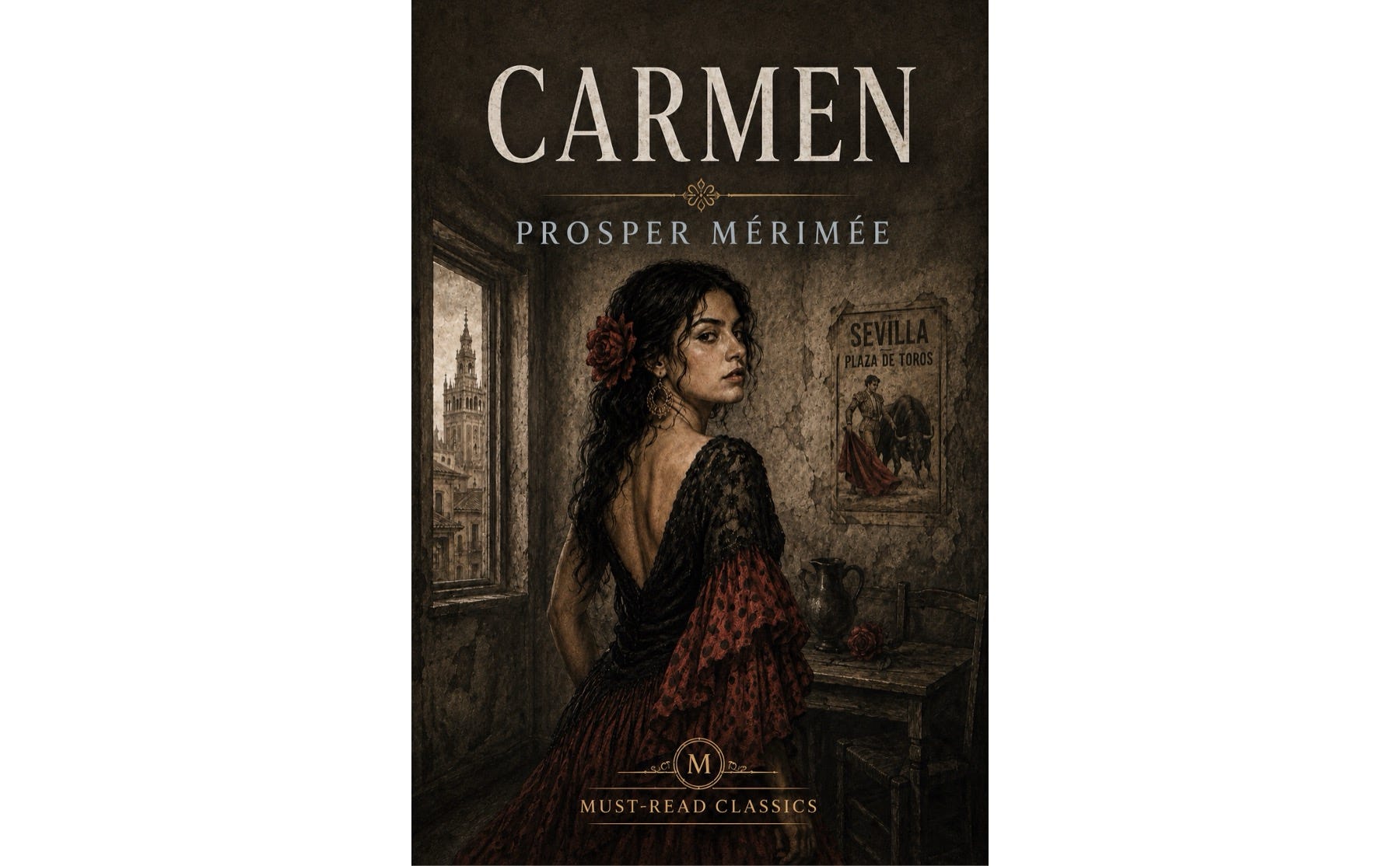
Before Carmen became inseparable from opera houses, red dresses, castanets, and the famous habanera, it was a compact and unsettling novella by Prosper Mérimée. First published in 1845, Carmen by Prosper Mérimée belongs to a nineteenth-century literary world fascinated by passion, crime, folklore, travel, and the perceived exoticism of Europe’s margins. Yet the work is more than a Romantic tale of fatal love. It is also a study in narration, cultural distance, masculine obsession, and the refusal of a woman to be possessed.
Mérimée was a writer of elegant restraint. He was drawn to violence, irony, and unusual psychological situations, but he rarely indulged in excess. His prose often keeps emotion at a deliberate distance. This makes Carmen especially interesting. The story contains jealousy, seduction, betrayal, murder, and social transgression, but its tone is often cool, almost archaeological. Mérimée frames the tale through an educated French narrator who travels in Spain and encounters both Don José, a condemned soldier-turned-bandit, and Carmen, the Romani woman whose independence becomes the center of José’s ruin. The result is not simply a story of passion. It is a story about how passion is interpreted, reported, judged, and mythologized.
The novella emerges from the Romantic fascination with Spain as a land of intensity, danger, and color. For many French writers of the period, Spain represented an alternative to bourgeois modernity: older codes of honor, sharper contrasts of faith and violence, and a landscape in which desire seemed less domesticated. Mérimée uses that atmosphere, but he does not merely decorate the story with local color. He turns the reader’s attention toward the act of looking itself. The narrator studies customs, languages, ruins, and people. Carmen, in particular, becomes an object of fascination, but she also resists being reduced to an object. She is watched, described, pursued, and judged; still, she continually slips away from the categories imposed upon her.
At the center of the novella is the tension between freedom and possession. Carmen’s famous insistence on her liberty is not presented as a sentimental slogan. It is the governing fact of her being. She enters relationships on her own terms, leaves them on her own terms, and refuses the moral vocabulary by which others attempt to define her. This freedom is not softened to make her agreeable. Carmen can be manipulative, mocking, and dangerous. She lies, steals, and uses desire as a form of power. But Mérimée gives her something rarer than innocence: consistency. She does not pretend to belong to anyone.
Don José, by contrast, is a man who loses himself because he cannot accept the separateness of another person. His tragedy is not that he loves Carmen too deeply, but that he mistakes love for ownership. At the beginning, he is attached to duty, family, military order, and a more conventional moral world. Carmen’s entrance disrupts those structures. Step by step, José abandons his old identity: he neglects discipline, becomes violent, joins smugglers, and descends into criminality. He explains his fall as the result of Carmen’s power over him, but the novella allows us to see something more troubling. José’s destruction comes from within. Carmen awakens his desire, but his possessiveness shapes its fatal course.
This is one reason the story remains relevant. Modern readers are less likely to accept José’s account at face value. His confession is moving, but it is also self-serving. He presents himself as bewitched, helpless, almost a victim of Carmen’s nature. Yet his language often reveals his inability to recognize her autonomy. He wants her fidelity without granting her freedom. He wants her body, her attention, her obedience, and finally her life. The violence at the end of the novella is not an inexplicable crime of passion. It is the logical endpoint of possessive love when it refuses all limits.
Carmen herself remains difficult to summarize, which is part of her literary vitality. She is neither a conventional heroine nor a simple femme fatale. The label “femme fatale” can be useful, but it can also flatten her into a male fear: the woman who destroys men by being desirable. Mérimée’s Carmen is more complicated. She lives by intelligence, instinct, appetite, and courage. She understands the social world around her with unsentimental clarity. She knows that men desire her, that institutions exclude her, and that survival often requires performance. Her freedom is not abstract. It is practical, bodily, immediate.
There is also a deep tension in the novella’s portrayal of Carmen’s Romani identity. Mérimée writes from within the assumptions and prejudices of his century, and parts of the book reflect the exoticizing gaze of nineteenth-century Europe. Carmen is associated with mystery, lawlessness, sexuality, and cunning in ways that modern readers should examine carefully. Yet this difficulty does not make the book less worth reading. On the contrary, it gives the work an additional layer of importance. Carmen asks us to consider not only what is being narrated, but who has the authority to narrate, and what kinds of people are turned into symbols for the desires and fears of others.
The narrator’s role is crucial here. He appears rational, cultivated, and detached, but his detachment is not neutral. He collects stories and observations; he interprets people as specimens of culture. The novella begins almost like a travel anecdote and at times resembles an ethnographic note. This framing creates distance between the reader and the central drama, but it also raises questions. Does the narrator understand Carmen, or does he merely classify her? Does Don José confess the truth, or the version of the truth that makes his crime bearable to himself? Carmen’s voice reaches us through layers of male narration. The fact that she remains so vivid despite this mediation is one of the work’s quiet achievements.
Mérimée’s style contributes to the book’s enduring force. He does not explain everything. He leaves moral judgments partly suspended. The prose is economical, the structure controlled, the atmosphere suggestive rather than expansive. This restraint gives the novella a hard, polished quality. Unlike longer novels that invite the reader to inhabit an entire social world, Carmen moves with the compression of a remembered encounter or a legal testimony. Much is implied. A glance, a gesture, a phrase, or a silence can carry the weight of a turning point.
The story’s later transformation into Bizet’s opera has inevitably changed how readers approach it. Many come to Mérimée’s novella already hearing music. But the original work is darker, colder, and in some ways more morally ambiguous than its famous adaptation. It does not romanticize Carmen as easily. Nor does it ask us simply to admire José’s suffering. It gives us a world in which desire crosses boundaries of class, law, ethnicity, and gender, but where such crossings do not lead to liberation for everyone. Freedom, in this story, is real; so is the punishment imposed on those who claim it too openly.
Reading Carmen by Prosper Mérimée today means encountering a classic that is both familiar and strange. Familiar, because its central dynamics—desire, jealousy, fascination with the outsider, the confusion of love with control—remain painfully recognizable. Strange, because its narrative manners belong to another age: its ethnographic curiosity, its masculine framing, its compressed fatalism, its coolness before violence. That combination makes the novella rewarding. It invites admiration, but also resistance. It asks to be read, not merely consumed as a legend.
Perhaps the deepest reason to return to Carmen is that it refuses to make freedom comfortable. Carmen’s independence is not presented as gentle, respectable, or easily assimilated into social order. She is not an emblem of modern self-realization in a simple sense. She is more unsettling than that. She reminds us that freedom can disturb, attract, offend, and frighten those who encounter it. Don José cannot survive such freedom because he cannot love without enclosing. Carmen cannot surrender it without ceasing to be herself.
For readers who appreciate concise classics with psychological tension and moral complexity, Carmen offers far more than its cultural reputation suggests. It is a brief work, but not a slight one. Behind the familiar name lies a sharp, elegant novella about storytelling, desire, and the fatal consequences of trying to possess another human being. It is worth reading slowly, with attention to what is said, what is withheld, and whose version of events we are being asked to believe. A good edition of Carmen belongs on the shelf not simply because it is a classic, but because it still has the power to unsettle the reader’s confidence in easy judgments.
Carmen
Translated by Wilma Baltus. Copyright © Wilma Baltus. All rights reserved.
Every woman is gall; yet she has two good hours: one in the bedchamber, and one in death.
- Palladas
I had always suspected geographers of not knowing what they were talking about when they placed the battlefield of Munda in the land of the Bastuli-Poeni, near modern Monda, some two leagues north of Marbella. From my own conjectures about the text of the anonymous author of the Bellum Hispaniense, and from certain information I had gathered in the excellent library of the Duke of Ossuna, I believed that the memorable place where Caesar, for the last time, played double or quits against the champions of the Republic ought to be sought somewhere near Montilla. Finding myself in Andalusia at the beginning of the autumn of 1830, I made a fairly long excursion to clear up the doubts that still remained in my mind. A paper I shall publish shortly will, I hope, leave not the slightest uncertainty in the mind of any honest archaeologist. While awaiting the dissertation that will at last resolve the geographical problem that still keeps learned Europe in suspense, I should like to tell you a little story; it prejudges nothing about the interesting question of Munda’s location.
In Cordoba I had hired a guide and two horses, and had set out on my campaign with Caesar’s Commentaries and a few shirts as my entire baggage. One day, wandering across the higher part of the plain of Cachena, exhausted with fatigue, dying of thirst, scorched by a leaden sun, I was heartily consigning Caesar and the sons of Pompey to the devil when I noticed, some distance from the path I was following, a little patch of green meadow scattered with rushes and reeds. This promised the presence of a spring nearby. Indeed, when I drew closer, I saw that the supposed meadow was a marsh, in which a brook was losing itself, emerging, as it seemed, from a narrow gorge between two high spurs of the Sierra de Cabra. I concluded that by following the brook upstream I would find cooler water, fewer leeches and frogs, and perhaps a little shade among the rocks. At the entrance to the gorge, my horse neighed, and another horse, which I could not see, immediately answered. I had scarcely gone a hundred paces when the gorge, widening suddenly, revealed to me a kind of natural amphitheater, perfectly shaded by the height of the cliffs that surrounded it. No place could have promised a traveler a more agreeable halt. At the foot of sheer rocks, the spring burst out in a bubbling rush and fell into a little basin lined with sand as white as snow. Five or six fine evergreen oaks, always sheltered from the wind and refreshed by the spring, rose along its banks and covered it with their dense shade; and around the basin, at last, a fine, glossy grass offered a better bed than could have been found in any inn for ten leagues around.
The honor of discovering so beautiful a place did not belong to me. A man was already resting there, and had no doubt been sleeping when I entered. Awakened by the neighing, he had risen and gone over to his horse, which had taken advantage of its master’s sleep to make a good meal of the grass nearby. He was a young fellow of medium height, but robust in appearance, with a dark, proud gaze. His complexion, which must once have been handsome, had been darkened by the sun until it was deeper in color than his hair. In one hand he held his mount’s halter; in the other, a brass blunderbuss. I admit that at first the blunderbuss and the savage air of the man carrying it surprised me somewhat; but I no longer believed in robbers, having heard so much about them and never once met any. Besides, I had seen so many honest farmers armed to the teeth on their way to market that the sight of a firearm gave me no right to question the stranger’s morality. And then, I said to myself, what would he do with my shirts and my Elzevir Commentaries? So I greeted the man with the blunderbuss by a familiar nod of the head, and asked him, smiling, whether I had disturbed his sleep. Without answering, he looked me up and down; then, as if satisfied with his inspection, he examined with the same attention my guide, who was coming up behind me. I saw the latter turn pale and stop short, showing obvious terror. A bad encounter! I said to myself; but prudence immediately advised me not to let any uneasiness appear. I dismounted, told the guide to unbridle the horses, and, kneeling at the edge of the spring, plunged my head and hands into it; then I drank a deep draught, lying flat on my stomach like Gideon’s bad soldiers.
All the while, however, I was watching my guide and the stranger. The first was approaching very reluctantly; the other seemed to have no ill intentions toward us, for he had given his horse its freedom, and his blunderbuss, which at first he had held horizontally, was now pointed toward the ground.
Not thinking I ought to take offense at the slight regard that seemed to have been paid to my person, I stretched myself out on the grass and, with an easy air, asked the man with the blunderbuss whether he had a flint on him. At the same time I drew out my cigar case. The stranger, still without speaking, searched his pocket, took out his flint, and hurried to give me a light. Clearly he was becoming more human, for he sat down opposite me, though without letting go of his weapon. Once my cigar was lit, I chose the best of those I had left and asked him whether he smoked.
“Yes, sir,” he answered. These were the first words he had uttered, and I noticed that he did not pronounce the s in the Andalusian manner, from which I concluded that he was a traveler like myself, only less of an archaeologist.
“You will find this one rather good,” I said, offering him a genuine Havana regalia.
He gave me a slight bow of the head, lit his cigar from mine, thanked me with another nod, and began to smoke with every appearance of very keen pleasure.
“Ah!” he exclaimed, letting his first puff escape slowly through his mouth and nostrils. “How long it’s been since I smoked!”
In Spain, a cigar given and accepted establishes the bonds of hospitality, just as, in the East, bread and salt are shared. My man proved more talkative than I had hoped. Besides, although he claimed to live in the district of Montilla, he seemed to know the country rather poorly. He did not know the name of the charming valley where we found ourselves; he could not name a single village in the surrounding area; and when I asked him whether he had seen any ruined walls nearby, any large rimmed tiles, any carved stones, he confessed that he had never paid attention to such things. On the other hand, he showed himself an expert in matters of horses. He criticized mine, which was not difficult; then he gave me the genealogy of his own, which came from the famous stud farm at Cordoba: a noble animal indeed, so tireless, according to its master, that it had once covered thirty leagues in a single day, at a gallop or a full trot. In the middle of this speech, the stranger stopped abruptly, as if surprised and vexed at having said too much.
“It was because I was in a great hurry to get to Cordoba,” he resumed, with some embarrassment. “I had to petition the judges about a lawsuit…”
As he spoke, he looked at my guide Antonio, who lowered his eyes.
The shade and the spring charmed me so much that I remembered several slices of excellent ham that my friends in Montilla had put into my guide’s saddlebag. I had them brought out and invited the stranger to take his share of the impromptu meal. If he had not smoked for a long time, it seemed likely to me that he had not eaten for at least forty-eight hours. He devoured the food like a starving wolf. I thought that my arrival had been providential for the poor devil. My guide, meanwhile, ate little, drank even less, and did not speak at all, although from the beginning of our journey he had revealed himself to me as a chatterbox without equal. The presence of our guest seemed to embarrass him, and a certain mistrust kept the two men apart, though I could not positively guess the cause.
Already the last crumbs of bread and ham had disappeared; we had each smoked a second cigar; I ordered the guide to bridle our horses, and I was about to take leave of my new friend when he asked me where I intended to spend the night.
Before I had noticed a sign from my guide, I had answered that I was going to the Venta del Cuervo.
“A poor lodging for a person like you, sir… I am going there myself, and, if you will allow me to accompany you, we can travel together.”
“Very gladly,” I said, mounting my horse. My guide, who was holding my stirrup, gave me another warning look. I answered it with a shrug of my shoulders, as if to assure him that I was perfectly calm, and we set off.
Antonio’s mysterious signals, his uneasiness, a few words let fall by the stranger, above all his ride of thirty leagues and the rather unconvincing explanation he had given for it, had already formed my opinion of my traveling companion. I had no doubt that I was dealing with a smuggler, perhaps even a robber; but what did that matter to me? I knew the Spanish character well enough to feel quite certain that I had nothing to fear from a man who had eaten and smoked with me. His very presence was a sure protection against any unfortunate encounter. Besides, I was rather pleased to learn what a brigand was like. One does not see them every day, and there is a certain fascination in finding oneself close to a dangerous being, especially when one feels him to be gentle and tamed.
I hoped, little by little, to draw the stranger into making confidences, and despite the winks and warning glances of my guide, I turned the conversation to highway robbers. Naturally, I spoke of them with respect. At that time there was in Andalusia a famous bandit named José-Maria, whose exploits were on everyone’s lips. What if I were sitting beside José-Maria? I said to myself. I told the stories I knew about that hero, all of them, moreover, to his credit, and loudly expressed my admiration for his courage and generosity.
“José-Maria is nothing but a rogue,” the stranger said coldly.
Is he doing himself justice, or is this an excess of modesty on his part? I wondered silently; for, from studying my companion so closely, I had managed to fit him to the description of José-Maria, which I had seen posted at the gates of many a town in Andalusia. Yes, it is certainly him. Blond hair, blue eyes, a wide mouth, fine teeth, small hands; a linen shirt, a velvet jacket with silver buttons, white leather gaiters, a bay horse… no more doubt! But let us respect his incognito.
We arrived at the inn. It was exactly as he had described it to me—that is to say, one of the most miserable I had yet encountered. One large room served as kitchen, dining room, and bedroom. On a flat stone in the middle of the room the fire was made, and the smoke escaped through a hole cut in the roof—or rather stopped there, forming a cloud a few feet above the ground. Along the wall lay five or six old mule blankets; these were the travelers’ beds. Twenty paces from the house, or rather from the single room I have just described, stood a kind of shed that served as a stable. In this charming abode there were no other human beings, at least for the moment, than an old woman and a little girl of ten or twelve, both the color of soot and dressed in appalling rags. So this, I said to myself, is all that remains of the population of Munda Baetica! O Caesar! O Sextus Pompey! How astonished you would be if you returned to the world!
On seeing my companion, the old woman let out an exclamation of surprise.
“Ah! Señor Don José!” she cried.
Don José frowned and lifted one hand with a gesture of authority that instantly silenced the old woman. I turned toward my guide, and with an imperceptible sign made him understand that he had nothing to teach me about the man with whom I was about to spend the night. Supper was better than I had expected. We were served, on a little table a foot high, an old rooster stewed with rice and plenty of peppers, then peppers in oil, and finally gazpacho, a kind of pepper salad. Three dishes so fiercely seasoned obliged us to resort often to a wineskin of Montilla wine, which proved delicious. After we had eaten, noticing a mandolin hanging on the wall—there are mandolins everywhere in Spain—I asked the little girl who had served us whether she knew how to play it.
“No,” she answered, “but Don José plays so well!”
“Be so kind,” I said to him, “as to sing me something. I have a passion for your national music.”
“I can refuse nothing to so honorable a gentleman, who gives me such excellent cigars,” cried Don José good-humoredly; and, having had the mandolin brought to him, he sang while accompanying himself. His voice was rough, yet pleasant; the melody melancholy and strange. As for the words, I did not understand a syllable.
“Unless I am mistaken,” I said to him, “the tune you have just sung is not Spanish. It resembles the zortzicos I have heard in the Provinces, and the words must be in Basque.”
“Yes,” Don José replied darkly.
He set the mandolin down on the floor, folded his arms, and began to stare at the dying fire with an extraordinary expression of sadness. Lit by a lamp placed on the little table, his face, at once noble and savage, reminded me of Milton’s Satan. Like him, perhaps, my companion was thinking of the home he had left behind, of the exile he had brought upon himself by his own fault. I tried to revive the conversation, but he did not answer, absorbed as he was in his mournful thoughts. The old woman had already lain down in a corner of the room, sheltered behind a ragged blanket stretched over a rope. The little girl had followed her into that retreat reserved for the fair sex. My guide then rose and invited me to follow him to the stable; but at that word, Don José, as though startled awake, asked him sharply where he was going.
“To the stable,” answered the guide.
“What for? The horses have food. Sleep here; the gentleman will permit it.”
“I’m afraid the gentleman’s horse may be ill. I would like the gentleman to see him; perhaps he will know what ought to be done.”
It was obvious that Antonio wanted to speak with me in private; but I did not care to arouse Don José’s suspicions, and at the point we had reached, it seemed to me that the wisest course was to show the greatest confidence. I therefore answered Antonio that I understood nothing about horses and that I wanted to sleep. Don José followed him to the stable, from which he soon returned alone. He told me the horse had nothing wrong with it, but that my guide considered it so precious an animal that he was rubbing it down with his own jacket to make it sweat, and intended to spend the night in that gentle occupation. Meanwhile, I had stretched myself out on the mule blankets, carefully wrapped in my cloak so as not to touch them. After asking pardon for the liberty he was taking in lying down near me, Don José settled himself in front of the door, not without having renewed the priming of his blunderbuss, which he took care to place under the saddlebag that served him as a pillow. Five minutes after we had wished each other good night, we were both sound asleep.
I had thought myself tired enough to sleep in such a lodging; but after an hour, some very unpleasant itching tore me from my first sleep. As soon as I understood its nature, I got up, convinced that it was better to spend the rest of the night under the open sky than beneath that inhospitable roof. Walking on tiptoe, I made my way to the door, stepping over Don José’s bed as he slept the sleep of the just, and I managed so well that I got out of the house without waking him. Near the door stood a broad wooden bench; I stretched myself out on it and arranged myself as best I could to finish the night there. I was about to close my eyes for the second time when I seemed to see the shadow of a man and the shadow of a horse pass before me, both moving without making the slightest sound. I sat up and thought I recognized Antonio. Surprised to see him outside the stable at such an hour, I rose and went to meet him. He had stopped, having noticed me first.
“Where is he?” Antonio asked me in a low voice.
“In the inn. He is asleep; clearly he isn’t afraid of bedbugs. But why are you taking that horse away?”
I then noticed that, so as not to make any noise while leaving the shed, Antonio had carefully wrapped the animal’s feet in the remnants of an old blanket.
“Speak lower, for God’s sake!” Antonio said to me. “You do not know who that man is. He is José Navarro, the most notorious bandit in Andalusia. All day long I have been making signs to you, and you refused to understand them.”
“Bandit or not, what does it matter to me?” I answered. “He has not robbed us, and I would wager he has no desire to.”
“All well and good; but there are two hundred ducats for whoever turns him in. I know a post of lancers a league and a half from here, and before daylight I will bring back some sturdy fellows… I would have taken his horse, but it is so vicious that no one but Navarro can go near it.”
“The devil take you!” I said to him. “What harm has the poor man done you that you should denounce him? Besides, are you sure he is the brigand you say he is?”
“Perfectly sure. Just now he followed me into the stable and said to me: ‘You look as though you know me. If you tell that good gentleman who I am, I’ll blow your brains out.’ Stay, sir, stay near him; you have nothing to fear. As long as he knows you are there, he will suspect nothing.”
While we were speaking, we had already moved far enough from the inn that the horse’s shoes could not be heard. In the blink of an eye, Antonio had freed the animal from the rags he had wrapped around its feet; he was preparing to mount. I tried both pleas and threats to hold him back.
“I am a poor devil, sir,” he said to me. “Two hundred ducats are not something one lets slip away, especially when it means ridding the country of such vermin. But take care: if Navarro wakes, he will leap for his blunderbuss, and then God help you! As for me, I have gone too far to turn back; manage as best you can.”
The rascal was already in the saddle. He dug in his spurs, and in the darkness I soon lost sight of him.
I was deeply irritated with my guide and fairly uneasy. After a moment’s reflection, I made up my mind and went back into the inn. Don José was still sleeping, no doubt at that moment repairing the fatigues and sleepless nights of several adventurous days. I had to shake him roughly to wake him. I shall never forget his savage look, nor the movement he made to seize his blunderbuss, which, as a precaution, I had placed some distance from his bed.
“Sir,” I said to him, “I beg your pardon for waking you; but I have a foolish question to ask: would you be very pleased to see half a dozen lancers arrive here?”
He sprang to his feet, and in a terrible voice asked me:
“Who told you?”
“It hardly matters where the warning comes from, provided it is sound.”
“Your guide has betrayed me, but he will pay for it! Where is he?”
“I don’t know… In the stable, I think… but someone told me…”
“Who told you?… It cannot have been the old woman…”
“Someone I do not know… Without more words: have you, yes or no, any reason not to wait for the soldiers? If you have, do not lose any time; if not, good night, and I apologize for interrupting your sleep.”
“Ah! Your guide! Your guide! I distrusted him from the first… but… his account is settled! Farewell, sir. May God repay you for the service I owe you… I am not quite as bad as you think… yes, there is still something in me that deserves the pity of an honorable man… Farewell, sir… My only regret is that I cannot repay you.”
“In return for the service I have done you, promise me, Don José, that you will suspect no one and think nothing of revenge. Here, take these cigars for your journey. Godspeed!”
And I held out my hand to him. He pressed it without answering, took up his blunderbuss and his saddlebag, and, after saying a few words to the old woman in a jargon I could not understand, ran to the shed. A few moments later I heard him galloping away across the countryside.
As for me, I lay down again on my bench, but I did not fall asleep. I asked myself whether I had been right to save from the gallows a thief, perhaps a murderer, and this only because I had eaten ham and Valencian rice with him. Had I not betrayed my guide, who was upholding the cause of the law? Had I not exposed him to the vengeance of a scoundrel? But then, the duties of hospitality… A savage prejudice, I told myself; I shall have to answer for every crime the bandit goes on to commit… And yet, is it prejudice, that instinct of conscience which resists every argument? Perhaps, in the delicate position in which I found myself, there was no way out without remorse. I was still wavering in the deepest uncertainty about the morality of my action when I saw half a dozen horsemen appear, with Antonio prudently keeping to the rear. I went to meet them and informed them that the bandit had fled more than two hours before. Questioned by the brigadier, the old woman answered that she knew Navarro, but that, living alone, she would never have dared risk her life by denouncing him. She added that whenever he came to her house, it was his habit always to leave in the middle of the night. As for me, I had to go several leagues away to produce my passport and sign my statement before an alcalde, after which I was permitted to resume my archaeological investigations. Antonio bore me a grudge, suspecting that it was I who had prevented him from earning the two hundred ducats. Nevertheless, we parted as friends in Cordoba; there I gave him a gratuity as large as the state of my finances allowed.
*
I spent several days in Cordoba. Someone had pointed me toward a certain manuscript in the library of the Dominicans, where I was supposed to find interesting information about ancient Munda. Kindly received by the good fathers, I spent my days in their convent, and in the evenings I walked about the city. In Cordoba, toward sunset, a great many idlers gather on the quay that borders the right bank of the Guadalquivir. There one breathes the fumes of a tannery that still preserves the ancient reputation of the region for the preparation of leather; but, in return, one enjoys a spectacle that has its own merits. A few minutes before the Angelus, a large number of women assemble at the edge of the river, below the quay, which is rather high. No man would dare mingle with that crowd. As soon as the Angelus rings, it is understood that night has fallen. At the final stroke of the bell, all these women undress and enter the water. Then come cries, laughter, an infernal uproar. From the top of the quay the men contemplate the bathers, straining their eyes and seeing very little. Yet those pale, uncertain forms, outlined against the dark blue of the river, set poetic imaginations to work; and with a little fancy, it is not difficult to picture Diana and her nymphs bathing, without having to fear Actaeon’s fate. I was told that certain scoundrels once clubbed together to grease the palm of the cathedral bell-ringer and make him ring the Angelus twenty minutes before the legal hour. Although it was still broad daylight, the nymphs of the Guadalquivir did not hesitate; trusting the Angelus more than the sun, they made their bathing toilette with a perfectly clear conscience—a toilette that is always of the simplest kind. I was not there. In my day the bell-ringer was incorruptible, the twilight dim, and only a cat could have distinguished the oldest orange-seller from the prettiest grisette in Cordoba.
One evening, at the hour when one can no longer see anything, I was smoking, leaning against the parapet of the quay, when a woman came up the stairway that leads down to the river and sat beside me. In her hair she wore a great bouquet of jasmine, whose broad petals give off, at night, an intoxicating fragrance. She was dressed simply, perhaps poorly, all in black, like most of the grisettes in the evening. Women of good society wear black only in the morning; in the evening they dress à la française. When she came near me, my bather let the mantilla that covered her head slip down over her shoulders, and in the dim light falling from the stars I saw that she was small, young, well made, and had very large eyes. I threw away my cigar at once. She understood this act of thoroughly French politeness, and hastened to tell me that she greatly liked the smell of tobacco, and that she herself smoked when she could find very mild papelitos. By good fortune I had some of that kind in my case, and I hastened to offer them to her. She deigned to take one and lit it from the end of a burning cord brought to us by a child in exchange for a sou. Mingling our smoke, the beautiful bather and I talked so long that we found ourselves almost alone on the quay. I thought I would not be indiscreet in offering to take her for ices at the nevería. After a modest hesitation, she accepted; but before deciding, she wished to know what time it was. I made my watch strike, and the sound seemed to astonish her greatly.
“What inventions you have in your country, you foreign gentlemen! What country are you from, sir? English, no doubt?”
“French, and very much at your service. And you, mademoiselle—or madame—you are surely from Cordoba?”
“No.”
“At least you are Andalusian. I think I recognize it in your sweet way of speaking.”
“If you notice people’s accents so well, you ought to be able to guess who I am.”
“I believe you are from the land of Jesus, two steps from paradise.”
I had learned this metaphor, which designates Andalusia, from my friend Francisco Sevilla, a well-known picador.
“Bah! Paradise… People here say it was not made for us.”
“Then you must be Moorish, or…” I stopped, not daring to say Jewish.
“Come, come! You can see well enough that I am a Gypsy. Would you like me to tell your fortune? Have you heard of Carmencita? That is me.”
I was such an unbeliever in those days, fifteen years ago now, that I did not recoil in horror at finding myself beside a witch.
“Good!” I said to myself. “Last week I had supper with a highway robber; today let us go and take ices with a servant of the devil. When traveling, one must see everything.”
I had another motive still for cultivating her acquaintance. Fresh out of college, I had, I confess to my shame, wasted some time studying the occult sciences, and had even tried several times to conjure the spirit of darkness. Long cured of the passion for such investigations, I nevertheless retained a certain curious attraction to all superstitions, and I promised myself the pleasure of learning how far the art of magic had advanced among the Gypsies.
As we talked, we had entered the nevería and sat down at a little table lit by a candle enclosed in a glass globe. I then had every opportunity to examine my gitana, while a few respectable people, eating their ices, stared in amazement at seeing me in such good company.