

Death in Venice by Thomas Mann
Thomas Mann’s novella traces the collapse of discipline under the pressure of beauty, desire, secrecy, and death.

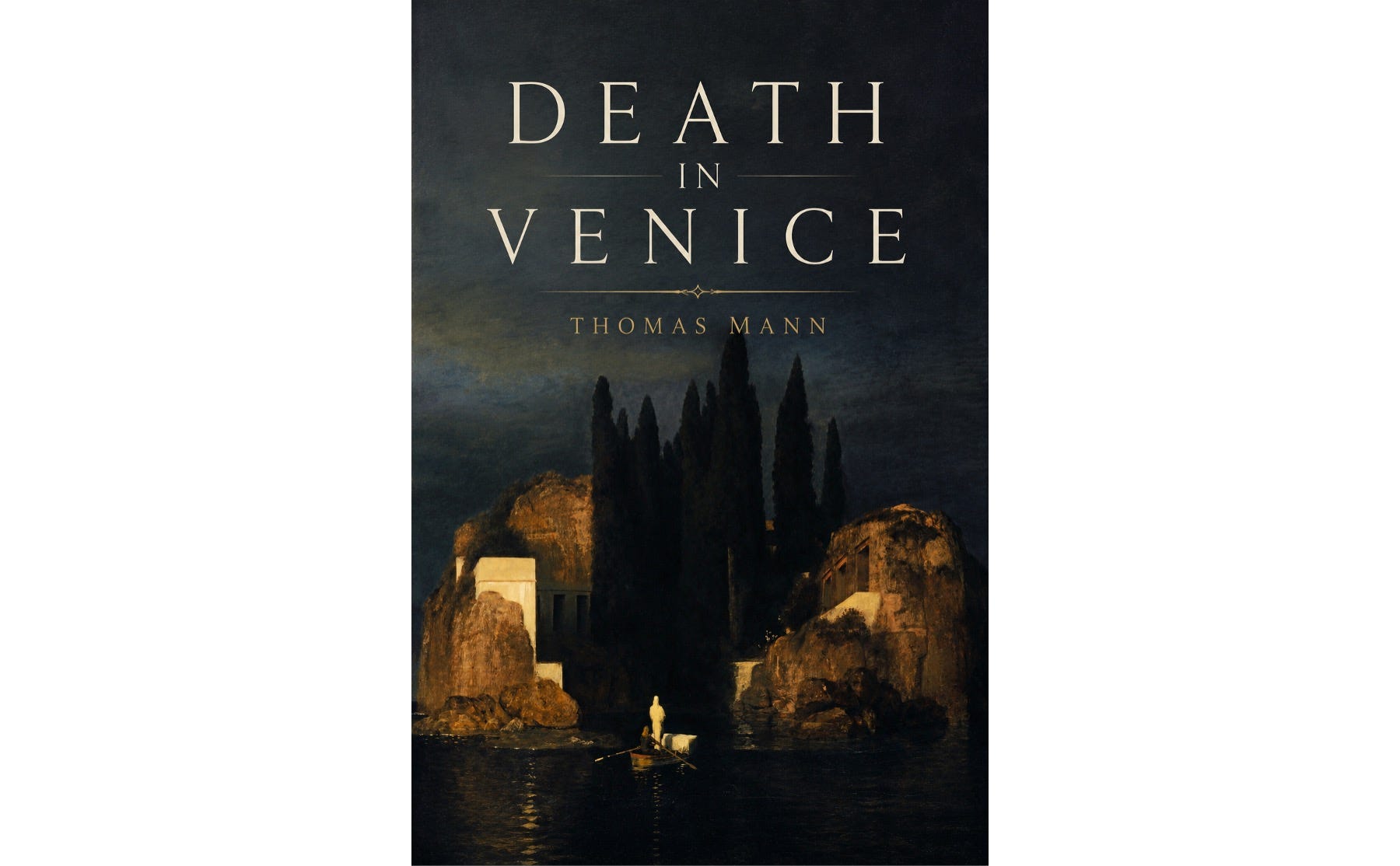
Introduction
Few works make beauty feel as dangerous as Death in Venice. Thomas Mann’s 1912 novella begins with an accomplished writer experiencing an obscure restlessness and ends in a city where elegance, illness, desire, and deception have become almost impossible to separate. Its surface is composed: polished hotels, formal clothes, classical references, and the luminous architecture of Venice. Beneath that surface, something is steadily giving way.
Death in Venice by Thomas Mann stands at the meeting point of nineteenth-century realism and literary modernism. Mann retains the traditional novella’s concentration and formal control, but uses them to explore an unstable consciousness. The book is less concerned with dramatic incident than with the gradual reorganisation of one man’s inner life. A respectable identity, built over decades, begins to loosen through a series of small permissions, evasions, and acts of self-deception.
Gustav von Aschenbach is a celebrated German author whose reputation rests on discipline. His art has been achieved through routine, restraint, and an almost moral devotion to work. He has trained himself to overcome fatigue, uncertainty, and private impulse. The public sees dignity and mastery; Mann allows us to see the strain required to maintain them.
After encountering a strange traveller near a cemetery in Munich, Aschenbach feels an unusually vivid desire to leave. He travels south until he reaches Venice. The journey appears to be a harmless interruption in a life of labour, yet it also marks a crossing from self-command into a place governed by water, heat, scent, chance, and disguise.
Venice is more than a setting. Mann makes the city an external form of Aschenbach’s divided condition. It is exquisitely ordered yet physically unstable, a centre of civilisation built on a lagoon. Its façades suggest permanence, while its alleys, canals, damp air, and corrupt odours indicate decay. Aschenbach is attracted to precisely this combination. He wants beauty without acknowledging its proximity to dissolution.
At his hotel, he notices Tadzio, a Polish adolescent staying with his mother and sisters. Tadzio is graceful, reserved, and strikingly beautiful. Aschenbach initially observes him with the detached interest of an artist, comparing him to figures from Greek sculpture and interpreting his appearance through the language of classical proportion. Gradually, contemplation becomes fixation.
Tadzio is not a character in the same sense as Aschenbach. We are given almost no access to his thoughts. Much of what Aschenbach believes about him is inferred from posture, expression, or movement. This absence is essential: Tadzio exists largely as Aschenbach sees him, an image onto which longing, aesthetic theory, and fear of ageing are projected.
For a modern reader, the fact that Tadzio is a boy cannot be absorbed into the elevated language surrounding Aschenbach’s desire. The imbalance is ethically decisive. Mann does not offer a reciprocal romance. He shows an adult intellectual turning another person into an aesthetic object and using culture to dignify his obsession. The classical allusions are therefore not merely decorative; they expose the sophistication of Aschenbach’s rationalisations.
Here lies one of the novella’s most unsettling insights: intelligence does not necessarily protect a person from self-deception. It may make self-deception more elaborate. Aschenbach never stops thinking. He invokes Greek philosophy, artistic destiny, beauty, and the relation between form and passion. Yet these ideas increasingly serve what he already wants.
The tension between form and desire governs the book. Aschenbach has lived according to artistic form, social restraint, bodily discipline, and public reputation. His attraction to Tadzio releases forces that his orderly life has excluded. Mann draws on the contrast between the measured energies associated with Apollo and the ecstatic, dissolving energies associated with Dionysus. More broadly, he asks what happens when discipline becomes so rigid that desire can emerge only in distorted ways.
Several minor figures anticipate Aschenbach’s decline. On the journey to Venice, he sees an elderly man dressed and made up to resemble a youth. He finds the disguise repellent. Later, anxious about his own appearance, he allows a barber to dye his hair, colour his lips, and restore an artificial freshness to his face. He becomes the figure he had despised.
The parallel is characteristic of Mann’s irony. Aschenbach imagines himself through noble and tragic images, while the narrative records something more humiliating: an ageing man following a boy through streets and corridors, altering his appearance and surrendering his judgment. The prose rises towards myth, then lets an ordinary detail expose the distance between Aschenbach’s self-conception and his conduct.
Meanwhile, cholera is spreading through Venice. The authorities conceal the danger because public knowledge would drive away visitors. Officials offer evasive assurances, disinfectant appears in the streets, and tourists begin to leave. Aschenbach suspects the truth and eventually confirms it, but he does not warn Tadzio’s family. An honest warning would probably cause them to depart, and he prefers their continued presence to their safety.
This decision gives the novella its moral centre. Aschenbach’s collapse does not consist simply in disorienting or forbidden desire. Desire changes what he is willing to conceal. Venice protects its economy and reputation; Aschenbach protects his access to Tadzio. Public corruption and private self-deception become reflections of each other.
The epidemic also sharpens the book’s treatment of knowledge. Several people understand more than they admit. The authorities know the city is unsafe, hotel staff recognise that something is wrong, and Aschenbach gathers the evidence but chooses not to act. The failure is not ignorance. It is a refusal to accept the obligations created by knowledge.
This is one reason Death in Venice remains recognisable. Institutions still minimise danger when truth threatens prestige, profit, or stability. Individuals still reinterpret warnings when those warnings interfere with desire. The novella understands how easily cultivated people can treat reality as negotiable when it demands an unwanted decision.
It is equally relevant to questions of image and identity. Aschenbach has become attached to a public version of himself: disciplined, dignified, productive, above disorder. Because that identity leaves little room for vulnerability, ageing, or unsatisfied longing, its collapse is severe. His attempt to look younger is not merely vanity. It is the visible sign of a man who can no longer reconcile himself with the image through which he has lived.
The book is also alert to the danger of aestheticising others. Aschenbach believes that beauty leads towards truth, yet his worship of beauty steadily narrows his moral vision. Tadzio becomes less human to him as he becomes more symbolically important. The temptation is not confined to art: people often prefer the meanings they assign to someone over the reality of that person’s separate existence.
Mann does not reduce the story to punishment. Aschenbach’s exhaustion is real, his longing is not explained by a single motive, and his discipline has produced genuine achievement. The narrative understands the attraction of beauty even as it examines the damage caused by projection, possession, and denial. Sympathy and judgment remain in uneasy proximity.
In the final scene, Aschenbach watches Tadzio move towards the water. The boy appears to turn and gesture towards the horizon, though we cannot know whether the gesture is real, intended for Aschenbach, or another projection. The image suggests transcendence; the physical reality is death.
Death in Venice by Thomas Mann is brief, but it rewards an unhurried reading. Its patterns of doubling, its shifts between irony and grandeur, and its use of Venice reveal more than the familiar outline of a story about obsession. Mann asks what discipline costs, how desire recruits intelligence, when admiration becomes possession, and how beauty can enlarge our awareness while obscuring another person’s reality.
Readers who know the novella mainly by reputation may find that its precise, uncomfortable inquiry is best encountered directly on the page.
Chapter I
Gustav Aschenbach—or von Aschenbach, as his official name had been since his fiftieth birthday—had set out alone on a longer walk one spring afternoon in the year 19.., a year in which Europe seemed to threaten danger for months on end. He left his apartment on Prinz-Regenten-Strasse in Munich, feeling overstimulated from the difficult and hazardous work that, especially now, demanded the utmost caution, focus, persistence, and precision of will during his morning hours. Even after lunch, the writer had been unable to stop the ongoing drive within him—the “motus animi continuus,” as Cicero called the essence of eloquence—and he hadn’t found the restorative nap he so badly needed now that his powers were wearing thin. So, soon after tea, he sought the fresh air, hoping that being outside and moving around would revive him and prepare him for a productive evening.
It was early May, and after weeks of chilly rain, a false high summer had suddenly arrived. The English Garden, though only lightly leafed, felt as stifling as August, and near the city, it was full of carriages and walkers. At the Aumeister—where quieter and quieter paths had led him—Aschenbach had spent a while overlooking the lively beer garden, where a few carriages and cabs waited at the edge, and then, as the sun sank, he took the open country road home, outside the park, expecting, since he felt tired and a thunderstorm threatened over Föhring, to catch the tram at the Northern Cemetery, which would take him straight back into the city. By chance, he found the stop and its surroundings empty. There was no one on the paved Ungererstrasse, whose tram tracks gleamed in solitude towards Schwabing, nor on the Föhringer causeway; behind the stonecutter’s fences, where crosses, memorial plaques, and monuments for sale formed a second, uninhabited graveyard, nothing moved; and the Byzantine mortuary chapel opposite lay silent in the glow of the fading day. Its front, decorated with Greek crosses and hieratic paintings in bright colors, also bore symmetrically arranged gold-lettered inscriptions—selected phrases about the afterlife, such as: “They enter into the house of God” or “Let perpetual light shine upon them.” For a few minutes, he found solemn distraction in reading these formulas and letting his mind lose itself in their transparent mysticism. Then, snapping out of his reverie, he noticed, in the portico above the two apocalyptic beasts guarding the steps, a man whose unusual appearance suddenly changed the direction of his thoughts.
Whether the man had come from inside the hall through the bronze doors or had suddenly arrived from outside and gone up the steps, Aschenbach couldn’t tell, though he suspected the former. Moderately tall, thin, beardless, and strikingly flat-nosed, the man was of a red-haired type, with milky, freckled skin. He was clearly not Bavarian—at least, the broad, straight-brimmed straw hat he wore gave him an exotic, far-traveled look. Yet he also carried a local-style rucksack strapped over his shoulders, wore a yellowish belt suit of loden cloth, it seemed, a gray weather cape over his left arm, which rested in the crook of his elbow, and in his right hand, a stick with an iron tip, which he propped at an angle against the ground, leaning his hip on its handle with his feet crossed. With head held high, so that his Adam’s apple stood out stark and bare on his wiry neck above his loose sports shirt, he gazed into the distance with colorless, red-lashed eyes. Between them—oddly fitting his abruptly upturned nose—were two vertical, energetic furrows. His posture—perhaps enhanced by his slightly elevated position—seemed commanding, bold, even wild; and whether he was grimacing against the setting sun or it was a permanent quirk, his lips seemed too short, pulled back entirely from his teeth, so that his long white teeth, exposed to the gums, showed between them.
It’s possible that Aschenbach, in his half-distracted, half-inquisitive scrutiny, had stared too openly; for suddenly he realized that the man was meeting his gaze—so aggressively, so directly, so clearly determined to push matters to the limit and force Aschenbach to look away, that Aschenbach, uncomfortably embarrassed, turned aside and began to walk along the fences, deciding not to pay the man any more attention. He forgot about him in the next minute. But perhaps the stranger’s wanderer-like appearance had left a mark on his imagination, or maybe some other physical or mental influence was at work: he suddenly became aware of a strange expansion within himself, a kind of restless yearning, a youthful thirst for far-off places, a feeling so vivid, so new or at least so long unexperienced that he stopped, hands behind his back, eyes on the ground, to examine the sensation for its nature and purpose. It was nothing more than a desire to travel, but it came on him like a fit, rising to the point of passion, even hallucination. For example, as if to capture all the wonders and terrors of the varied earth his longing tried to imagine, he saw—almost as if with his physical eyes—a vast landscape, a tropical swamp under a thick, steamy sky, lush, unhealthy, and shunned by people, a primeval wilderness of islands, marshes, and muddy waterways. The flat islets, whose ground was covered with leaves as big as hands, with giant ferns, with thick, swollen, fantastically blooming plants, sent up hairy palm trunks, and strangely twisted trees, whose roots grew out of the trunk and sank through the air into the soil and water, formed tangled forests. On the stagnant, green-shaded water floated milky-white flowers as big as bowls; strange birds, high-shouldered, with ungainly beaks, stood on long legs in the shallows, staring motionless to the side, while from the vast reed beds came a clattering rasp and rustle, like armies of armored men; the onlooker felt as if the warm, mephitic breath of this lush, useless wasteland blew on him, suspended in some monstrous state of becoming or decay, and among the knotted bamboo stalks, he thought he glimpsed, for a moment, the phosphorescent eyes of a tiger—and his heart pounded with terror and mysterious longing. Then the vision faded, and with a shake of the head, Aschenbach resumed his walk along the fences of the stonemasons’ yards.
Ever since he’d had the means to travel as he wished, he had always thought of travel just as a health measure, something to which he sometimes had to submit against his inclination. Too busy with the tasks his own self and the European spirit set for him, too burdened by the obligation to create, too averse to distraction to be a lover of the bright outside world, he had been satisfied with the view of the earth’s surface that anyone can get today without leaving home, and had never even been tempted to leave Europe. Especially since his life had begun to wind down, since his artist’s fear of not finishing—this worry that time might run out before he had done his work and given himself fully—could no longer be dismissed as a mere whim, his life had been almost entirely confined to the beautiful city he called home, and the rugged country house he’d built in the mountains, where he spent the rainy summers.
So, what had just come over him so suddenly and so late, was soon moderated and corrected by reason and lifelong self-control. He had intended to advance the work that was his life up to a certain point before moving to the countryside, and the idea of wandering the world for months, away from his work, seemed too aimless, too haphazard to be considered seriously. And yet, he knew all too well why this temptation had arisen so suddenly. It was, he admitted, an urge to escape: this longing for distant, new places, this desire for freedom, relief, and forgetting—the urge to get away from his work, from the daily grind of a rigid, cold, and passionate duty. True, he loved this duty, and almost loved the exhausting, ever-renewed struggle between his tough, proud, much-tested will and his growing tiredness, which no one must know about and which must never show in his work, never betray itself in slackness or failure. But it seemed wise not to overstretch the bow and not to stubbornly suppress such a powerful rising need. He thought about his work, about the passage where, as yesterday, he’d had to leave off today, which seemed unwilling to yield to either patient care or a bold stroke. He considered it again, tried to break through or resolve the block, and recoiled with a shudder of disgust. It was not any real difficulty that paralyzed him, but a kind of disgusted dissatisfaction, a feeling of inadequacy that nothing could satisfy. Dissatisfaction, indeed, had always seemed to him the very nature of talent, and for its sake, he had restrained and cooled his feelings, knowing that talent tends to settle for cheerful mediocrity and half-perfection. Was the repressed feeling now taking revenge by abandoning him, refusing to support and inspire his art any further, taking away all joy and delight in form and expression? Not that he was producing bad work: at least, at his age, he could always rely on his mastery. But he himself, though the nation honored it, no longer found joy in it, and it seemed to him that his work lacked that spark of playful mood—born of joy itself—that, more than any deep content or real merit, formed the delight of the public. He dreaded the coming summer in the country, alone in the small house with the maid who cooked his meals and the servant who served them; dreaded the familiar faces of the mountain peaks and cliffs, which would again surround his dissatisfied sluggishness. So he needed a break, some spontaneous living, a bit of idleness, fresh air and new blood, so the summer would become bearable and fruitful. So—travel, then. That was the answer. Not too far, not all the way to the tigers. A night in a sleeper car and three or four weeks’ rest at some typical holiday spot in the lovely South…
So he thought as the noise of the electric tram grew nearer along Ungererstrasse, and, boarding, he resolved to spend the evening studying maps and timetables. On the tram platform, he remembered to look out for the man in the straw hat, his companion in this eventful encounter. But he couldn’t spot him again—neither at his previous place, nor at the next stop, nor on the tram itself.
Chapter II
The author of the clear and powerful prose epic about the life of Frederick of Prussia; the patient artist who, through years of effort, wove the densely populated tapestry novel called “Maja,” gathering so many human destinies under the shadow of a single idea; the creator of that striking story “A Wretch,” which showed a whole grateful youth the possibility of moral resolve beyond the deepest understanding; and finally, the author of the passionate essay “Spirit and Art”—a work whose organizing force and antithetical eloquence led serious critics to compare it directly to Schiller’s reflections on naïve and sentimental poetry: Gustav Aschenbach was born in L., a district town in the province of Silesia, the son of a senior judge. His ancestors had been officers, judges, and civil servants—men who lived disciplined, modest lives in the service of the king and the state. A deeper spirituality had expressed itself once in their line, in the person of a preacher. His mother, the daughter of a Bohemian orchestra conductor, brought swifter, more sensual blood to the family. From her came the foreign features in his appearance. The union of practical, dutiful conscientiousness with darker, fiery impulses produced an artist—and this particular artist.
His whole being was set on fame. He was not exactly precocious, but thanks to the decisiveness and personal force of his voice, he became ready and fit for the public eye early on. Almost while still at school, he made a name for himself. Ten years later, he had learned to represent himself from his writing desk, to manage his fame with brief correspondence (as many demands are placed on the successful and reliable), and to be both kind and important. By his forties, worn out by the rigors and uncertainties of his real work, he faced daily mail stamped from all over the world.
His talent lay equally far from the banal and the eccentric—it was made to win both the faith of the general public and the admiration and demands of the discerning. Thus, required by all sides—even as a youth—to produce extraordinary work, he never knew idleness or the carelessness of youth. When he fell ill in Vienna at about thirty-five, a keen observer remarked in company: “You see, Aschenbach has always lived like this”—and he clenched the fingers of his left hand into a fist—“never like this”—letting the open hand hang loosely from the armrest. That was true; and the truly moral thing about it was that his nature was not robust by birth, only called, not made, for constant tension.
Doctors had barred the boy from school and insisted on home tutoring. He grew up alone, without friends, and learned early that he belonged to a family where talent was not rare, but the physical foundation for fulfilling it was—and that in his family, people tended to give their best early, but rarely lived long. Yet his favorite word was “persevere.” He saw his Frederick novel as nothing more than the glorification of that command—which, to him, was the very essence of active virtue. He longed to grow old, believing that only an artist fruitful at every stage of life was truly great, truly honorable.
Since he intended to bear the burdens his talent placed on him with delicate shoulders and go far with them, discipline was essential—and discipline, fortunately, was his paternal inheritance. At forty and fifty, just as in an age when others waste, dream, or postpone great plans, he would start his day early, dousing chest and back with cold water, then, by candlelight at his manuscript, would devote the energy gathered in sleep to two or three hours of intensely conscientious morning work. It was forgivable—even a victory of morality—if the uninitiated mistook the world of “Maja” or the epic masses of Frederick’s life for the product of sheer force and endurance. In fact, they were built up from hundreds of small daily inspirations, becoming great only because their creator, with steadfastness like that which conquered his home province, persevered for years under the strain of a single project, devoting to it only his strongest and most worthy hours.
For a major work of the mind to have immediate, wide, and deep impact, there must be a profound connection—even identity—between its creator’s fate and that of his generation. People don’t know why they make a work famous. Far from being experts, they find a hundred virtues to justify their enthusiasm, but the real reason is intangible: sympathy. Aschenbach had once stated, in an obscure place, that almost everything great in the world exists in spite of suffering and hardship, poverty, loneliness, physical weakness, vice, passion, and a thousand obstacles. This wasn’t just an observation; it was the formula of his life and fame, the key to his work—and unsurprisingly, it was the moral character of his most distinctive figures as well.
On the new heroic type that recurred in various forms in his work, a clever analyst once wrote: it embodied “an intellectual and youthful masculinity that clenches its teeth in proud shame and stands calmly while swords and spears pierce its body.” This was apt, despite its passive tone. For composure in the face of fate, grace under suffering, is not just endurance; it’s an active achievement, a positive triumph, and the figure of Sebastian is the finest symbol—if not of all art, then certainly of the art in question. If you entered Aschenbach’s fictional world, you saw elegant self-control, hiding inner collapse and biological decay from the world to the last moment; the yellow, sensually disadvantaged ugliness transforming smoldering lust into pure flame—and even rising to mastery in the realm of beauty; the pale powerless figure drawing from the depths of spirit the strength to bring a proud people to its knees; the charming posture in the strict, empty service of form; the false, dangerous life, the quick-burning longing and art of the born deceiver. Considering all this, one might wonder if there was any heroism except the heroism of weakness. And what heroism could be more timely? Gustav Aschenbach was the poet of those who work on the edge of exhaustion, the overburdened, the already worn-out but still upright—all those moralists of achievement who, slight and limited, squeeze greatness from willpower and careful management, at least for a while. There are many of them—they are the heroes of the age. And they all recognized themselves in his work, found themselves affirmed, elevated, and celebrated within it. They thanked him; they proclaimed his name.
He had once been young and raw, and, poorly advised by the times, had stumbled publicly, made mistakes, exposed himself, and committed lapses of tact and judgment in word and work. But he had gained the dignity that, as he claimed, every great talent naturally hungers for. In fact, his whole development was a conscious, defiant rise to dignity, leaving behind all doubts and irony.
Lively, easily grasped portrayals are the delight of the masses, but only passionate, unconditional youth is captured by the problematic—and Aschenbach was problematic, as absolute as any young man. He had served the mind, exploited knowledge, used seed corn for bread, revealed secrets, doubted talent, betrayed art. Even while his works entertained and inspired the faithful audience, the young artist kept the twenty-year-olds in suspense with his cynicism about the questionable nature of art and the artist’s life itself.
Yet it seems that nothing blunts a noble, capable mind more quickly or thoroughly than the sharp, bitter sting of insight. And the most painstaking thoroughness of youth means little compared to the deep resolve of the mature master to deny, reject, and rise above knowledge—whenever it threatens to weaken, discourage, or discredit will, action, feeling, or even passion. How else could his famous story “A Wretch” be interpreted, except as a revolt against the indecent psychologizing of the times, embodied in the weak and foolish antihero who manufactures a destiny by driving his wife, through impotence, vice, and moral indecision, into the arms of another man and believes he has the right to do evil out of supposed depth? The force of the condemnation in this story proclaimed a turning away from all moral ambiguity, from any sympathy with the abyss, a rejection of the indulgent notion that to understand all is to forgive all. What was being prepared, even enacted, was the “miracle of reborn innocence” that the author would soon discuss explicitly in his dialogues, with a hint of mystery. Strange connections! Was it a result of this “rebirth,” this new dignity and strictness, that at the same time Aschenbach’s sense of beauty seemed to grow almost excessively—a noble purity, simplicity, and harmony of form that would henceforth give his works such a striking, even deliberate, stamp of mastery and classicism? But moral resolve beyond knowledge and paralyzing insight—doesn’t that, in turn, simplify the world and soul, and thus strengthen the capacity for evil, for the forbidden, for the morally impossible? And doesn’t form have two faces? Isn’t it both moral and immoral—moral as the product and expression of discipline, but also, by its nature, morally indifferent, even essentially bent on bending morality under its proud and absolute scepter?
Be that as it may! A life’s development is its fate; and how could a fate, followed by the attention and trust of a broad public, not proceed differently than one lived without the glare and obligations of fame? Only eternal wanderers find it dull and mock when a great talent outgrows its libertine puppet stage, learns to embody the dignity of mind, and adopts the courtly manners of a solitude full of independent, unadvised suffering and struggle, bringing it to power and honor among people. How much play, defiance, and pleasure lies in the self-shaping of talent! Something didactic and official crept into Aschenbach’s later work; his style, as he got older, lost its daring, subtle shades and became exemplary, polished, conventional, formulaic. Like the legend of Louis XIV, the aging man banished all common words from his vocabulary. It was then that the education authorities selected passages of his for the official school readers. This suited him, and he did not refuse when a German prince, newly crowned, granted the author of “Frederick” a personal title of nobility on his fiftieth birthday.
After some years of restlessness and brief stays here and there, he chose Munich as his permanent home and lived there in the kind of respectable, middle-class life that only the spirit, in special cases, receives. The marriage he entered while still young, with a girl from an academic family, ended in a brief period of happiness before her death. A daughter, now married, remained to him. He never had a son.
Gustav von Aschenbach was slightly below average height, dark-haired, clean-shaven. His head seemed a little too large for his almost delicate frame. His hair, brushed back, thin at the part, thick and gray at the temples, framed a high, rugged, almost scarred forehead. The arm of a gold-rimmed, rimless pair of glasses cut into the root of his sturdy, finely curved nose. His mouth was large, often slack, sometimes suddenly thin and taut; his cheeks were lean and lined; his well-shaped chin had a soft cleft. Great events seemed to have passed over this mostly suffering, side-tilted head. And yet it was art that had shaped his features so intensely, as it is usually the result of a turbulent, eventful life. Behind that forehead had been born the sparkling dialogue between Voltaire and the king about war; those tired, deep eyes had seen the bloody hell of the Seven Years’ War’s hospitals. Even taken personally, art is a heightened life. It brings deeper happiness, but it also burns faster. It carves imaginary and spiritual adventures onto its servant’s face, and even in the cloister-like quiet of outward life, it produces, over time, a refinement, exhaustion, and curiosity of the nerves that the wildest passions and pleasures could hardly achieve.
Chapter III
Several matters, both personal and literary, kept the restless traveler in Munich for about two more weeks after that walk. He finally gave instructions to have his country house ready to move into within a month and, on a day between mid and late May, took the night train to Trieste. He stayed only twenty-four hours there before setting sail for Pola the next morning. What he sought was something exotic and unfamiliar, but still easy to reach. So he chose to stay on an Adriatic island, praised in recent years, not far from the Istrian coast, with a colorful, ragged local people speaking strange languages and dramatic, jagged cliffs where the sea opened up. But rain and heavy air, the closed-off, small-minded Austrian hotel company, and the lack of a peaceful closeness to the sea—something only a gentle, sandy beach can provide—frustrated him. He didn’t feel he’d found the right place. Something inside him (though he didn’t know what) left him restless. He studied ship schedules and looked around, and suddenly, both surprisingly and obviously, his true destination dawned on him. If you wanted to reach the incomparable, the magically different overnight, where would you go? It was clear: he had made a mistake in coming here. He wasted no time in ending his stay. A week and a half after arriving on the island, an early morning motorboat took him and his luggage back to the naval port, and he immediately boarded a ship bound for Venice.
It was an old Italian steamer—worn, grimy, and dark. As soon as Aschenbach set foot on board, a hunchbacked, dirty sailor, grinning obsequiously, led him into a dimly lit, cave-like cabin. There, behind a table, sat a man with a goatee who looked like an old-fashioned circus director, his hat askew and a cigarette stub at his lips. With brisk, theatrical manners, he recorded the passengers’ details and issued tickets. “To Venice!” he repeated, stabbing his pen into an inky, tilted bottle. “To Venice, first class! You are served, sir!” He scribbled in big, sprawling letters, sprinkled blue sand on the writing, poured it into a bowl, folded the paper with yellow, bony fingers, and wrote again. “A splendid destination!” he chattered. “Ah, Venice! A marvelous city—irresistible to the cultured, for its history and present-day charms!” His quick movements and empty talk seemed almost meant to distract, as if worried the traveler might change his mind. He collected the fare and, like a croupier, flicked the coins onto the stained table covering. “Bon voyage, sir!” he said with a dramatic bow, then called out for the next customer, though no one else was waiting. Aschenbach returned to the deck.
Leaning on the railing, he watched the idle crowd at the quay and the passengers aboard. Second-class passengers, men and women, huddled on the bow, sitting on boxes and bundles. A group of young people occupied the first-class deck, apparently clerks from Pola going on an Italian excursion. They were loud and lively, chatting, laughing, and enjoying their own antics, calling out mock insults to friends on the quay. One in particular, wearing a bright yellow, overly stylish suit, red tie, and a sharply curved Panama hat, stood out with his crowing voice. But as Aschenbach looked more closely, he realized with horror that the “youth” was actually old. Wrinkles surrounded his eyes and mouth, his rosy cheeks were painted, his brown hair under the colored straw hat was a wig, his neck was withered and sinewy, his mustache and goatee were dyed, his teeth—shown when he laughed—were cheap dentures, and his hands, with rings on both index fingers, were the hands of a very old man. Ashenbach watched him and his companions with a chilling unease. Did they not notice he was old, that he was playing a part he had no right to? Yet they accepted him as one of their own, responding to his playful jabs without disgust. How could this be? Covering his forehead with his hand, Aschenbach closed his tired eyes—he hadn’t slept well. It felt as if everything had taken on a surreal, dreamlike quality, as if reality itself was starting to warp. At that moment, he felt the ship begin to move. With unreasonable alarm, he looked up and saw the dark, heavy vessel slowly parting from the dock. Inch by inch, under the engine’s push and pull, a strip of dirty, shimmering water widened between the quay and the ship, and after some awkward maneuvering, the steamer pointed its bow toward the open sea. Aschenbach crossed to starboard, where the hunchback had prepared a deck chair for him and a steward in a stained coat asked for his orders.
The sky was gray and the wind moist. Harbor and islands fell behind, and soon all land disappeared into the mist. Clumps of coal dust, swollen with moisture, settled on the damp deck that wouldn’t dry. Within an hour, a canvas awning was stretched against the rain.
Bundled in his coat with a book in his lap, Aschenbach rested, losing track of the hours. The rain stopped, the awning was removed, and the horizon cleared. Under the broad sky, the immense, empty disk of the sea stretched all around. But in such a featureless space, we lose all sense of time, drifting in the immeasurable. Strange, shadowy figures—the old fop, the goateed man from below deck—flitted through the dreamscape of his mind, and he fell asleep.
At noon, he was called below to eat in the corridor-like dining room, above a long table where the young clerks (including the old man) had been drinking with the lively captain since ten o’clock. The meal was poor, and he finished it quickly, eager to see if the sky had cleared over Venice. He fully expected it would, for the city had always welcomed him in sunlight. But the sky and sea remained gray and heavy, sometimes drizzled, and he resigned himself to entering Venice by water in a different mood than ever before. He stood by the mast, eyes scanning the horizon, waiting for land. He thought of the melancholic poet whose domes and bell towers had once risen from these waters in a dream, and quietly repeated to himself some lines of reverence, happiness, and sorrow. Deeply moved by these recollections, he wondered if, for an idle traveler like him, some late adventure of feeling—some renewal of passion—might still be possible.
Soon, the low coastline appeared to his right, fishing boats dotted the sea, the resort island came into view, and the steamer, leaving it to port, slowed to enter the narrow channel named for it. In the lagoon, facing the colorful, impoverished dwellings, the ship stopped to await the health inspection boat. It took an hour to arrive. They had reached their destination but hadn’t quite arrived; there was no rush, yet everyone grew impatient. The young Poles, perhaps drawn to the military bugles sounding from the public gardens, came on deck, toasting the Bersaglieri drilling across the water. But it was upsetting to see the state to which the old dandy’s false camaraderie with youth had led him. His old brain couldn’t withstand the wine like the young men; he was pathetically drunk, his gaze blank, a cigarette trembling in his fingers, swaying in place, pulled back and forth by the booze. Unable to step forward, he showed a pitiful bravado, clutching anyone who came near, babbling, winking, giggling, wagging his wrinkled finger in silly teasing, and licking the corners of his mouth in a horribly suggestive way. Aschenbach watched him darkly, feeling again that sense of unreality, as if the world were turning grotesque. But the ship’s engines started up and the journey resumed through the San Marco channel. Once more, Aschenbach beheld the most astonishing landing in the world: the dazzling scene of fantastical architecture presented by the Republic to the awed eyes of arriving sailors—the airy magnificence of the palace, the Bridge of Sighs, the columns with lion and saint on the shore, the ornate temple, glimpses of gate and giant’s clock. He reflected that arriving at Venice by land, at the train station, was like entering a palace through the back door; one should always arrive, as he did now, by ship, over the sea, to the most improbable of cities.
The ship stopped, gondolas crowded around, the gangway was lowered, customs officers boarded, and disembarkation began. Aschenbach asked for a gondola to take himself and his luggage to the station for the small steamers running between the city and the Lido, planning to stay by the sea. His request was relayed to the water, where the gondoliers argued in dialect. He was still delayed by his luggage being dragged down the gangway, so he couldn’t escape the drunken old man, who insisted on bidding him farewell. “We wish you a most happy stay!” the old man cackled, scraping his feet. “Remember us! Au revoir, excusez, bon jour, Your Excellency!” His mouth watered, he squeezed his eyes, licked the corners of his mouth, and his dyed goatee bristled. “Our compliments,” he slurred, two fingers at his lips, “to the sweetheart, the dearest, the most beautiful sweetheart…” Suddenly, his false teeth dropped onto his lower lip. Aschenbach was able to escape. “To your sweetheart, your lovely sweetheart…” he heard the old man calling in a hollow, mocking voice as he made his way down the gangway.
Who hasn’t felt at least a secret shiver when first boarding a Venetian gondola? This odd craft, unchanged from ballad times and so uniquely black—like a coffin—reminds one of silent, sinister adventures on rippling nights, and even more of death itself, of hearses and final journeys. And have you noticed how the gondola’s seat, with its coffin-black lacquer and soft black upholstery, is the most luxurious and relaxing seat in the world? Aschenbach realized this as he settled at the gondolier’s feet, his luggage neatly stowed at the prow. The rowers were still arguing, but the particular stillness of the water city seemed to absorb, soften, and scatter their voices. It was warm in the harbor, the air touched by the mild sirocco. Reclining on the yielding element, he closed his eyes, enjoying a sweet, unfamiliar laziness. The ride would be short, he thought—if only it could last forever! With gentle rocking, he felt himself drifting away from the crowd and noise.
How quiet it grew around him! Nothing but the lapping of the oar, the hollow slap of waves against the prow, and another sound—a whisper, a mutter—the gondolier talking to himself between his teeth, his words pressed out by the rhythm of his work. Aschenbach looked up, surprised to find the lagoon widening and the gondola heading for open water. Clearly, he needed to pay attention to his route.
“To the steamer station!” he said, turning halfway around. The muttering stopped, but he got no reply.
“To the steamer station!” he repeated, turning fully and looking up at the gondolier, who stood tall behind him against the pale sky. The man had a rough, even brutal look, dressed in sailor blue with a yellow sash and a shapeless straw hat slipping apart on his head. His features and blond, curly mustache made him look anything but Italian. Though rather slight in build—unsuited for his job—he rowed with great energy, using his whole body. Several times, his lips drew back with effort, baring his white teeth. Frowning, he looked past Aschenbach, replying in a firm, almost rude tone:
“You’re going to the Lido.”
Aschenbach replied, “Yes, but I only took the gondola to be taken to San Marco. I want to use the Vaporetto.”
“You can’t use the Vaporetto, sir.”
“And why not?”
“The Vaporetto doesn’t carry luggage.”
This was true; Aschenbach remembered. He kept silent, but the man’s rough, arrogant manner seemed insufferable. He said, “That’s my business. Maybe I want to store my luggage. You will turn back.” Silence. The oar splashed, the water thudded against the prow. The gondolier began muttering to himself again.
What to do? Alone on the water with this strange, stubborn man, Aschenbach saw no way to enforce his will. How comfortable it was, though, if he didn’t resist! Hadn’t he wished for the ride to last forever? It was wisest to let things take their course—and it was, above all, pleasant. The gondola’s seat seemed to cast a spell of inertia, gently rocked by the strokes of the willful gondolier at his back. The thought that he might have fallen into the hands of a criminal flitted dreamily through his mind—without rousing him to action. More likely, it was a matter of overcharging for the ride. A sense of duty or pride, a kind of self-reminder, made him speak up once more.
“What do you charge for the ride?” he asked.
Staring over him, the gondolier answered, “You will pay.”
The proper response was obvious. “I’ll pay nothing, absolutely nothing, if you take me somewhere I don’t want to go,” said Aschenbach mechanically.
“You want to go to the Lido.”
“But not with you.”
“I’ll take you well.”
That’s true, thought Aschenbach, relaxing. That’s true—you’re taking me well. Even if you rob me or strike me down, you’ll have given me a good ride. But nothing of the sort happened. Even company showed up: a boat with singing musicians, men and women playing guitar and mandolin, pulling up alongside and filling the air with their tourist ballads. Aschenbach tossed coins into their outstretched hat; they fell silent and rowed away. The gondolier’s muttering resumed.
They arrived, rocked by the wake of a steamer heading to the city. Two municipal officers, hands behind their backs, gazes on the lagoon, paced the shore. Aschenbach left the gondola at the dock, helped by one of those old men with a boat hook, ever-present at Venetian landings. Lacking small change, he crossed into the hotel near the steamer pier, changed money, and paid the gondolier as he saw fit. When he returned, his luggage sat on a cart by the quay—but the gondola and its gondolier had vanished.
“He’s gone,” said the old man with the boat hook. “A bad man, a man without a license, sir. He’s the only gondolier without a license. The others called ahead to warn us. He saw he was expected—so he left.”
Aschenbach shrugged.
“You had the ride for free,” said the old man, holding out his hat.
Aschenbach threw in some coins, asked for his bags to be taken to the hotel, and followed the cart through the white-blossoming avenue lined with taverns, bazaars, and boarding houses, running across the island to the beach.
He entered the sprawling hotel from the rear, through the garden terrace, and passed through the large lobby and antechamber to the front desk. Having reserved ahead, he was received with attentive service. The manager, a small, soft-spoken, courteously polite man with a black mustache and French-cut tailcoat, took him up in the elevator to his room—a pleasant, cherry-wood furnished space, decorated with fragrant flowers and high windows offering a view of the open sea. After the staff set down his bags and left, he gazed out at the afternoon’s empty beach and the calm sea, whose gentle, even waves rhythmically lapped the shore.
The experiences and observations of the solitary are both vaguer and more intense than those of the sociable; his thoughts are heavier, stranger, always tinged with sadness. Things that could be dismissed with a glance or a laugh linger, deepen in silence, become meaningful, and turn into experience, adventure, emotion. Solitude breeds originality—the daring and strange beauty of poetry. But it also breeds the wrong, the disproportionate, the absurd, and the forbidden. The events of the journey—the dreadful old dandy with his talk of sweethearts, the unlicensed gondolier who had outwitted him—still troubled Aschenbach. Though they gave no real cause for worry, their sheer oddness was disturbing. Between these thoughts, he greeted the sea with his eyes and took pleasure in knowing Venice was so close. He washed up, gave orders to the chambermaid to complete his comfort, then let the green-uniformed Swiss elevator man take him downstairs.
He had tea on the seaside terrace, then walked along the promenade towards the Hotel Excelsior. When he returned, it was time to dress for dinner. He did so slowly and carefully, as was his habit, being used to working at his toilette, and still found himself a bit early in the lobby, where most of the guests—strangers to each other, politely ignoring one another but united in anticipation of the meal—were gathering. He picked up a newspaper and settled into a leather chair, observing the company, which differed from that of his previous stay in a pleasing way.
A wide, tolerant horizon opened up. The sounds of the world’s great languages mingled softly. Evening dress, society’s uniform, brought together all types in decent unity. He saw the dry, long American face, the sprawling Russian family, English ladies, German children with French nannies. The Slavic element seemed dominant; Polish was spoken nearby.
A group of semi- and barely-adult youths, under a governess’s care, sat around a rattan table: three girls, about fifteen to seventeen, and a long-haired boy of maybe fourteen. Aschenbach was surprised to see that the boy was perfectly beautiful. His face—pale, gracefully reserved, framed by honey-blond curls, with a straight nose, sweet mouth, and expression of gentle, divine seriousness—reminded Aschenbach of the finest Greek sculpture, and with its purity of form and uniquely personal charm, surpassed anything he had seen in nature or art. Also striking was the contrast in how the siblings were dressed and presented. The three girls, the oldest nearly grown, were dressed so severely and modestly as to seem disfigured—plain, drab, nun-like outfits with white collars, suppressing any hint of style. Their hair was slicked down, making their faces look empty and blank. Clearly, a mother was in charge, but she applied none of this discipline to the boy. His life was shaped by softness and affection. His face—pale, gently closed off, ringed with honey-colored hair, with a straight nose, a lovely mouth, and an expression of sweet and almost divine seriousness—reminded one of Greek sculptures from the noblest era. And though the form was absolutely perfect, it had such a unique and personal charm that the observer believed he had never seen anything so perfectly beautiful in nature or art before.
Another striking detail was the clear contrast in how the siblings were dressed and presented. The three girls, the oldest of whom could be considered an adult, were dressed so severely and modestly as to be almost unattractive. Their clothes were like convent uniforms—grayish, mid-length, plain, intentionally unflattering in cut, with white collars as the only relief—suppressing any hint of shape or prettiness. Their hair was slicked flat against their heads, making their faces look blank and nun-like. It was obvious that a mother was in charge, but she didn’t seem to apply this strict discipline to the boy. His life was clearly shaped by softness and affection. No one had dared to cut his beautiful hair, which curled over his forehead, ears, and down the nape of his neck, like the classic statue of the “Thorn Puller.”
He wore an English sailor suit, its puffy sleeves narrowing around his slim, still childish wrists, and with its cords and embroidery, the outfit gave him an air of luxury and pampering. He sat in half-profile, one foot in a black patent shoe in front of the other, one elbow on the armrest of his cane chair, his cheek resting against his closed hand—with a relaxed dignity free of the stiff formality his sisters seemed used to.
Was he unwell? His face was as white as ivory against the golden darkness of his curls. Or was he simply spoiled, the favorite child, carried by a parent’s indulgent and capricious love? Aschenbach was inclined to believe this. Almost every artist has a secret, even dangerous, inclination to admire the injustice that creates beauty and to pay homage to aristocratic favoritism.
A waiter went around announcing in English that dinner was ready. Gradually, the guests filed through the glass doors into the dining room. Some latecomers passed by from the lobby and the lifts. Service had begun inside, but the young Poles still lingered at their table, and Aschenbach, comfortable in his armchair and with beauty before his eyes, waited with them.
The governess, a small and plump half-lady with a red face, finally gave the signal to rise. With raised brows, she pushed back her chair and bowed as a tall woman, dressed in gray and white and richly adorned with pearls, entered the lobby. The woman’s posture was cool and composed; her slightly powdered hair and the cut of her dress showed that elegant simplicity typical where piety is seen as part of good breeding. She could have been the wife of a senior German official. Only her jewelry—almost priceless, with earrings and a triple, very long strand of cherry-sized, softly glowing pearls—hinted at extravagance.
The siblings promptly stood up, bending over their mother’s hand to kiss it. With a reserved smile on her well-groomed but somewhat tired and sharp-featured face, she looked over their heads and spoke a few words in French to the governess. Then she walked toward the glass doors, the children following: the girls in age order, then the governess, and finally the boy. For some reason, before crossing the threshold, he turned around, and since no one else was left in the lobby, his unusual, grayish eyes met Aschenbach’s, who sat lost in thought, watching the group go by.
What he saw had nothing particularly remarkable in its details. They hadn’t gone to the table before their mother, they had waited for her, greeted her respectfully, and observed the usual forms when entering the room. But all of this had been done so deliberately, with such a sense of discipline, duty, and self-respect, that Aschenbach felt strangely moved. After a moment’s hesitation, he too went to the dining room and let himself be shown to a table—which, to his brief regret, was quite far from that of the Polish family.
Tired but mentally stirred, he spent the long meal thinking about abstract, even transcendent matters—about the mysterious connection between law and individuality that must exist for human beauty to arise, and from there, about the general problems of form and art. In the end, he found his thoughts resembled those lucky inspirations of dreams that, upon waking, prove empty and useless.
After the meal, he lingered in the fragrant evening park, sometimes sitting, sometimes strolling, then went to bed early and spent the night in a deep sleep, though filled with vivid dreams.
The weather did not improve the next day. A land wind blew. Under a pale, overcast sky, the sea lay in dull stillness, shrunken, with a close, sober horizon, and had retreated so far from the shore that several rows of long sandbanks were exposed. When Aschenbach opened his window, he thought he could smell the lagoon’s decay.
He felt uneasy and already considered leaving. Years ago, after two cheerful spring weeks here, this same weather had come and ruined his health so much that he had to flee Venice. Was he feeling the same feverish restlessness, the pressure in his temples, the heaviness in his eyelids as before? Moving again would be a bother; but if the wind didn’t change, he couldn’t stay. He didn’t fully unpack, just in case. At nine, he had breakfast in the buffet room between the lobby and dining room.
The room had the solemn quiet that big hotels aim for. The waiters moved silently. Only the clatter of teacups and an occasional whispered word could be heard. In a corner, two tables away, Aschenbach noticed the Polish girls with their governess. Very upright, their ash-blond hair freshly smoothed and their eyes red from sleep, they sat in stiff blue-linen dresses with small white collars and cuffs, passing a glass of preserves between them. They were nearly finished with breakfast. The boy was missing.
Aschenbach smiled. Little Phaeacian, he thought. You seem to enjoy the privilege of sleeping as long as you like. Suddenly cheered, he recited to himself the verse:
“Often adorned with jewels, warm baths, and rest.”
He finished his breakfast leisurely, received some forwarded mail from the porter, smoked a cigarette, and opened a few letters. So it happened that he was there to see the late riser arrive.
The boy entered through the glass door, walking diagonally across the quiet room to his sisters’ table. His walk, both in how he held his upper body and bent his knees, and in the way his white-shod foot touched the ground, was extraordinarily graceful—light, delicate, and proud, enhanced by a childlike shyness as he twice turned his head and glanced around the room. Smiling, speaking softly in his gentle, indistinct language, he took his seat, and now, as he turned his profile fully to Aschenbach, the latter was once again, even more deeply, struck by the truly godlike beauty of the boy.
Today, the boy wore a light blouse suit of blue and white striped cotton, with a red silk bow at his chest and a simple white standing collar at his neck. Upon that collar—which didn’t even particularly suit the outfit—the bloom of his head rested in incomparable charm: the head of Eros, like yellowish Parian marble, with delicate, serious brows and temples and ears softly shaded by the right-angled curls of his hair.
Good, good, thought Aschenbach, with the cool professional approval artists sometimes use to cover their delight and rapture before a masterpiece. And further he thought: Truly, if I were not bound for the sea and shore, I would stay here as long as you do! But he went out, passed through the hall and down the terrace, across the boardwalk to the private beach for hotel guests. The barefoot old man serving as lifeguard, in linen pants, sailor’s shirt, and straw hat, showed him his rented beach hut, set up a table and chair on the sandy platform, and Aschenbach settled comfortably into the deckchair he had pulled closer to the sea.
The beach scene—this view of a culture enjoying itself sensually at the edge of the elements—entertained and delighted him as much as ever. The gray, flat sea was already alive with wading children, swimmers, and colorful figures lying on the sandbanks, arms folded under their heads. Others rowed in small, red and blue boats without keels, capsizing and laughing. In front of the row of huts, people sat on their platforms as on verandas, chatting, playing, resting, and mixing careful morning elegance with the nakedness that cheerfully enjoyed the freedoms of the place. On the wet, firm sand in front, some strolled in white bathrobes or brightly colored shirts. To the right, a large sandcastle built by children was decorated with flags from every nation. Vendors knelt to spread out shells, cakes, and fruit. To the left, in front of a hut that stood at an angle to the others and marked the edge of the beach, camped a Russian family: bearded men with big teeth, weary women, a Baltic lady painting the sea in desperate exclamations, two kindly ugly children, an old maid with a headscarf and slavishly affectionate manners. They enjoyed life, calling the names of their unruly children, joking for ages in broken Italian with the cheerful old man selling them sweets, kissing each other on the cheeks, and caring not a bit about onlookers.
I will stay, Aschenbach thought. Where could it be better? Folding his hands in his lap, he let his gaze wander over the vastness of the sea, drifting and breaking in the monotony of the misty space. He loved the sea for deep reasons: for the rest it promised the hard-working artist, who longed to hide from the demands of variety in the embrace of something simple and immense; and for the forbidden, alluring call to the boundless, the measureless, the eternal, and the nothingness that tempted him away from his task. Resting in perfection is the longing of one who strives for excellence; and isn’t nothingness a form of perfection?
Deep in this reverie, the line of the shore was suddenly crossed by a human figure, and as Aschenbach refocused his gaze, it was the beautiful boy, coming from the left, walking barefoot, legs bared above the knees, slow but so light and proud as if he’d always moved without shoes, looking back at the huts. But as soon as he noticed the Russian family, a sudden storm of contempt swept over his face—his brow darkened, his mouth lifted in scorn, a bitter twist split his cheek, and his brows furrowed so heavily that his eyes seemed sunken and glared with hatred. He looked down, looked back threateningly, shrugged his shoulder in a sharp, dismissive gesture, and left the “enemies” behind.
A mix of tenderness and embarrassment—something like respect and shame—made Aschenbach turn away, as if he hadn’t seen anything; for the serious observer of passion resists even using what he perceives, even for himself. But he was both amused and shaken—in other words, delighted. This childish fanaticism, directed against the most good-natured part of life—gave the godlike, enigmatic beauty of the boy a new depth, making him worthy of deeper attention, giving his beautiful form a historical and political dimension, making him seem serious beyond his years.
Still turned away, Aschenbach listened for the boy’s voice, high and a little weak, as he called out to his playmates at the sandcastle. They answered, calling his name or a nickname several times. Aschenbach listened with curiosity, but couldn’t quite catch it—he heard two melodic syllables, something like “Adgio” or “Adgiu” with a drawn-out u at the end. He liked the sound, found it fitting, repeated it silently, and turned back to his letters and papers.
With his small travel desk on his knees, he started working through some correspondence with his fountain pen. But after a quarter of an hour, he regretted spending the most enjoyable situation he knew in such a distracted way. He put his writing aside, turned back to the sea, and soon, distracted by the voices of the young people at the sandcastle, turned his head comfortably on the chair to look for “Adgio” again.
He spotted him right away—the red bow on his chest unmistakable. Busy with the others, laying a plank as a bridge over the wet moat of the sandcastle, he gave directions with a nod and a shout. There were about ten boys and girls, his age or younger, chattering in Polish, French, and Balkan languages. But his name was heard most often—clearly, he was admired and sought after. One, a Pole like him, strong, with black oiled hair and a linen belt, seemed to be his closest companion and friend. When the sandcastle was finished for now, they walked arm-in-arm down the beach, and the boy called “Jaschu” kissed the beautiful one.
Aschenbach was tempted to wag his finger at him. “But I advise you, Critobulus,” he thought with a smile, “go traveling for a year! For you’ll need at least that long to recover.” Then he ate big, ripe strawberries he’d bought from a vendor. It had become very warm, even though the sun could not break through the mist. Laziness bound his mind, while his senses enjoyed the immense, intoxicating stillness of the sea. Trying to figure out what name sounded like “Adgio” seemed a fitting, completely absorbing task for the serious man. With some help from his knowledge of Polish, he concluded that “Tadzio” must be meant—short for “Tadeusz” and addressed as “Tadziu.” Tadzio was swimming. Aschenbach, who had lost sight of him, spotted his head and outstretched arm far out to sea—the water must have been shallow for a long way. But people were already concerned for him; women called from the huts, shouting his name, which seemed to dominate the beach like a password, sweet and wild: “Tadziu, Tadziu!” He obeyed, running back through the foaming water, head thrown back. To see the living form, half-boy, half-god, dripping with curls and beautiful as a young deity, emerging from sea and sky—this sight conjured up mythical images, like tales of the origins of form and of the birth of the gods. Aschenbach listened to the song that sounded within him, and again thought how good it was here, and that he would stay.
Later, Tadzio, resting after his swim, lay wrapped in his white towel, head on his bare arm. Even when Aschenbach wasn’t looking at him, reading a few pages in his book, he almost never forgot that the boy was there, and that all it took was a slight turn of the head to behold something admirable. It almost seemed to him that he was there to watch over the resting boy—busy with his own affairs, but constantly on guard for that noble human image to his right, not far away. And a kind of fatherly tenderness, the moved affection of one who, in spirit, creates beauty, filled and moved his heart. The boy was wearing a light blouse suit today, made of blue and white striped cotton, finished at the neck with a simple white standing collar and a red silk bow at the chest. But on that collar—which didn’t even particularly suit the outfit—rested the bloom of his head in unmatched beauty: the head of Eros, like yellowish Parian marble, with fine and serious brows, temples and ears shaded softly and darkly by the square curls of his hair.
Good, good, thought Aschenbach, with that cool, professional approval that artists sometimes use to mask their excitement and delight in the presence of a masterpiece. And further he thought: Truly, if the sea and the beach weren’t waiting for me, I’d stay here as long as you do! But instead, he left, making his way—attended by the staff—through the lobby, down the large terrace, and straight across the boardwalk to the private beach for hotel guests.
He had the barefoot old lifeguard, who wore canvas pants, a sailor’s shirt, and a straw hat, assign him a beach hut, had table and chair set out on the wooden platform in the sand, and made himself comfortable in the deckchair he’d pulled closer to the sea into the pale yellow sand.
The view of the beach—the image of a culture enjoying itself so carelessly and sensually at the edge of the elements—entertained and delighted him. The gray, shallow sea was already alive with wading children, swimmers, and colorful figures lying on the sandbars with their arms under their heads. Others rowed in small red and blue painted boats without keels, tipping over and laughing. In front of the long row of cabanas, people sat on platforms like little verandas, some moving about, some stretched out in lazy relaxation, with visits and chatter, careful morning elegance next to the comfortable, bold nakedness that enjoyed the freedoms of the place. On the wet, firm sand ahead, people strolled in white bathrobes or wide, brightly colored shirts. To the right, a large sandcastle made by children was surrounded by little flags from every country. Sellers of shells, cakes, and fruit laid out their goods while kneeling. To the left, in front of one of the huts that stood at an angle to the others and to the sea, marking the end of the beach on that side, a Russian family was camped: bearded men with big teeth, soft and lazy women, a Baltic lady painting the sea at an easel while exclaiming in frustration, two good-natured but ugly children, and an old maid in a headscarf, with affectionately submissive, almost slavish manners. They lived there gratefully, calling the names of their unruly children again and again, joking for ages in broken Italian with the cheerful old man from whom they bought candy, kissing each other on the cheeks, and not caring in the least about any onlookers.
I’ll stay, thought Aschenbach. Where could it be better? Folding his hands in his lap, he let his eyes wander into the vastness of the sea, his gaze drifting, blurring, and breaking in the endless haze. He loved the sea for deep reasons: for the peace longed for by the hard-working artist who wishes to escape the demanding variety of life’s appearances in the embrace of something simple and immense; for a forbidden, temptingly opposite urge toward the formless, the boundless, the eternal, toward nothingness. To rest in perfection is the longing of one who strives for excellence; and isn’t nothingness a form of perfection?
As he dreamed so deeply, the horizon was suddenly crossed by a human figure and, bringing his gaze back from the limitless, he saw it was the beautiful boy, coming from the left, passing in front of him on the sand. He walked barefoot, ready to wade, his long legs bare above the knee—slowly, but so lightly and proudly, as if moving without shoes were completely natural. He looked around at the huts. But as soon as he noticed the Russian family, living their grateful harmony, a storm of angry contempt swept over his face. His forehead darkened, his mouth lifted, a bitter tug twisted his cheek, and his brows were furrowed so deeply that his eyes seemed sunken, glaring darkly with hate from beneath. He looked at the ground, glared back one more time, then shrugged his shoulder in a sharp, dismissive gesture and left the “enemy” behind.
A kind of delicacy or embarrassment—something like respect and shame—made Aschenbach turn away as if he hadn’t seen anything; for a serious accidental observer of passion resists making use of his perceptions, even for himself. Yet he was both amused and moved, that is to say: delighted. This childish fanaticism, directed at the gentlest part of life, placed the godlike and mysterious into human relationships; it made a precious creation of nature, which had previously served only as a thing of beauty, worthy of deeper engagement, and it gave the already beautiful figure of the youth a political and historical context that allowed him to be taken seriously beyond his years.
Still turned away, Aschenbach listened for the boy’s voice—a high, slightly weak voice, with which he announced himself from afar to the friends busy at the sandcastle. They answered him, calling his name or a nickname several times. Aschenbach listened with curiosity, catching only two melodic syllables like “Adgio,” or more often “Adgiu” with its drawn-out u at the end. He enjoyed the sound, found it fitting, repeated it silently to himself, and turned, satisfied, to his letters and papers.
With his little travel writing case on his knees, he began to attend to various correspondence with his fountain pen. But after only a quarter of an hour, he regretted spending such an enjoyable situation lost in work and missing out on the experience. He cast aside the writing, turned back to the sea, and soon, distracted by the voices of the young people at the sandcastle, leaned his head comfortably to the right to seek out what “Adgio” was up to.
He found him at once; the red bow on his chest was unmistakable. He was busy with others, laying an old plank as a bridge over the sandcastle’s wet moat, calling out and nodding as he gave directions for the work. There were about ten boys and girls with him, his age and some younger, chattering in Polish, French, and Balkan languages. But his name was called most often—clearly, he was wanted, sought after, admired. One in particular, a Pole like him, a sturdy boy called something like “Jaschu,” with black, greased hair and a linen belt, seemed to be his closest companion and friend. When the work on the sandcastle was done for now, they walked down the beach arm in arm, and “Jaschu” kissed the beautiful boy.
Aschenbach was tempted to wag his finger at him. “But I advise you, Critobulus,” he thought with a smile, “go traveling for a year! You’ll need at least that long to recover.” Then he ate large, ripe strawberries he had bought from a vendor. It had become very warm, though the sun never managed to break through the layer of haze. Laziness overtook his mind while his senses enjoyed the immense, numbing entertainment of the sea’s stillness. Trying to guess what name sounded like “Adgio” now became an absorbing and satisfying task. Using his knowledge of Polish, he concluded it had to be “Tadzio,” short for “Tadeusz,” called “Tadziu.” Tadzio was swimming. Aschenbach, who had lost sight of him, spotted his head and outstretched arm far from shore—the sea must have been shallow far out. But soon, people grew concerned for him: women’s voices called from the huts, shouting the name that seemed to dominate the beach like a password, both sweet and wild: “Tadziu, Tadziu!” He obeyed, running back, beating the resisting water to foam with his legs, head thrown back. To see the living form, pre-adolescent and beautiful as a god, with wet curls, coming from the depths of sky and sea, emerging from the elements—this sight suggested mythical images, like the origin of form or the birth of gods. Aschenbach listened with closed eyes to that inner song and thought again that it was good to be here and that he wanted to stay.
Later, Tadzio, resting after his swim, lay on the sand, wrapped in his white towel drawn under his right shoulder, his head resting on his bare arm. Even as Aschenbach did not look at him but read a few pages in his book, he almost never forgot that the boy was there and that it would only take a slight turn of his head to see something so admirable. It almost seemed to him that he sat here to watch over the resting boy—busy with his own affairs but always alert to the noble figure to his right, not far away. And a fatherly tenderness, the moved affection of someone who, in spirit, creates beauty, for the one who possesses it, filled and moved his heart.
After lunch, he left the beach and returned to the hotel, taking the elevator to his room. He spent a long time at the mirror, looking at his gray hair, his tired and sharp face. In that moment, he thought of his fame, of how many people recognized him and looked at him respectfully on the streets for his sure, graceful words—he recalled all the outward successes of his talent and even his ennoblement. Then he went down for lunch and ate at his little table. After the meal, he got in the elevator, which filled with young people coming from breakfast, including Tadzio himself. For the first time, Tadzio stood so close, no longer at a picturesque distance, but close enough for Aschenbach to observe the details of his humanity. The boy was spoken to by someone, and as he answered with an indescribably sweet smile, he was already stepping out on the first floor, eyes cast down. Beauty makes one shy, thought Aschenbach, and pondered deeply why. He had also noticed that Tadzio’s teeth were not healthy: a bit jagged and pale, lacking the sheen of health, and strangely fragile as sometimes seen in the anemic. He is very delicate, he is sickly, thought Aschenbach. He probably won’t live long. And he refrained from exploring any sense of satisfaction or consolation that accompanied this thought.
He spent two hours in his room, then in the afternoon took the vaporetto across the foul-smelling lagoon to Venice. He got off at San Marco, had tea in the square, and then, as usual, took a walk through the city streets. But this walk brought about a complete change in his mood and his plans.
A disagreeable humidity filled the alleys; the air was so thick that smells from apartments, shops, and kitchens—oil fumes, perfume, and many others—hung in clouds that would not disperse. Cigarette smoke lingered and only slowly drifted away. The crowds in the narrow streets annoyed rather than entertained him. The longer he walked, the more unbearable became the dreadful state brought on by the sea air and the sirocco: both excitement and exhaustion. Sweat broke out on him, his eyes failed him, his chest was tight, he felt feverish, his blood pounded in his head. He fled the crowded commercial streets, over bridges into the alleys of the poor: there, beggars pestered him, and the foul vapors of the canals made breathing unpleasant. On a quiet square—one of those forgotten, enchanted spots in the heart of Venice—he rested by a well, dried his brow, and realized he had to leave.
For a second and now final time, it was clear that this city, in this weather, was extremely bad for him. Stubbornly staying on seemed unreasonable, and a change in the wind uncertain. He had to make a quick decision. Going home was out—neither his summer nor winter quarters were ready. But there were other coasts and beaches elsewhere, without the lagoon’s unhealthy dampness. He remembered a small seaside resort not far from Trieste, which had been recommended to him. Why not go there? And right away, so the change would be worthwhile. He made up his mind and stood up. At the next gondola stop, he took a boat through the gloomy maze of canals, under delicate marble balconies flanked by lion statues, around slippery corners, past mourning palace facades reflecting business signs in the dirty water, toward San Marco. It was hard to get there because the gondolier, in league with lace factories and glass shops, tried to stop him everywhere for sightseeing and shopping, and whenever the magical ride through Venice began to work its charm, the city’s relentless commercial spirit spoiled his mood.
Back at the hotel, he informed the desk before dinner that unforeseen circumstances required him to leave the next morning. They expressed regret and settled his bill. He ate, then spent the mild evening reading newspapers in a rocking chair on the back terrace. Before going to bed, he packed completely for departure.
He didn’t sleep well, disturbed by the coming journey. When he opened the window in the morning, the sky was still overcast, but the air seemed fresher—and immediately he began to regret his decision. Perhaps he had acted hastily, too soon, out of a passing, unimportant mood? If he had waited a little, tried to adapt to the Venetian air or hoped for better weather, he could have spent another morning on the beach just like yesterday. Too late. Now he had to stick with what he had decided. He dressed and went down for breakfast at eight.
The buffet room was still empty. A few guests arrived as he sat and waited for his order. With his teacup at his lips, he saw the Polish girls and their chaperone arrive, strict and fresh from sleep, eyes red, walking to their table in the corner. Just then the porter approached, hat in hand, urging him to get ready. The car was waiting to take him and other guests to the Hotel “Excelsior,” from where a motorboat would take them by the company’s private canal to the train station. Time was short. —Aschenbach thought it wasn’t short at all. There was more than an hour until his train. He was annoyed by the hotel’s habit of hustling guests out early and told the porter he wished to have breakfast in peace. The man withdrew reluctantly, only to return five minutes later. Impossible to keep the car waiting any longer. Then let it go, taking his suitcase, replied Aschenbach irritably. He would take the public steamboat at the right time and asked to be left alone to manage his own departure. The porter bowed. Aschenbach, glad to have fended off the nagging, finished his meal leisurely and even had the waiter bring him the daily papers. Time was now tight when he finally got up. Just then, Tadzio entered through the glass door.
He crossed Aschenbach’s path, head lowered before the gray-haired, high-browed man, and then, in his sweet way, lifted his eyes warmly and fully to him before passing by. Farewell, Tadzio! thought Aschenbach. I barely saw you. And, against his habit, he actually formed the words on his lips and whispered: Be blessed!—He then departed, handed out tips, was seen off by the quiet little manager in the French coat, and left the hotel on foot, as he had come, followed by the porter with his hand luggage, walking through the white-blossoming avenue across the island to the steamboat dock. He arrived, took his seat—and what followed was a journey of sorrow, filled with regret at every turn.
It was the familiar trip across the lagoon, past San Marco, up the Grand Canal. Aschenbach sat on the round bench at the bow, arm on the railing, shading his eyes with his hand. The public gardens faded, the Piazzetta appeared once more in princely grace and was left behind, the long succession of palaces came, and when the waterway turned, the magnificent marble arch of the Rialto bridge appeared. The departing man looked, his heart torn. The city’s atmosphere, that faintly rotten smell of sea and marsh which he’d so longed to escape—he now breathed in deep, tender, aching drafts. Was it possible he hadn’t realized, hadn’t thought, how much his heart belonged to all of this? What that morning had been a slight regret, a gentle doubt, was now real pain, real grief, a soul-ache so bitter that it brought tears to his eyes more than once, and he told himself he could never have foreseen it. What he found so hard to bear—sometimes utterly unbearable—was the thought that he would never see Venice again, that this was a final farewell. For now, a second time, the city had made him ill, and he had been forced to leave it again, so he had to regard it as an impossible and forbidden place for him, one he could not handle, one it would be pointless to return to. Indeed, he felt that, if he left now, shame and stubbornness would prevent him from ever seeing his beloved city again—the city before which he had twice failed physically; and this conflict between his soul’s longing and his body’s weakness now seemed so heavy and important, the physical defeat so shameful, so unendurable, that he could not understand the casual surrender with which he had, just yesterday, decided to accept it without a fight.
Meanwhile, the steamboat was nearing the station, and pain and confusion rose to the point of bewilderment. Leaving seemed impossible, and turning back no less so. Torn in two, he entered the station. It was very late; he had not a moment to lose if he wanted to catch the train. He wanted to, and did not want to. But time pushed him forward; he hurried to get his ticket and looked for the hotel company’s agent. The man appeared and reported that the large suitcase had been sent. Already sent? Yes, to Como. To Como? And after hurried questions and embarrassed answers, it turned out the suitcase, together with other, foreign luggage, had been sent in the completely wrong direction from the Hotel “Excelsior’s” baggage station.
Aschenbach struggled to keep the only reasonable expression under the circumstances. An adventurous joy, an incredible cheerfulness shook him inside, almost to laughter. The agent rushed off to try to recover the suitcase, but, as expected, returned unsuccessful. Aschenbach then declared he would not travel without his luggage and intended to return to the hotel and wait for the suitcase’s return. Was the company’s motorboat at the station? The man assured him it was. He told the ticket office to cancel the ticket, swore that everything would be done to recover the suitcase quickly—and so, twenty minutes after arriving at the station, the traveler found himself once again on the Grand Canal, heading back to the Lido.
A strange, unbelievable, almost comical adventure: to see, within the same hour, places from which you had just taken a final, tearful farewell, turned and sent back by fate itself! Spray at the prow, the little boat darted nimbly between gondolas and steamers toward its goal, while its passenger, under a mask of resignation, hid the nervous, almost gleeful excitement of a runaway boy. At times, his chest was shaken by laughter at this mishap, which, he told himself, could hardly have happened to anyone more fortunate. There would be explanations, astonished faces—then, he told himself, everything would be fine again, a misfortune avoided, a major error corrected, and all he’d thought he’d left behind would be his again, for as long as he wanted… Did the quick ride deceive him, or did the wind now finally come from the sea?
Waves slapped against the concrete walls of the narrow canal leading to the Hotel “Excelsior.” A motorbus waited for the returnee, taking him straight along the shore to the hotel. The little manager with the mustache came down the steps to greet him.
He softly, courteously apologized for the incident, calling it most embarrassing for himself and the hotel, but agreed wholeheartedly with Aschenbach’s decision to wait for the suitcase here. Of course, his room was already taken, but another, no worse, was ready. “Pas de chance, monsieur,” said the Swiss elevator man with a smile as they rode up. And so the runaway was reinstalled in a room almost identical in location and furnishings to the previous one.
Exhausted and dazed by the morning’s strange events, he distributed his hand luggage around the room and sank into an armchair by the open window. The sea had taken on a pale green tint, the air seemed thinner and purer, the beach and its huts and boats more colorful, even though the sky was still gray. Aschenbach looked out, hands folded in his lap, satisfied to be back, shaking his head at his indecision, his ignorance of his own wishes. He sat like this for an hour, resting and dreamy. At midday, he saw Tadzio, in a striped linen suit with a red bow, returning from the sea, through the beach gates and along the boardwalks to the hotel. Aschenbach recognized him from his high vantage, even before he really saw him, and wanted to think something like: “Look, Tadzio, you’re back too!” But at that very moment, he felt how that casual greeting fell silent in the face of his true feelings—he felt the excitement of his blood, the joy, the pain of his soul, and he realized it was because of Tadzio that saying goodbye had been so hard.
He sat very still, unseen in his high place, looking inward. His features came alive, his brows rose, an attentive, curious, intelligent smile played on his lips. Then he raised his head and, letting his arms hang slack over the back of the chair, made a slow, opening, embracing motion with his hands forward, as if to signal welcome and acceptance.