


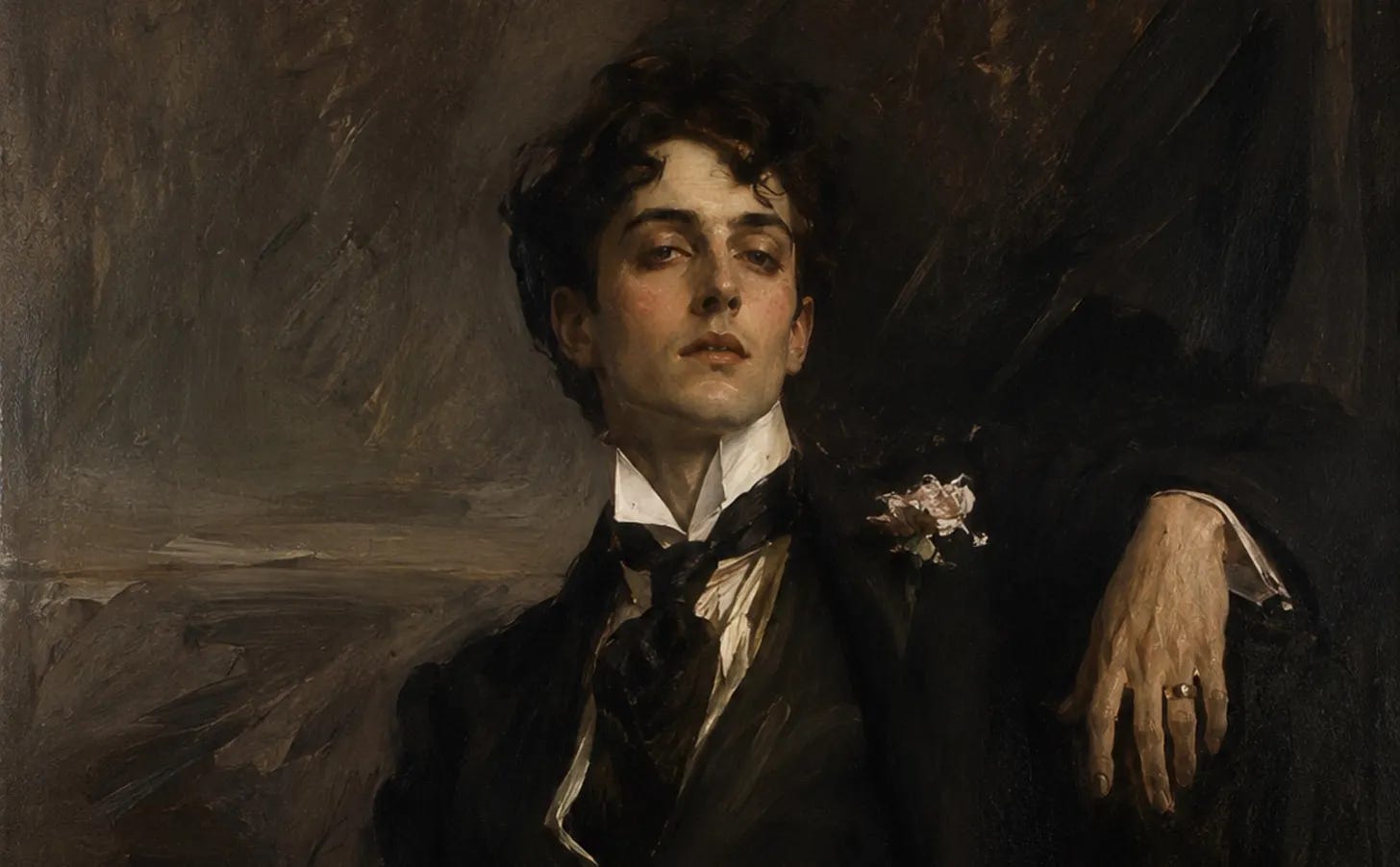
Before Dorian Gray ever hid his portrait in a locked room, The Picture of Dorian Gray had already acquired a secret version of itself.
When Oscar Wilde submitted his only novel for publication in 1890, readers were not allowed to see exactly what he had written. J. M. Stoddart, editor of Lippincott’s Monthly Magazine, quietly removed close to 500 words from Wilde’s typescript. Some of those cuts softened the intensity of the painter Basil Hallward’s feelings for Dorian; others removed references to sexual impropriety of a more conventional kind. Wilde apparently did not know the full extent of the alterations before publication.
The edited story appeared in the July 1890 issue of Lippincott’s as a work of thirteen chapters. Even in its modified form, it provoked outrage. Wilde did not abandon the novel. Instead, he revised it again. For the 1891 book edition, he expanded the story to twenty chapters, altered existing passages and added the famous Preface.
So there is not quite one Picture of Dorian Gray. There is Wilde’s submitted typescript, the magazine text that Victorian readers first encountered, and the substantially revised book that became the familiar classic.
For a novel obsessed with the distance between appearance and what lies beneath it, the coincidence is difficult to resist. Dorian has his hidden portrait. Wilde’s novel has its hidden text.
And in both cases, what was concealed tells us something about the society doing the concealing.
Everyone Is Making a Picture of Dorian
The supernatural premise of Wilde’s novel remains wonderfully simple.
Basil Hallward paints a portrait of the extraordinarily beautiful Dorian Gray. Under the influence of the dazzlingly cynical Lord Henry Wotton, Dorian becomes horrified by the thought that he will age while the painting remains young. He wishes that the arrangement could somehow be reversed.
It is.
Dorian retains the appearance of perfect youth while the portrait changes in his place, recording what time, cruelty and experience ought to have written upon his face. He can pass through drawing rooms looking untouched while the evidence of his life accumulates elsewhere.
But the painting is not the only portrait of Dorian in the novel.
Basil turns him into an artistic ideal. Lord Henry turns him into a philosophical experiment. Society sees beauty, youth and wealth and repeatedly mistakes them for innocence. Dorian eventually learns to see himself through these borrowed interpretations.
That is one reason the novel continues to feel more unsettling than its famous premise might suggest. Dorian does not simply lose his morality. He gradually loses the distinction between himself and the images other people have made of him.
The supernatural portrait merely makes the process visible.
What Victorian Readers Were Supposed Not to See
The censorship of Dorian Gray matters because it was not happening in a cultural vacuum.
Late-Victorian Britain was a society in which sexual relationships between men could lead to criminal prosecution. Under the Criminal Law Amendment Act of 1885, acts of “gross indecency” between men were criminalised, whether they took place publicly or privately. Wilde himself would eventually be convicted under that law.
Against that background, the emotional relationships in Dorian Gray take on a different temperature.
The novel rarely speaks directly. Instead, it works through fascination, devotion, beauty, secrecy, ruined reputations and attachments that polite society recognises without openly naming. Basil’s feelings for Dorian are especially important. The material removed from Wilde’s typescript made some of those feelings less ambiguous; Stoddart’s cuts softened passages that more openly suggested the intensity of Basil’s attraction.
Yet the edited story still caused a scandal.
That is revealing. The supposedly dangerous element of Dorian Gray was not contained in one sentence that an editor could simply delete. Desire is built into the novel’s structure: into who looks at whom, who worships whom, what may be suggested but not declared, and what happens when a reputation becomes attached to Dorian Gray.
Wilde had written a novel about things hidden in plain sight. His editor responded by hiding some of them more carefully.
Wilde Changes the Picture
The version Wilde prepared for book publication in 1891 was not merely a corrected reprint. He enlarged the novel from thirteen chapters to twenty, added characters and episodes, and altered material that had already appeared.
The additions change the book’s shape.
James Vane, the protective brother of the actress Sibyl Vane, gives Dorian’s treatment of Sibyl a consequence capable of physically pursuing him. Other additions widen the social geography of the novel, moving it beyond elegant interiors into the darker London through which Dorian conducts the life that his face refuses to reveal.
At the same time, some homoerotic suggestions became less direct.
Wilde therefore did something more complicated than simply censoring or uncensoring his own work. He made the novel larger while changing the way it signalled its secrets.
And then he put a Preface in front of it.
“There is no such thing as a moral or an immoral book,” Wilde famously declares.
The statement is often quoted as though it settles the argument. In fact, it makes the novel stranger.
Because The Picture of Dorian Gray looks remarkably like a book about consequences.
A Morality Tale That Refuses to Behave Like One
Dorian chooses vanity over maturity. He treats Sibyl Vane first as an artistic revelation and then, when she disappoints him, as something disposable. Cruelty becomes easier. The portrait grows more hideous. His attempt to escape consequence produces more consequence.
Eventually he tries to destroy the evidence and destroys himself instead.
On the surface, it has the machinery of a moral fable.
But Wilde refuses to let the lesson remain comfortable.
Lord Henry, who supplies some of the novel’s most dangerous ideas, is also its most entertaining character. His epigrams are far too pleasurable to function simply as warnings. Basil may stand closer to conventional morality, but his own worship of beauty is hardly uncomplicated. Nor does the novel ever suggest that Dorian’s appreciation of art, perfume, music, jewellery or history is worthless simply because he becomes corrupt.
Beauty itself is never put on trial.
What Wilde questions is the desire to separate beauty from responsibility.
Dorian does not merely want to remain young. He wants experience without visible cost, pleasure without accountability, and an immaculate surface that cannot be contradicted by the life beneath it.
His catastrophe is not that he loves beauty too much.
It is that he wants beauty without consequence.
Can a Book Corrupt Its Reader?
That question becomes even more interesting when Lord Henry gives Dorian the mysterious “yellow book.”
Dorian becomes obsessed with it. Its decadent protagonist supplies him with another model of how a life might be constructed, and for years he reads his own desires through it. The fictional book is generally associated with J.-K. Huysmans’s 1884 Decadent novel À rebours (Against Nature).
At first glance, the episode seems to confirm precisely the kind of fear that surrounded Wilde’s own novel: perhaps books really can corrupt people.
That was not an abstract question for Victorian critics. A supposedly dangerous work of literature might be attacked not simply because it represented vice, but because representation itself was believed capable of seducing, infecting or instructing its readers.
Dorian almost adopts that defence for himself. Lord Henry influenced him. The yellow book influenced him. Beauty influenced him. Circumstances influenced him.
But Wilde never allows influence to become innocence.
Lord Henry talks far more wickedly than he acts. Dorian eventually acts more wickedly than Lord Henry talks. The book may offer Dorian a script, but he repeatedly chooses to perform it.
That makes the yellow book episode a sly mirror of the controversy around Dorian Gray itself.
What responsibility belongs to the book?
What responsibility belongs to its reader?
Wilde refuses to make the answer easy.
The Queerness of What Cannot Be Said
For many readers, the censorship history of Dorian Gray provides an obvious invitation: restore the passages that were cut, identify the desires Victorian publication tried to obscure, and recover the novel’s hidden meaning.
That work matters. But the hiddenness of Dorian Gray goes deeper than individual sentences.
The novel itself is difficult to classify. It is Gothic horror, drawing-room comedy, philosophical dialogue, Decadent catalogue, melodrama, crime story and tragic fable.
Recent scholarship has suggested that this instability may be part of the point. Sean O’Toole, for instance, has argued that the novel’s mixed form can be understood as historically queer: it registers homoerotic experience while also finding ways to conceal, redirect and encode what late-Victorian culture could not comfortably state outright.
Seen that way, the doubleness of Dorian Gray is everywhere.
There is the public Dorian and the private Dorian.
The face and the portrait.
The drawing room and the locked room.
Reputation and behaviour.
What Basil feels and what Basil can say.
The published text and the words removed from it.
Concealment is not merely one of the novel’s subjects. It is one of its methods.
When Fiction Became Evidence
Five years after Dorian Gray first appeared, the distinction between Wilde’s art and Wilde’s private life became dangerously difficult to defend.
In 1895, during Wilde’s libel action against the Marquess of Queensberry, barrister Edward Carson questioned him about The Picture of Dorian Gray. Passages from the novel were used to challenge Wilde over morality, admiration between men and the relationship between an author and the material he had written.
The irony is painful.
Wilde had insisted that a work of art should not simply be treated as a confession by its creator. His opponents did precisely the opposite. They looked at fiction and searched for the man behind it.
The culture stared at the picture and demanded that it reveal the person.
Wilde’s failed prosecution of Queensberry was followed by his own criminal trials. He was eventually convicted of gross indecency and sentenced to two years’ imprisonment with hard labour. It would be misleading to claim that The Picture of Dorian Gray caused his imprisonment. It did not. But the novel’s appearance in the courtroom gave frighteningly concrete form to one of its deepest questions: how much can an image, a text or a reputation be made to reveal about the person behind it?
Beauty as an Alibi
The enduring modernity of Dorian Gray does not depend on finding a contemporary technology with which to compare it.
Its insight is older and more disturbing.
Dorian is not destroyed because he looks at himself too much. He is destroyed because he gradually replaces a self with an image.
The widening gap between what other people see and what he knows becomes addictive. Each time the portrait absorbs another consequence, his beautiful face becomes more useful to him. Society sees the surface and supplies the innocence.
His beauty ceases to be merely a gift.
It becomes an alibi.
That is why the portrait must remain locked away. It does more than show ugliness. It contradicts Dorian’s public identity.
It is evidence.
And the desire behind the supernatural plot is not difficult to recognise. Dorian wants a private place into which the marks of experience can disappear while his public self remains untouched.
The fantasy of eternal youth is also a fantasy of eternal exemption.
The Other Portrait
Today, the history that nineteenth-century readers could not see is visible again.
We can compare the magazine version with the expanded novel. Modern editions allow readers to encounter passages removed before publication. What was once concealed behind the respectable surface of the printed book has become part of the story we tell about it.
That does not give us one final, “true” Dorian Gray. If anything, it makes the novel more unstable and more interesting.
It is a book about a portrait that changes while the man it represents appears not to.
And the novel has changed too: submitted, cut, published, attacked, expanded, defended, quoted in court, adapted and repeatedly reinterpreted.
Dorian tries to hide the portrait because it tells a truth his beautiful face cannot.
The history of The Picture of Dorian Gray works in much the same way.
The passages Victorian editors softened or removed do not simply reveal something about Wilde. They reveal something about the culture that believed those words had to disappear.
Dorian’s hidden portrait exposes the life behind the surface.
The novel’s hidden text exposes the world that first tried to read it.