

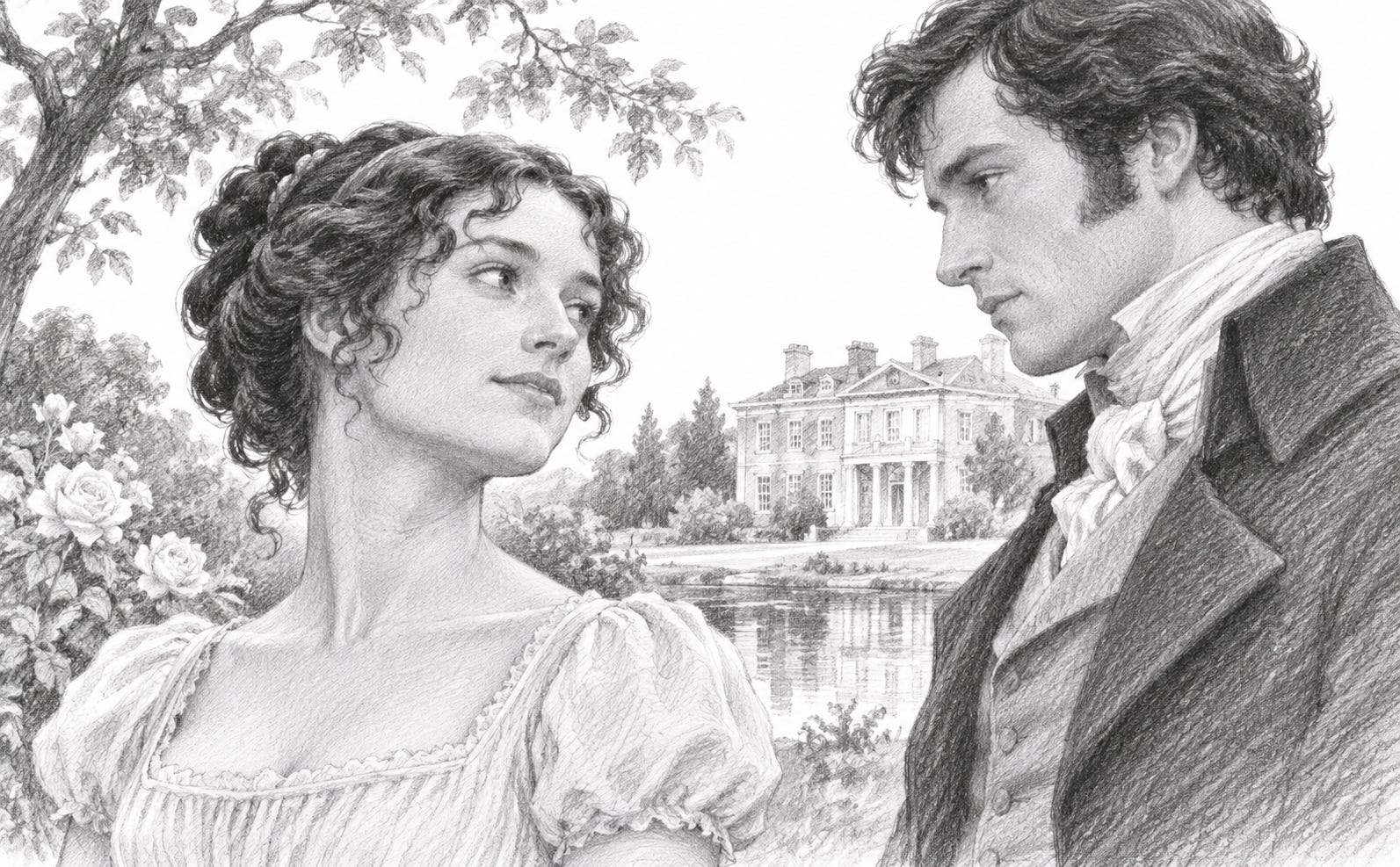
More than two centuries after its publication, Pride and Prejudice remains one of literature’s most beloved novels. Beyond the romance of Elizabeth Bennet and Mr Darcy lies a brilliantly observed world of social ambition, financial insecurity and human misunderstanding, brought to life through Jane Austen’s incomparable wit.
A Novel That Changed the Way We Read Romance
Few opening sentences in English literature are as instantly recognizable as the first line of Jane Austen’s Pride and Prejudice:
“It is a truth universally acknowledged, that a single man in possession of a good fortune, must be in want of a wife.”
With this apparently straightforward observation, Austen introduces a world in which marriage, money and social expectations are inseparable. Yet the sentence is also a joke. It is not necessarily the wealthy bachelor who wants a wife, but the families around him who are determined that he should find one.
That playful reversal establishes the novel’s defining quality: an extraordinary ability to expose human motives beneath the polished surface of respectable society.
First published on 28 January 1813, Pride and Prejudice has become one of the most widely read and admired works of English fiction. Its central romance between the intelligent, outspoken Elizabeth Bennet and the wealthy, reserved Fitzwilliam Darcy has inspired generations of readers, filmmakers and writers.
But reducing the novel to a love story overlooks much of what makes it remarkable. Austen examines the relationship between wealth and social position, the vulnerability of women without independent fortunes, the absurdities of fashionable manners and the ease with which intelligent people deceive themselves.
At its heart, Pride and Prejudice asks a deceptively simple question: how well can we really know another person when our judgments are shaped by pride, prejudice and the desire to be right?
The answer unfolds through one of literature’s most entertaining and psychologically perceptive stories.
From First Impressions to Pride and Prejudice
The history of Pride and Prejudice began long before its publication.
Jane Austen was born on 16 December 1775 in Steventon, Hampshire, into a large family headed by her father, the Reverend George Austen. Books, conversation, amateur theatricals and reading aloud were important features of family life, and Austen began experimenting with fiction while still young.
Between 1796 and 1797, when she was in her early twenties, she wrote an early version of the novel under the title First Impressions.
The title was particularly appropriate. The story revolves around judgments made too quickly, appearances mistaken for character and opinions formed before sufficient evidence is available.
In November 1797, George Austen approached the London publisher Thomas Cadell about the manuscript. The offer was rejected without the publisher requesting the novel itself.
It would be another sixteen years before the book reached the public.
After moving to Chawton, Hampshire, in 1809, Austen entered an especially productive period of her writing career. Following the publication of Sense and Sensibility in 1811, she returned to First Impressions, revising it during 1811 and 1812.
Exactly how much changed remains unknown. The original manuscript has not survived, and the suggestion that the earliest version took the form of a novel written entirely through letters, although supported by family tradition, cannot be established with certainty.
The completed novel nevertheless makes extensive use of correspondence. Letters reveal secrets, circulate misunderstandings and alter the course of relationships, suggesting how important written communication was to Austen’s conception of storytelling.
The revised work appeared as Pride and Prejudice in three volumes, published by Thomas Egerton. Its title page identified its creator only as the author of Sense and Sensibility, preserving Austen’s anonymity.
The original three-volume set cost eighteen shillings. Austen had sold the copyright to Egerton for £110, meaning that she would not share directly in the additional profits generated by the novel’s success. A second edition appeared later in 1813.
Austen herself greeted publication with evident affection. In a letter to her sister Cassandra, she described the newly published book as her “darling Child.”
She also jokingly complained that it was “rather too light & bright & sparkling.”
What Austen presented as a possible weakness has become one of the novel’s greatest strengths. Its brilliance lies in the effortless appearance of its comedy, beneath which runs a remarkably sophisticated understanding of society and human character.
The Bennet Family: Five Daughters and an Uncertain Future
The story opens in the fictional Hertfordshire village of Longbourn, where Mr and Mrs Bennet live with their five daughters: Jane, Elizabeth, Mary, Catherine, usually called Kitty, and Lydia.
Their circumstances initially appear comfortable. Mr Bennet is a gentleman with a country estate producing approximately £2,000 annually, enough to maintain a respectable position among the local landed gentry.
Yet the family’s financial future is far from secure.
Longbourn is subject to an entail that will direct the estate to a male relative, Mr Collins, rather than to Mr Bennet’s daughters. The precise legal mechanism has attracted scholarly debate, but its practical consequence within the novel is clear: none of the five Bennet sisters can expect to inherit the family home.
If Mr Bennet dies, his widow and daughters will lose the income and security provided by the estate.
This circumstance explains Mrs Bennet’s consuming determination to see her daughters married.
Her behavior is frequently ridiculous. She embarrasses her family through indiscretion, exaggeration and relentless speculation about eligible bachelors. Yet the economic anxiety beneath her comic behavior is entirely understandable.
For women of the landed and professional classes in late Georgian England, marriage was often the principal available route to long-term financial security.
Women could own and inherit property in certain circumstances, but inheritance arrangements could exclude them from particular estates. Marriage itself also carried legal disadvantages. Under the common-law doctrine of coverture, a married woman’s independent control over property and legal affairs was generally restricted, although settlements and other arrangements could provide important exceptions.
Austen does not pause to deliver a lecture about these institutions. Instead, she allows their consequences to govern the lives of her characters.
The Bennet sisters are expected to marry well, but the meaning of marrying well is constantly disputed.
Should a woman prioritize wealth, affection, social rank, personal compatibility or simple security?
Through the different choices made by her characters, Austen shows that the answers are neither obvious nor equally available to everyone.
Elizabeth Bennet: Intelligence, Independence and Imperfect Judgment
Elizabeth Bennet remains one of the most engaging heroines in classic literature.
As the second eldest Bennet daughter, she possesses neither an impressive fortune nor the conventional beauty for which her sister Jane is admired. Her greatest advantages are her intelligence, lively humor, independence of mind and ability to recognize the absurdities of those around her.
She is particularly skilled at exposing pretension.
Where others defer to wealth or social position, Elizabeth questions the assumptions that make such distinctions seem important. Her conversations are animated by teasing, argument and a refusal to be intimidated.
Her individuality becomes especially apparent when she rejects a marriage proposal from the pompous clergyman Mr Collins.
Because Collins stands to inherit Longbourn, accepting him would provide Elizabeth with considerable financial security while keeping the estate connected to the family.
Mrs Bennet considers the match desirable. Elizabeth considers it intolerable.
Her refusal is more than a moment of comic entertainment. It is a declaration that economic convenience alone cannot justify a marriage without affection or respect.
Nevertheless, Austen carefully avoids presenting Elizabeth as an entirely reliable judge of character.
Indeed, her greatest weakness grows directly from her greatest strength.
Elizabeth knows that she is perceptive. She takes pleasure in recognizing other people’s foolishness, and her confidence in her intelligence makes her especially vulnerable to errors she does not expect herself to commit.
When Darcy insults her at a public assembly, she forms an unfavorable opinion of him. That judgment seems increasingly justified when the charming George Wickham later presents himself as the victim of Darcy’s cruelty.
Wickham is handsome, agreeable and apparently sincere. Darcy is awkward, reserved and socially proud.
Elizabeth consequently believes the wrong man.
What makes her mistake so convincing is that Wickham’s account confirms what she already wishes to believe.
Austen’s achievement is to make readers participate in the same error. We enjoy Elizabeth’s sharp observations and share her indignation, only to discover that her certainty has concealed a serious failure of judgment.
Elizabeth must eventually confront an uncomfortable truth: intelligence does not necessarily protect a person from prejudice.
Mr Darcy: Pride, Privilege and the Possibility of Change
Fitzwilliam Darcy has become one of fiction’s most recognizable romantic heroes, but his first appearance offers little indication that he deserves the title.
He is wealthy, handsome and socially distinguished, with an annual income of approximately £10,000 and a substantial Derbyshire estate, Pemberley.
He is also noticeably proud.
At the Meryton assembly, Darcy refuses to dance with Elizabeth and dismisses her as insufficiently attractive to interest him.
His behavior exposes the arrogance associated with his privileged position, establishing the antagonism that shapes their early relationship.
Yet Darcy is more complicated than his initial conduct suggests.
His reserve is partly a consequence of personal temperament and social discomfort. He is protective of his younger sister, Georgiana, loyal to those he loves and capable of substantial generosity.
These qualities, however, are not immediately apparent to Elizabeth.
Their relationship develops through encounters in which attraction and irritation become increasingly difficult to distinguish.
Their conversations are among the novel’s greatest pleasures. Neither is easily impressed, and both enjoy intellectual opposition. What begins as mutual disapproval gradually becomes a form of fascination.
The decisive crisis occurs when Darcy unexpectedly proposes marriage during Elizabeth’s visit to Hunsford.
His declaration is passionate but disastrously expressed.
Rather than simply confessing his affection, Darcy emphasizes the social disadvantages of marrying her. He makes clear that her family connections and their perceived lack of refinement have caused him considerable hesitation.
Elizabeth rejects him.
Her refusal is devastating because she does not merely decline the proposal. She challenges Darcy’s character, accusing him of separating her sister Jane from Charles Bingley and mistreating Wickham.
For perhaps the first time, Darcy must seriously consider how his behavior appears to someone whose opinion matters deeply to him.
His subsequent letter provides a turning point.
It explains his interference in Bingley’s relationship with Jane and reveals the truth about Wickham’s conduct, including an attempt to elope with Georgiana Darcy for financial gain.
The letter changes Elizabeth’s understanding, but it also forces her to examine her own motives.
In one of the novel’s most important moments of self-recognition, she declares:
“Till this moment, I never knew myself.”
This admission marks the beginning of genuine transformation.
Darcy must learn humility, while Elizabeth must learn intellectual honesty. Their eventual relationship becomes possible not because either character abandons individuality, but because both recognize the need to change.
Marriage: Romance, Necessity and Social Survival
Marriage provides the organizing structure of Pride and Prejudice, but Austen’s treatment of it is far more varied than a conventional romantic narrative might suggest.
The novel presents several contrasting relationships, each illuminating a different understanding of what marriage can offer.
Jane Bennet and Charles Bingley represent affectionate compatibility. Both are gentle, generous and reluctant to think badly of others. Their attraction develops naturally, although their happiness is temporarily disrupted by the interference of Bingley’s sisters and Darcy.
At the opposite extreme stands the marriage of Mr and Mrs Bennet.
Their relationship demonstrates the lasting consequences of choosing a spouse without sufficient understanding of character.
Mr Bennet’s wit has become a means of escaping his domestic responsibilities, while Mrs Bennet’s limited judgment and constant anxiety invite his mockery. Their mutual dissatisfaction provides both comedy and a warning to their daughters.
Perhaps the most revealing marriage is that of Charlotte Lucas and Mr Collins.
Charlotte is twenty-seven, without a personal fortune and conscious that her prospects are diminishing. She accepts Collins not because she admires him, but because marriage offers stability and a respectable home.
Her attitude is entirely pragmatic.
“I am not romantic, you know; I never was.”
Elizabeth is shocked by her friend’s decision, believing that a marriage without love cannot produce genuine happiness.
Yet Charlotte’s circumstances expose the limits of Elizabeth’s idealism.
Charlotte does not possess Elizabeth’s confidence in her ability to reject an unsuitable partner and eventually find a better one. Her decision reflects a society in which financial independence is difficult for women to achieve.
Austen neither celebrates nor wholly condemns Charlotte’s choice. Instead, she makes its practical logic impossible to ignore.
The marriage of Lydia Bennet and George Wickham presents another danger.
Their reckless elopement threatens not only Lydia’s reputation but also the social standing and marriage prospects of her sisters. In the society Austen depicts, a young woman’s perceived sexual misconduct can damage an entire family’s respectability.
Lydia’s situation reveals the unequal consequences of personal freedom for men and women.
Wickham’s irresponsibility is serious, but the social consequences fall particularly heavily upon Lydia and her relatives.
Against these examples, Elizabeth and Darcy’s eventual marriage offers an ideal founded upon affection, mutual respect and the willingness to correct personal faults.
It is a romantic resolution, certainly, but one built upon a sustained examination of what marriage should mean.
Class, Wealth and the True Meaning of Gentility
Money matters enormously in Pride and Prejudice, yet Austen consistently distinguishes wealth from moral worth.
Darcy’s income of £10,000 a year places him among the prosperous landed elite. Bingley’s income, generally described as between £4,000 and £5,000 annually, also establishes him as an exceptionally desirable marriage prospect.
Their fortunes immediately alter the expectations of the neighborhood.
But Austen is interested in more than the possession of money. She examines the complicated relationship between inherited rank, commercial wealth, manners and character.
The distinction becomes particularly clear through Elizabeth’s aunt and uncle, Mr and Mrs Gardiner.
Mr Gardiner earns his living in trade, a connection that makes him socially inferior in the eyes of people who measure status primarily through inherited property and aristocratic relationships.
Yet the Gardiners possess qualities that many supposedly superior characters lack.
They are intelligent, considerate, well-mannered and generous. Their judgment is sound, their conduct is discreet and their affection for Elizabeth is genuine.
By contrast, Lady Catherine de Bourgh, despite her aristocratic connections and impressive estate, frequently behaves with extraordinary arrogance.
She assumes that wealth and rank entitle her to interfere in the private decisions of others.
Mr Collins likewise confuses social distinction with personal merit, treating Lady Catherine’s opinions with almost comical reverence.
Through these contrasts, Austen raises a fundamental question: what truly makes someone a gentleman or a lady?
Is it birth, money, property and social acceptance, or the manner in which a person treats others?
The answer emerges most clearly in the changing relationship between Elizabeth and Darcy.
Their eventual happiness depends upon recognizing that character cannot be reliably measured by conventional signs of status.
Pemberley: The House That Reveals a Character
Among the most memorable episodes in Pride and Prejudice is Elizabeth’s visit to Pemberley, Darcy’s magnificent estate in Derbyshire.
The scene is often remembered as the moment when Elizabeth begins to appreciate the attractions of becoming mistress of a great country house.
Austen certainly allows readers to enjoy the beauty and grandeur of Pemberley, but its importance extends far beyond material luxury.
Elizabeth encounters the estate in Darcy’s absence, allowing her to reconsider him without the immediate complication of their personal relationship.
The landscape is admired for its natural beauty and tasteful improvement rather than excessive artificial display. The house conveys refinement without ostentation.
More significantly, Elizabeth hears Darcy described by people who know him in circumstances entirely different from those in which she has judged him.
Mrs Reynolds, the housekeeper, speaks warmly of his conduct as a master, brother and landlord.
Her testimony challenges Elizabeth’s established opinion.
A man who appears proud and disagreeable in fashionable company can nevertheless be generous, responsible and deeply respected by those who depend upon him.
When Darcy unexpectedly arrives, his behavior reinforces the change.
He treats Elizabeth and the Gardiners with a courtesy that would previously have seemed unimaginable. Rather than dismissing her relatives because of their commercial background, he receives them with genuine consideration.
Pemberley therefore becomes an important setting for moral discovery.
The estate represents not simply privilege, but the responsibilities associated with it. Its beauty is accompanied by evidence of good management, loyalty and concern for others.
Literary critics have frequently explored the significance of houses and estates in Austen’s fiction. Alistair Duckworth’s influential study The Improvement of the Estate examines how property, landscape and responsible stewardship reflect broader moral and social values.
In Pride and Prejudice, Pemberley provides Elizabeth with an alternative means of evaluating Darcy.
She begins to recognize that genuine character is revealed less through polished conversation than through consistent behavior.
The Brilliance of Austen’s Narrative Voice
One reason Pride and Prejudice continues to reward repeated reading is its extraordinary narrative technique.
Austen does not simply tell readers what her characters think. She subtly encourages us to inhabit their judgments, often without our realizing that we are doing so.
A central feature of her style is free indirect discourse, a technique in which third-person narration takes on the vocabulary, assumptions or emotional perspective of a character without explicitly announcing a transition into that person’s thoughts.
This creates an unusually intimate relationship between the narrator, the characters and the reader.
Much of the novel is filtered through Elizabeth’s experience.
Because she is entertaining, observant and intellectually appealing, readers naturally trust her interpretations.
When she finds Darcy disagreeable, we are inclined to agree. When Wickham appears charming and injured, we are similarly persuaded.
But Austen carefully withholds information that would allow us to judge these men more accurately.
The result is a remarkable narrative reversal.
As Elizabeth discovers the limitations of her perceptions, readers must reconsider their own confidence in everything they have previously accepted.
Austen thus transforms an apparently conventional courtship story into a sophisticated examination of how knowledge is formed.
The narrative is also sustained by precise dialogue and subtle irony.
Mr Collins exposes his vanity through elaborate compliments and absurd declarations. Lady Catherine reveals her authoritarian temperament through intrusive questions. Mr Bennet’s sarcastic remarks demonstrate both his intelligence and his refusal to take his responsibilities seriously.
Austen rarely needs to explain what makes these characters ridiculous.
She allows them to reveal themselves.
Her comedy depends upon the distance between what people believe they are communicating and what their words actually disclose.
This is one reason the novel remains so accessible despite the historical distance between Austen’s world and our own.
Human vanity, self-deception, social ambition and the tendency to misinterpret other people’s intentions have changed remarkably little.
The Darker Truths Beneath the Comedy
Although Pride and Prejudice is celebrated for its sparkling wit, its social observations are often surprisingly severe.
Austen exposes the dangers of irresponsible parenting, the vulnerability of financially dependent women and the damaging consequences of placing appearance above character.
Mr Bennet provides an especially revealing example.
At first, his intelligence and sarcastic humor make him one of the novel’s most appealing figures. He appears superior to his foolish wife and takes obvious pleasure in exposing the absurdities of his family.
Yet his detachment proves increasingly troubling.
He allows Lydia to develop without sufficient restraint or guidance, dismissing concerns about her behavior until her elopement creates a family crisis.
The reader gradually recognizes that wit is not a substitute for responsibility.
Mrs Bennet, meanwhile, may be socially embarrassing, but her anxieties arise from genuine economic insecurity.
The distinction complicates the apparent opposition between the sensible father and the foolish mother.
Austen is similarly unsparing in her portrayal of Wickham.
His charm disguises dishonesty and selfishness, demonstrating how easily attractive manners can conceal moral failure.
These darker elements have encouraged critics to question the idea of Austen as merely a gentle observer of country-house society.
In his influential essay Regulated Hatred, published in 1940, the critic D. W. Harding argued that Austen’s comedy could express a controlled but powerful hostility toward the social pressures surrounding her.
Later critics have explored the political and economic tensions underlying her fiction.
Marilyn Butler situated Austen within the ideological disputes of her period, while feminist scholars have examined the tension between Elizabeth’s independence and the social institutions that ultimately determine her future.
Claudia L. Johnson, for example, has emphasized Austen’s defense of female judgment and personal happiness against coercive authority.
Mary Poovey has drawn greater attention to the limitations that remain even when Austen’s heroines achieve apparently satisfying resolutions.
These interpretations illuminate an important ambiguity.
Elizabeth’s marriage to Darcy represents a triumph of personal choice, but it does not abolish the inequalities that make marriage such an urgent necessity for women like Charlotte Lucas.
Austen’s ending is joyful without implying that the society surrounding her characters has become entirely just.
Pride and Prejudice in Its Historical World
The novel belongs to the late Georgian world in which Austen lived and wrote, although its publication in 1813 places it firmly within the Regency period.
Its attention to village society and domestic relationships can make it appear detached from the major historical events of its age.
Yet Britain was experiencing profound political, military and economic change.
The Revolutionary and Napoleonic Wars formed part of the wider background to Austen’s writing career, while traditional structures of landed wealth were increasingly interacting with commercial fortunes and changing social ambitions.
These developments are present in the novel’s social fabric.
The militia officers stationed near Meryton bring military life into the everyday experience of the Bennet family. Their uniforms and social activities excite Lydia and Kitty, while Wickham’s position as an officer lends him an attractive appearance of respectability.
Bingley’s wealth reflects the possibility of social advancement through fortunes not originally rooted in landownership.
The Gardiners’ commercial position similarly complicates assumptions about inherited gentility.
Meanwhile, the clergy, represented by Mr Collins, remain closely connected with systems of property, patronage and aristocratic influence.
Austen does not turn these subjects into an explicit political narrative. Instead, she reveals how institutions shape apparently private decisions.
The desire to marry, the ability to refuse a proposal, the reputation of a family and the value attached to particular social connections all reflect the larger structures of the society she depicts.
This attention to the relationship between personal experience and social circumstances helps explain why Pride and Prejudice offers far more than a picturesque portrait of Regency manners.
From Literary Success to Cultural Phenomenon
Pride and Prejudice was well received when it first appeared.
Contemporary reviews in The British Critic and The Critical Review praised Austen’s characterization, lively writing and skill in presenting believable social situations.
Its appeal was not limited to Britain. A French translation appeared in 1813, beginning a long international history in which the novel would be repeatedly translated, reinterpreted and adapted.
During the nineteenth century, Austen’s reputation continued to develop through new editions, biography and illustration.
One particularly celebrated edition appeared in 1894, illustrated by Hugh Thomson. Commonly known as the Peacock Edition because of its distinctive cover design, it became an enduring example of Victorian book illustration.
The twentieth century brought the novel to increasingly large audiences through theater, film and television.
The 1940 Hollywood adaptation, starring Greer Garson and Laurence Olivier, presented the story in a highly stylized form, altering elements of Austen’s original narrative to suit contemporary cinematic tastes.
The 1995 BBC television adaptation, written by Andrew Davies and starring Jennifer Ehle and Colin Firth, achieved extraordinary popularity.
Its six-part structure gave room for Austen’s intricate social relationships, while Firth’s portrayal helped establish Darcy as one of the most recognizable romantic figures in modern popular culture.
Joe Wright’s 2005 film, starring Keira Knightley and Matthew Macfadyen, offered a different interpretation.
With its expressive cinematography, atmospheric landscapes and emotionally heightened performances, the film emphasized the physical and romantic tensions of the story.
Both adaptations have introduced new generations to Austen, although neither should be mistaken for a definitive version of the novel.
The story’s influence also extends well beyond direct adaptations.
Helen Fielding’s Bridget Jones’s Diary reimagines aspects of Austen’s courtship plot within contemporary London.
Gurinder Chadha’s Bride & Prejudice (2004) moves the story into a world of Indian family expectations, international relationships and musical spectacle.
The web series The Lizzie Bennet Diaries, launched in 2012, transforms Elizabeth into a modern video blogger, demonstrating how Austen’s concerns with gossip, misunderstanding and self-presentation translate into digital culture.
The 2022 film Fire Island reworks the novel’s relationships and social hierarchies within a contemporary queer setting.
Such adaptations are evidence of the story’s remarkable flexibility.
Different generations have found new ways to explore its central conflicts, whether through romantic comedy, social satire, cultural identity or changing ideas about gender and independence.
Yet the novel itself remains richer than any single interpretation.
Why Pride and Prejudice Still Matters
More than two centuries after its publication, Pride and Prejudice continues to speak to readers because its central concerns reach far beyond the circumstances of early nineteenth-century England.
Its world is governed by introductions, letters, visits, dances and carefully observed conventions of behavior.
Modern readers inhabit a society of instant communication and far greater opportunities for personal independence.
Nevertheless, the underlying problems remain familiar.
People still judge one another through incomplete information. Wealth and social background continue to influence perceptions of personal worth. Romantic attraction can distort judgment, while pride can prevent people from acknowledging their mistakes.
Perhaps the novel’s most enduring insight concerns the relationship between intelligence and self-knowledge.
Elizabeth Bennet is clever enough to recognize almost everyone else’s weaknesses. What she must learn is that her own perceptions are not necessarily more reliable.
Darcy, meanwhile, must discover that possessing admirable qualities does not excuse arrogant behavior.
Their transformation is mutual.
Neither becomes worthy of the other simply through the intensity of romantic feeling. Their relationship develops because both are capable of reconsidering deeply held assumptions.
This gives the novel’s conclusion an ethical significance beyond its romantic satisfaction.
The eventual marriage of Elizabeth and Darcy suggests that love is strongest when accompanied by humility, honesty, respect and the willingness to grow.
At the same time, Austen refuses to make the surrounding world entirely harmonious.
Charlotte’s practical marriage remains a reminder of economic necessity. Lydia and Wickham’s troubled relationship exposes the consequences of irresponsibility. Mr and Mrs Bennet continue to demonstrate the failures of a marriage founded upon insufficient understanding.
The happy ending does not erase these contrasting examples. It gains much of its meaning from them.
For readers who return to Pride and Prejudice over the years, the novel often changes with experience.
A first reading may emphasize the pleasure of Elizabeth and Darcy’s developing romance. A later reading may reveal the poignancy of Charlotte’s choices, the inadequacy of Mr Bennet’s parenting or the moral importance of the Gardiners.
With every return, Austen’s extraordinary attention to character reveals something new.
That is the achievement of a truly great classic: it remains recognizable while continuing to deepen our understanding.
Pride and Prejudice endures not simply because it offers an unforgettable love story, but because it makes the act of understanding another person—and ourselves—its central adventure.
Beneath its elegant comedy lies a profound recognition that the judgments we trust most confidently may be those we most urgently need to question.
And that, perhaps, is Jane Austen’s most timeless truth.