


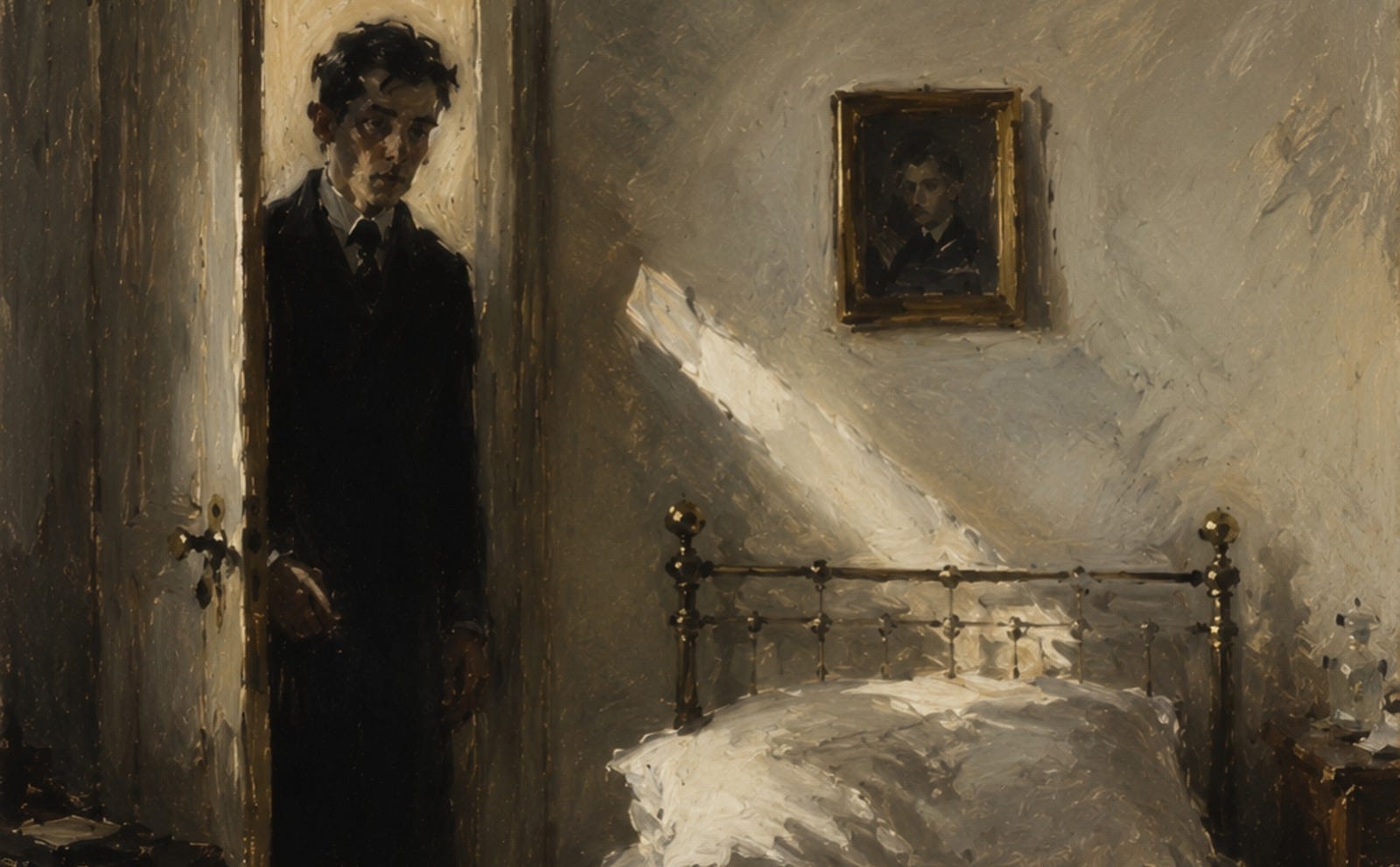
When Gregor Samsa woke one morning after a night of restless dreams, he discovered that he had been transformed in his bed into an enormous insect.
He was lying on his hard, shell-like back. When he lifted his head slightly, he could see his rounded brown belly, divided into stiff curved sections. The blanket was barely balanced on top of it and looked ready to slide off completely. His many legs, pitifully thin compared with the rest of his body, waved helplessly in front of his eyes.
“What has happened to me?” he thought.
It was not a dream.
His room was still there, quiet and familiar between its four walls. It was an ordinary human bedroom, though a little too small. On the table lay a collection of fabric samples he had unpacked for work—Gregor was a traveling salesman. Above the table hung a picture he had recently cut out of an illustrated magazine and placed in a handsome gold frame. It showed a woman sitting upright in a fur hat and fur scarf, holding up a large fur muff that covered her entire forearm.
Gregor turned his eyes toward the window. The gloomy weather made him feel miserable. He could hear raindrops striking the metal ledge outside.
“What if I just go back to sleep for a while and forget all this nonsense?” he thought.
But that was impossible. He was used to sleeping on his right side, and in his present condition he could not roll himself into that position. No matter how hard he threw his body toward the right, he always rocked back onto his shell.
He tried again and again, perhaps a hundred times. He closed his eyes so he would not have to watch his legs twitching wildly. Eventually he stopped only because he began to feel a dull, unfamiliar pain in his side.
“Oh God,” he thought. “What an exhausting job I’ve chosen. Traveling day after day. The stress is worse than working in the office itself, and then there’s all the misery of being on the road: worrying about train connections, eating bad meals at irregular times, constantly meeting new people but never knowing anyone long enough to become close to them. To hell with all of it.”
He noticed a slight itch near the top of his belly. Slowly, he pushed himself closer to the bedpost so he could raise his head and see the spot better. It was covered with tiny white dots that he could not make sense of. He tried to touch the area with one of his legs, but the moment he did, a cold shiver ran through his entire body and he pulled the leg away.
He slid back into his previous position.
“Getting up this early makes a person stupid,” he thought. “People need their sleep. Other traveling salesmen live like royalty compared with me. Sometimes I go back to the hotel in the middle of the morning to write up the orders I’ve collected, and those gentlemen are only just sitting down to breakfast. If I tried that with my boss, I’d be fired immediately.”
Then he thought, “Maybe that would actually be the best thing that could happen to me. If I didn’t have my parents to think about, I would have quit a long time ago. I would have walked straight up to the boss and told him exactly what I think of him. He would have fallen right off his desk.”
It was strange enough that the boss liked to sit high up behind his desk and speak down to the employees from above, forcing them to come close because his hearing was poor.
Still, Gregor had not completely given up hope.
Once he had saved enough money to pay off his parents’ debt to the boss—which would probably take another five or six years—he would definitely quit. That would be the great break in his life.
For now, though, he had to get up.
His train left at five.
He looked over at the alarm clock ticking on the chest beside the bed.
“Good God!”
It was already half past six.
The hands were moving calmly forward. In fact, it was past half past. It was getting close to quarter to seven.
Had the alarm not gone off?
From where he lay, Gregor could see that it had been correctly set for four o’clock. It must have rung. But was it really possible that he had slept through a noise loud enough to shake the furniture?
He certainly had not slept peacefully, but perhaps that was why he had slept so deeply.
What was he supposed to do now?
The next train left at seven. To catch it, he would have to rush like a madman. His sample collection was not even packed yet, and he did not exactly feel energetic or flexible.
And even if he managed to catch the seven o’clock train, there was no avoiding the boss’s anger. One of the company employees would have been waiting for Gregor at the five o’clock train and would already have reported that he had failed to appear.
Gregor hated that man. He was completely devoted to the boss and seemed to have neither independence nor common sense.
Could Gregor call in sick?
That would be embarrassing and suspicious. In the five years he had worked for the company, Gregor had never once been ill.
No doubt the boss would come with the insurance doctor, complain to Gregor’s parents about their lazy son, and dismiss every objection by appealing to the doctor, who seemed to believe there were no genuinely sick employees, only healthy people who wanted to avoid work.
And in this particular case, Gregor wondered, would the doctor even be entirely wrong?
Apart from feeling strangely sleepy after such a long night’s rest, Gregor actually felt quite well.
In fact, he was extremely hungry.
He was still racing through all these thoughts, unable to bring himself to leave the bed, when the clock struck quarter to seven.
There was a gentle knock at the door near the head of his bed.
“Gregor,” someone called.
It was his mother.
“It’s quarter to seven. Weren’t you supposed to leave?”
Her soft voice startled him.
Gregor was even more frightened when he heard his own reply. The voice was unmistakably his old voice, yet beneath it ran a strange, painful squeaking sound he could not control. His words sounded clear at first, but the strange noise distorted their endings so badly that anyone listening might wonder whether they had heard him correctly.
Gregor wanted to answer at length and explain everything, but under the circumstances he limited himself to saying, “Yes, yes. Thank you, Mother. I’m getting up now.”
The wooden door must have muffled the change in his voice, because his mother seemed satisfied and shuffled away.
But their brief conversation had alerted the rest of the family to the fact that Gregor, unexpectedly, was still at home.
Soon his father knocked on one of the side doors, softly at first but with his fist.
“Gregor! Gregor!” he called. “What’s going on?”
A moment later, in a deeper voice, he called again.
“Gregor! Gregor!”
At the other side door, his sister spoke quietly and anxiously.
“Gregor? Are you all right? Do you need anything?”
Gregor answered both of them.
“I’m nearly ready.”
He tried to hide everything unusual about his voice by pronouncing each word as carefully as possible and leaving long pauses between them.
His father returned to breakfast.
His sister, however, whispered, “Gregor, open the door. Please.”
But Gregor had no intention of opening it.
He was glad that his work had taught him the habit of locking every door at night, even when he was at home.
First, he wanted to get up quietly and without interruption. Then he would get dressed, have breakfast, and only afterward decide what to do next.
He could tell that lying in bed and thinking was getting him nowhere.
He remembered waking up before with some small pain caused by sleeping in an awkward position, only to discover after getting out of bed that the pain had been entirely imaginary. He was curious to see how quickly the strange impressions of this morning would disappear once he stood up.
As for the change in his voice, he was certain it was simply the beginning of a bad cold, an occupational hazard for a traveling salesman.
Getting rid of the blanket was easy enough. He only had to swell his body slightly, and the blanket slid off by itself.
After that, things became much harder.
The main problem was that he was so incredibly wide.
He would have needed arms and hands to push himself upright. Instead, he had all those little legs, each moving constantly in a different direction, none of which he could properly control.
Whenever he tried to bend one of them, it would straighten instead. And if he finally managed to make one leg do what he wanted, all the others would begin thrashing even more violently, as if suddenly released from restraint.
“There’s no point lying around in bed,” Gregor told himself.
He decided to try getting the lower half of his body out first.
Unfortunately, he had not actually seen that part of himself yet and could not properly imagine what it looked like.
It proved extremely difficult to move.
Progress was painfully slow.
Finally, growing desperate, Gregor gathered all his strength and threw himself forward without worrying about what might happen. He misjudged the direction and slammed hard into the foot of the bed.
A burning pain shot through him.
That told him that the lower part of his new body was probably the most sensitive.
So he tried the opposite approach.
He turned his head carefully toward the edge of the bed, hoping to get his upper body out first.
That worked more easily.
Despite its great weight and width, the rest of his body gradually followed the movement of his head.
But when he finally managed to get his head beyond the edge of the mattress and into the open air, he became afraid to continue.
If he let himself fall from that position, it would take a miracle for him not to injure his head.
Above all, he could not afford to lose consciousness now.
Better to stay in bed than risk that.
After another exhausting struggle, he ended up in his original position once more, breathing heavily.
His legs seemed to be fighting one another even more wildly than before, and he could see no way of bringing order to their chaotic movements.
Again he told himself that remaining in bed was impossible.
The sensible thing was to risk everything if there was even the slightest chance that doing so would free him.
At the same time, he kept reminding himself that calm, careful thought was better than desperate action.
At moments like this he stared intensely toward the window, trying to steady himself.
Unfortunately, the morning fog covered even the opposite side of the narrow street, and the view offered little comfort.
“Seven o’clock already,” he thought when he heard the clock strike again. “Seven o’clock, and the fog still hasn’t lifted.”
For a little while he lay still, breathing softly, almost as though complete silence might somehow restore the world to its normal and unquestionable condition.
Then he told himself, “Before quarter past seven, I absolutely have to be completely out of bed. Besides, someone from the office will probably come to check on me by then. The business opens before seven.”
So he began trying to rock his entire body evenly out of bed.
If he fell this way, he thought, he could lift his head sharply at the last moment and probably protect it.
His back seemed hard enough that landing on the carpet should not damage it.
What worried him most was the noise.
There was bound to be a tremendous crash, and even if it did not frighten everyone behind the doors, it would certainly alarm them.
Still, he would have to risk it.
By the time Gregor was hanging halfway out of bed, he realized that this new method was almost more like a game than an effort. All he had to do was rock his body back and forth in short movements.
It suddenly occurred to him how easy everything would be if someone helped him.
Two strong people would have been enough—his father and the maid, for example.
They could have put their arms beneath his curved back, lifted him out of bed, bent down with the weight, and then carefully lowered him to the floor.
Once his legs touched the ground, perhaps they would finally become useful.
Of course, the doors were locked.
And even if they had not been, should he really call for help?
Despite everything, the thought almost made him smile.
He had rocked himself so far out that one more strong movement might make him lose his balance completely.
He had only a few minutes left before quarter past seven.
Then the doorbell rang.
“That’s someone from the office,” Gregor thought.
His whole body seemed to freeze, though his legs began moving even faster.
For a moment, everything was silent.
“They’re not going to answer,” Gregor thought, clinging to a ridiculous hope.
Then, of course, the maid walked firmly through the apartment and opened the door.
Gregor needed to hear only the visitor’s first greeting to recognize him.
It was the office manager himself.
Why was Gregor condemned to work for a company where even the smallest mistake immediately caused the greatest suspicion?
Were all the employees considered crooks?
Was there not a single loyal and devoted worker among them who might fail to give the company a few hours one morning because he was so overwhelmed by guilt that he could not even get out of bed?
Would it not have been enough to send a junior employee to check on him, assuming anyone needed to come at all?
Did the office manager himself really have to appear?
And did his entire innocent family have to be shown that this supposedly suspicious situation was so serious that only a senior manager could be trusted to investigate it?
Gregor became so agitated by these thoughts that, without really deciding to, he threw himself out of bed with all his strength.
There was a loud thump, but not the terrible crash he had feared.
The carpet softened the fall, and his back was more flexible than he had expected, so the sound was dull rather than violent.
He had not protected his head carefully enough, however, and struck it against the floor.
Annoyed and in pain, he turned his head and rubbed it against the carpet.
“Something fell in there,” the office manager said from the room on the left.
Gregor wondered whether something like this might one day happen to the manager himself.
Surely the possibility could not be ruled out.
As if answering that thought with contempt, the manager took several sharp steps in the next room, his polished boots creaking.
From the room on the right, Gregor’s sister whispered to warn him.
“Gregor, the office manager is here.”
“I know,” Gregor said quietly to himself.
But he did not dare raise his voice enough for her to hear.
“Gregor,” his father called from the room on the left, “the office manager has come to ask why you didn’t leave on the early train. We don’t know what to tell him. And he wants to speak to you personally. So please open the door. I’m sure he’ll excuse the mess in your room.”
“Good morning, Mr. Samsa,” the office manager called pleasantly.
“He isn’t well,” Gregor’s mother told the manager while his father continued speaking at the door. “He isn’t well, believe me. Why else would Gregor miss a train? The boy thinks of nothing but work. Sometimes I almost get annoyed because he never goes out in the evenings. He’s been in town for eight days now, and he’s stayed home every single night. He sits with us at the table and quietly reads the newspaper or studies train schedules. His idea of relaxation is doing little woodwork projects. For example, he carved a small frame over the course of two or three evenings. You’ll be surprised how pretty it is. It’s hanging inside his room. You’ll see it as soon as Gregor opens the door.”
Then she added, “I’m very glad you came, sir. We would never have persuaded Gregor to open the door on our own. He can be so stubborn. And I’m certain he isn’t well, even though he denied it this morning.”
“I’m coming right away,” Gregor said slowly and carefully.
He stayed exactly where he was so he would not miss a word of the conversation.
“I can’t imagine any other explanation either, madam,” said the office manager. “I only hope it’s nothing serious. On the other hand, I must say that those of us in business are often forced, for better or worse, to overcome minor illnesses for the sake of our professional responsibilities.”
“So may the office manager come in now?” Gregor’s impatient father asked, knocking on the door again.
“No,” Gregor said.
An uncomfortable silence filled the room on the left.
From the room on the right, his sister began to cry.
Gregor wondered why she had not joined the others.
Perhaps she had only just gotten out of bed and had not even begun dressing yet.
And why was she crying?
Because he would not get up?
Because he refused to let the manager in?
Because he might lose his job?
And because the boss might then demand repayment of his parents’ old debts?
Surely those worries were premature.
Gregor was still here. He had no intention of abandoning his family.
At the moment, admittedly, he was lying on the carpet, and anyone who knew what had happened to him would hardly expect him to invite the office manager into his room.
Surely he could not be fired immediately over one small act of rudeness. He could easily invent a suitable excuse later.
It seemed to Gregor that the sensible thing would be to leave him alone instead of upsetting him with crying and arguments.
But of course the others did not know what was happening, and their uncertainty explained their behavior.
“Mr. Samsa,” the office manager suddenly called in a much louder voice, “what is going on in there? You’ve locked yourself in your room, you answer only yes or no, you’re causing your parents unnecessary worry, and—let me mention this only in passing—you are neglecting your professional duties in an extraordinary way.”
He continued without waiting for an answer.
“I’m speaking on behalf of your parents and your employer, and I must seriously ask you for an immediate and clear explanation. I’m astonished. Truly astonished. I thought I knew you as a calm and sensible man, and now you suddenly seem determined to behave in a completely unreasonable way.”
“The boss suggested a possible explanation for your absence this morning. It concerned the money you were recently entrusted with collecting. I practically gave my word that his suspicion could not be true. But now I come here and find you behaving with this incomprehensible stubbornness, and I’m losing any desire to defend you.”
“And your position at the company is by no means as secure as you may think.”
“I originally intended to discuss all this with you privately, but since you are wasting my time by keeping me standing outside your door, I see no reason your parents should not hear it too.”
“Your performance recently has been very unsatisfactory. I admit this is not the strongest season for business. We understand that. But there is no season in which an employee is permitted to do no business at all, Mr. Samsa.”
Gregor became frantic.
“But sir!” he cried, forgetting everything else in his agitation. “I’m opening the door immediately. Right now. A slight illness—a dizzy spell—kept me from getting up. I’m still in bed, but I feel completely refreshed now. I’m just getting out.”
“Please, just give me a moment. It isn’t going quite as easily as I expected, but I’m already feeling better.”
“It’s amazing how something like this can suddenly happen to a person. I felt perfectly fine last night. My parents know that. Or rather, perhaps I had a slight warning yesterday evening. Someone might have noticed.”
“Why didn’t I report it to the office? Because you always assume you can get through an illness without staying home.”
“Please, sir, don’t blame my parents. There’s no reason for all the accusations you’re making. No one has said anything like this to me before. Perhaps you haven’t seen the most recent orders I sent in.”
“And besides, I can still take the eight o’clock train. These few extra hours of rest have made me stronger.”
“Please don’t let me keep you any longer. I’ll be at the office myself shortly. Please tell the boss that, and put in a good word for me.”
As Gregor poured out all these words, barely knowing what he was saying, he worked his way toward the chest of drawers. His earlier struggles in bed had apparently taught him something about controlling his body.
He tried to pull himself upright against it.
He really did intend to open the door.
He genuinely wanted them to see him and to speak with the office manager.
He was curious to find out how the people who were so desperately demanding to see him would react when they finally did.
If they were horrified, then Gregor would no longer be responsible for anything, and he could stop worrying.
If they accepted the situation calmly, then he had no reason to panic either. If he hurried, perhaps he really could be at the station by eight.
At first he slipped several times against the smooth surface of the chest.
Finally he made one last effort and managed to hold himself upright.
The pain in his lower body was burning now, but he no longer paid attention to it.
He let himself fall against the back of a nearby chair and gripped its edges with his small legs.
At least now he had control of himself.
He became silent so he could listen to the office manager.
“Did you understand a single word of that?” the manager asked Gregor’s parents. “Surely he isn’t making fools of us?”
“Oh God,” his mother cried, already weeping. “Perhaps he’s seriously ill, and we’re tormenting him.”
Then she shouted, “Grete! Grete!”
“Mother?” his sister called from the other side.
They were speaking to each other through Gregor’s room.
“You must go and get the doctor immediately. Gregor is ill. Hurry, get the doctor! Did you hear him speaking?”
“That sounded like an animal,” the office manager said.
Compared with the mother’s shouting, his voice was remarkably quiet.
“Anna! Anna!” Gregor’s father shouted through the hallway toward the kitchen, clapping his hands. “Go and get a locksmith immediately!”
The two young women rushed through the hall, their skirts rustling.
Gregor wondered how his sister had managed to dress so quickly.
The apartment door was pulled open.
He did not hear it close again. They must have left it open, as people often do in homes where some terrible disaster has occurred.
Gregor, however, felt much calmer.
They could no longer understand his words.
To him, his speech had sounded perfectly clear—clearer than before, perhaps because he was becoming used to hearing his new voice.
But at least the others now believed that something was genuinely wrong with him, and they were preparing to help.
The confidence and decisiveness with which they began making arrangements comforted him.
He felt included in the human world again.
He expected extraordinary things from both the doctor and the locksmith, though in his mind he did not clearly distinguish between what either of them might be able to do for him.
Wanting his voice to be as clear as possible for the important conversations that were surely coming, he coughed slightly.
He tried to keep the sound quiet, since even his coughing might no longer sound human, and he no longer trusted himself to judge.
Meanwhile, the next room had become completely silent.
Perhaps his parents were sitting with the office manager at the table, whispering together.
Or perhaps they were all standing against the door, listening.
Gregor slowly pushed the chair toward the door.
Once he reached it, he let go of the chair and threw himself against the door instead.
He managed to hold himself upright. The pads on his small legs seemed to have some adhesive quality.
He rested for a moment after the effort.
Then he began trying to turn the key in the lock with his mouth.
Unfortunately, he seemed to have no real teeth.
How was he supposed to grip the key?
His jaws, however, were extremely strong.
With them he managed to move it.
He ignored the fact that he was obviously injuring himself. A brown liquid came from his mouth, ran over the key, and dripped onto the floor.
“Listen,” the office manager said in the other room. “He’s turning the key.”
That encouraged Gregor enormously.
He wished all of them would cheer him on.
“Come on, Gregor!” he imagined his father and mother calling. “Keep going! Hold on to the lock!”
Imagining that everyone was following his efforts anxiously, he bit down on the key with all the strength he had.
As the key turned, Gregor moved with it around the lock.
Soon his mouth was the only thing keeping him upright. Depending on what he needed to do, he either hung from the key or pushed down on it with the full weight of his body.
At last the lock clicked open.
The sharp sound seemed to wake him up completely.
“I didn’t need the locksmith after all,” he thought with relief.
He rested his head against the door handle and used it to push the door open.
Because of the awkward way he had to open it, the door was already quite wide before anyone could actually see him.
Gregor still had to work his way carefully around the edge of the door.
He moved very slowly because he was afraid of falling onto his back right at the entrance to the room.
He was so occupied with this difficult movement that he could not pay attention to anything else.
Then he heard the office manager cry out.
“Oh!”
The sound was almost like a rush of wind.
Gregor could see him now.
He was the person standing closest to the door. One hand rose to cover his open mouth while he slowly backed away, as though an invisible force were steadily pushing him from the room.
Gregor’s mother was still wearing her hair loose from the night. Despite the office manager’s presence, it stood wildly around her head.
At first she looked at Gregor’s father with her hands clasped together.
Then she took two steps toward Gregor.
Suddenly she collapsed among the skirts spreading around her on the floor, her face sinking so far toward her chest that Gregor could barely see it.
His father clenched his fist with a hostile expression, as though he wanted to force Gregor back into his room.
Then he looked uncertainly around the living room.
Finally, he covered his eyes with both hands and began to cry so violently that his broad chest shook.
Gregor did not enter the room.
He stayed inside his bedroom, leaning against the fixed half of the doorway so that only half his body and his tilted head were visible as he looked at the others.
The morning had grown much brighter.
Across the narrow street he could now clearly see part of the long, dark gray building opposite them. It was a hospital, its front broken up by rows of severe, evenly spaced windows.
Rain was still falling, but now in large separate drops that could be seen individually as they fell.
The breakfast table was crowded with dishes.
Breakfast was the most important meal of the day to Gregor’s father, and he usually stretched it out for hours while reading several newspapers.
On the wall opposite Gregor hung a photograph from his time in the military.
In it, Gregor was dressed as a lieutenant, one hand resting on his sword, smiling confidently. His posture and uniform demanded respect.
The door leading to the front hall stood open, and because the apartment door was also open, Gregor could see the landing outside and the top of the staircase descending from it.
“Well,” Gregor said, fully aware that he seemed to be the only person who had remained calm, “I’ll get dressed now, pack my samples, and leave.”
“Will you let me go? You will, won’t you?”
Then he addressed the office manager.
“You can see, sir, that I’m not stubborn. I like working. Traveling is exhausting, but I don’t think I could live without it.”
“Where are you going? Back to the office? Yes?”
“You’ll report everything truthfully, won’t you?”
“A person can be unable to work for a moment, but that is exactly when people should remember what he has done in the past and recognize that, once the problem is over, he will certainly work harder and more carefully than ever.”
“You know how much I owe the boss.”
“And I have my parents and my sister to think about.”
“I’m in a difficult situation, but I’ll get myself out of it.”
“Please don’t make things harder for me than they already are.”
“Take my side at the office.”
“People don’t like traveling salesmen. I know that. They imagine we earn huge amounts of money and live wonderful lives. They simply never have much reason to question that idea.”
“But you, sir, understand the situation better than most of the staff. Between us, I would even say you understand it better than the boss himself. A businessman in his position can easily be influenced into judging an employee unfairly.”
“You also know that a traveling salesman spends almost the entire year away from the office. That makes him an easy victim of gossip, accidents, and unfair complaints.”
“He can’t defend himself against them because most of the time he doesn’t even know they exist.”
“Then he returns home exhausted after a trip and finds himself suffering the consequences of accusations whose causes he can no longer even understand.”
“Please, sir, don’t leave without saying something to me—just something that shows you believe I’m right about at least part of this.”
But the office manager had turned away almost as soon as Gregor began speaking.
He kept glancing back at Gregor over his trembling shoulder, his lips raised in horror.
Not once during Gregor’s speech did he stop moving.
He continued edging toward the door without taking his eyes off Gregor, advancing so gradually that it was almost as though some secret rule forbade him from leaving the room too quickly.
By now he had reached the hallway.
The sudden motion with which he finally pulled his foot out of the living room made it look as if he had just burned the sole of his shoe.
Once in the hallway, he stretched his right arm toward the stairs as though some supernatural rescue were waiting for him there.
Gregor realized that he absolutely could not let the office manager leave in this state.
If he did, Gregor’s job would be in serious danger.
His parents did not fully understand this.
After all these years, they had convinced themselves that Gregor’s position at the company was secure for life. And at that moment they were so overwhelmed by the immediate crisis that they had lost all ability to think about the future.
Gregor had not.
The office manager had to be stopped.
He had to be calmed down, persuaded, and finally won over.
Gregor’s future—and his family’s—depended on it.
If only his sister had been there.
She was clever.
She had already been crying while Gregor was still lying quietly on his back.
And the manager seemed like the kind of man who would listen to a young woman.
She could have closed the apartment door, spoken calmly to him in the hall, and helped him get over his shock.
But his sister was gone.
Gregor would have to act himself.
Without considering that he still had almost no idea how well he could move in his new body, and without remembering that his speech had probably been completely incomprehensible, Gregor left the support of the doorway and pushed himself through the opening.
He wanted to approach the office manager, who was now clinging ridiculously to the railing on the landing with both hands.
Gregor tried to move toward him.
Instead, searching desperately for balance, he dropped onto his many legs with a small cry.
The moment it happened, however, he experienced physical comfort for the first time that morning.
His legs had solid ground beneath them.
To his delight, they obeyed him perfectly.
They even seemed eager to carry him wherever he wanted to go.
For a moment Gregor believed that the end of all his suffering was close.
He remained there on the floor, rocking slightly while holding himself still, only a short distance from his mother.
She was directly in front of him.
Although she had seemed completely collapsed into herself only seconds earlier, she suddenly sprang to her feet.
Her arms stretched wide.
Her fingers spread apart.
“Help!” she screamed. “For God’s sake, help!”
She tilted her head as though trying to get a better look at Gregor, yet at the same time she backed away from him wildly.
She had forgotten that the breakfast table was behind her.
When she reached it, she dropped onto it in confusion, apparently without realizing what she was doing.
A large coffee pot overturned beside her.
Coffee poured steadily onto the carpet.
“Mother. Mother,” Gregor said softly, looking up at her.
For a moment he completely forgot about the office manager.
At the sight of the flowing coffee, he could not stop himself from snapping his jaws several times at the empty air.
His mother screamed again.
She fled from the table and threw herself into the arms of Gregor’s father, who was hurrying toward her.
But Gregor had no time to think about his parents now.
The office manager was already on the staircase.
With his chin resting briefly on the railing, he looked back one final time.
Gregor gathered himself to rush after him.
The manager seemed to understand what Gregor intended.
He leaped down several steps at once and disappeared.
“Ugh!” he cried.
The sound echoed through the entire stairwell.
Unfortunately, the office manager’s escape seemed to destroy what little self-control Gregor’s father had left.
Instead of running after the man himself—or at least allowing Gregor to follow him—his father grabbed the manager’s walking stick, which had been left on a chair along with his hat and coat.
With his other hand, he seized a large newspaper from the table.
Then, stamping his feet, he began driving Gregor back toward his bedroom by waving the stick and newspaper at him.
Gregor’s pleading did no good.
His father could not understand him.
No matter how humbly Gregor lowered his head, his father only stamped harder.
Across the room, despite the cold weather, his mother had thrown open a window.
She leaned far outside it and buried her face in her hands.
A strong draft rushed between the street and the open apartment door.
The curtains flew upward.
Newspapers rustled across the table.
Loose pages blew onto the floor.
Gregor’s father continued advancing without mercy.
As he came forward, he made sharp hissing sounds, almost like a wild animal.
Gregor had no experience walking backward, and it was painfully slow.
If only he could have turned around, he could have reached his bedroom immediately.
But he was afraid that the time it took to turn would make his father even more impatient.
At any moment, the stick in his father’s hand might come crashing down on his back or head.
Finally, Gregor realized with horror that he had no choice.
He could not even keep himself moving in a straight line while going backward.
So, constantly glancing anxiously at his father, he began turning around as quickly as he could—which in reality was still extremely slowly.
Perhaps his father noticed that Gregor was trying to cooperate.
He did not interfere with the turn.
From a distance, he even used the end of the stick now and then to guide Gregor in the right direction.
If only he would stop that unbearable hissing.
The sound made Gregor completely lose his concentration.
He was almost fully turned around when, distracted by the hissing, he became confused and started turning back in the wrong direction.
At last, however, his head was facing the bedroom doorway.
Then he discovered another problem.
His body was too wide to pass through easily.
In his father’s present state, it never occurred to him to open the second half of the double door and give Gregor more room.
His father had only one thought: Gregor had to get back into his room as quickly as possible.
He would never have tolerated the complicated preparations Gregor would have needed in order to raise his body and perhaps pass through the doorway upright.
Instead, as though no obstacle existed at all, his father drove him forward with even greater noise.
The sounds behind Gregor no longer seemed like the voice of one ordinary father.
This was no longer a situation in which anyone could hesitate.
Whatever happened, Gregor had to force himself through the doorway.
One side of his body lifted upward.
He became wedged diagonally in the opening.
One of his sides scraped painfully against the doorframe, leaving ugly marks on the white-painted surface.
Soon he was completely stuck.
He could no longer move on his own.
The legs on one side of his body hung trembling in the air.
The legs on the other side were crushed painfully against the floor.
Then his father gave him one powerful shove from behind.
The blow, painful as it was, finally freed him.
Gregor flew deep into his bedroom, bleeding heavily.
The door slammed shut behind him with the walking stick.
Then, at last, everything was quiet.