

'The Nun' by Denis Diderot: Conscience, Captivity, and the Cost of Obedience
A calm introduction to Diderot’s unsettling novel about faith, freedom, family pressure, and institutional power

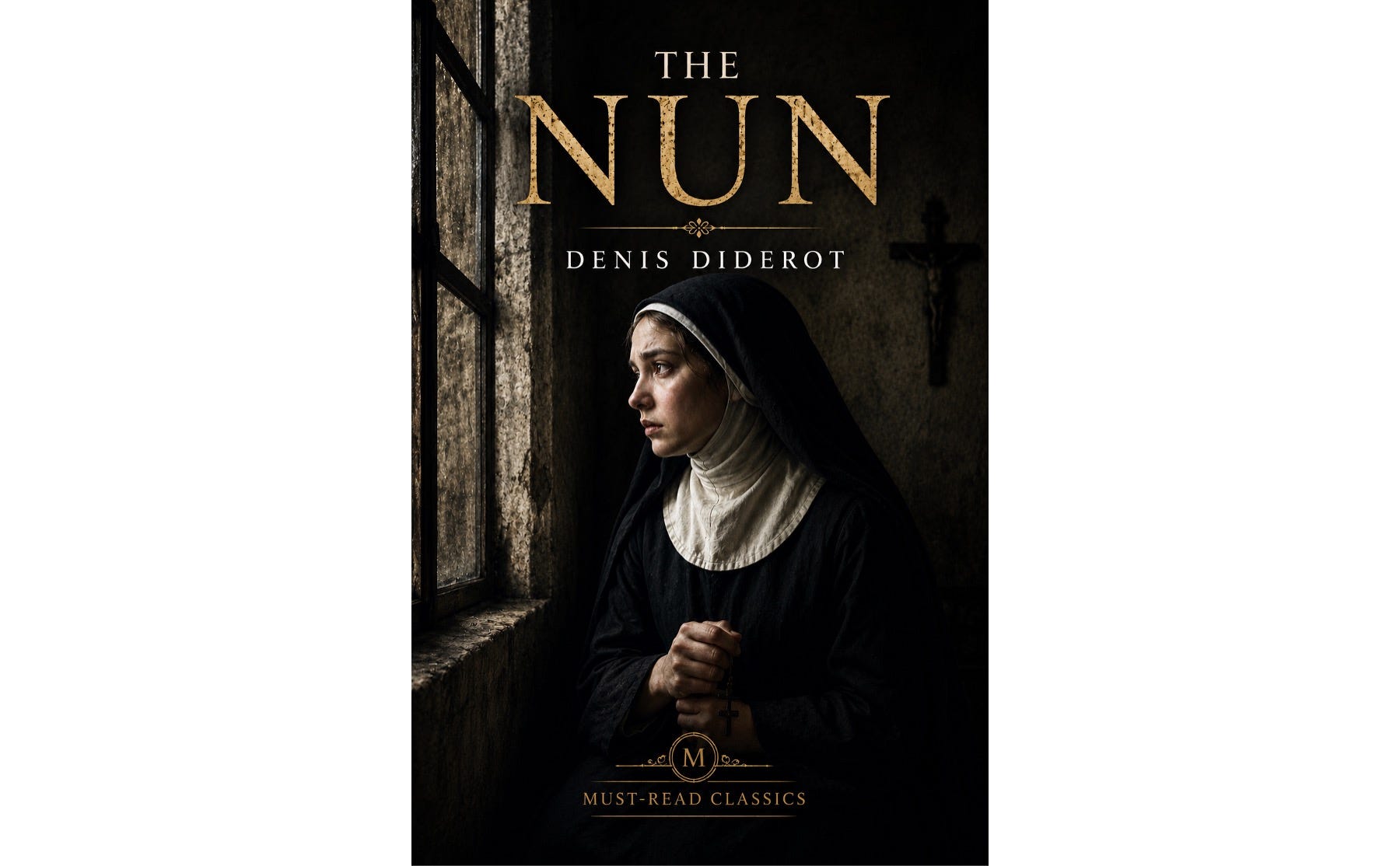
There are books whose power lies not in dramatic excess but in the steady pressure they exert on the reader’s moral imagination. The Nun by Denis Diderot is one of them. It is not a long novel, nor is it an ornate one. Much of its force comes from the plainness of its central situation: a young woman, Suzanne Simonin, is placed in a convent against her will, and must live with the consequences of a vow she never freely chose.
Diderot wrote La Religieuse in the eighteenth century, in the intellectual climate of the French Enlightenment. This was an age of arguments about reason, education, authority, nature, and the rights of the individual. Yet Diderot’s novel is not a philosophical treatise disguised as fiction. It is something more intimate and more troubling: a first-person account of a woman trapped by family interest, social convention, and religious bureaucracy. The result is a novel that feels at once historically specific and disturbingly recognizable.
The book’s origins are unusual. It began partly as a literary hoax, composed around a fictitious appeal from a nun to a worldly benefactor. But what might have remained a clever exercise became, in Diderot’s hands, a work of psychological seriousness. The artificial premise opened a door onto real anxieties: What happens when a sacred vow is extracted from an unwilling person? Can obedience be virtuous when it is imposed? What does an institution become when it values its own continuity over the human beings inside it?
Suzanne Simonin, the narrator, is not a rebel in any simple sense. That is one reason the novel remains so interesting. She does not reject religion itself. She rejects compulsion. She wishes to live honestly, and her tragedy is that honesty has no proper place in the world arranged around her. Her family pushes her toward the convent not because she has a vocation, but because she is inconvenient. Questions of inheritance, legitimacy, reputation, and parental control lie beneath the surface. The convent is presented not as a serene refuge from worldly corruption, but as one of the places where worldly calculations are quietly hidden.
This gives the novel its central tension. Suzanne is asked to perform submission while knowing that her submission is false. The vow, which should express inward conviction, becomes a social instrument. Diderot is especially acute in showing how language can be made to betray reality. Words such as duty, sacrifice, humility, and obedience are repeated around Suzanne until they begin to sound less like spiritual ideals than mechanisms of control. The novel asks the reader to notice the difference between genuine faith and the vocabulary of faith used without tenderness.
The convents through which Suzanne passes are not all alike, and this is important. Diderot is not merely painting one dark institution in a single color. At Longchamp, under the kindly Madame de Moni, Suzanne experiences something close to spiritual gentleness. Madame de Moni is devout, but her devotion is humane. She understands religious life as inward discipline and care for others. Under her, the convent briefly appears as it might have been: ordered, quiet, and capable of charity.
Her successor, Sister Sainte-Christine, transforms that world into one of surveillance and punishment. Here Diderot’s critique sharpens. Sainte-Christine is not frightening because she is openly monstrous, but because she believes herself righteous. Her cruelty is organized, pious, and bureaucratic. Suzanne is humiliated, isolated, deprived, and treated as a contaminating presence because she insists that she has been forced into a life she cannot accept. The violence is psychological before it is physical. The convent becomes a theatre in which authority proves itself by breaking resistance.
The later episodes at Arpajon introduce another kind of danger. The Mother Superior there is emotionally unstable, possessive, and drawn to Suzanne with an intensity that unsettles the boundaries between spiritual guidance, maternal attachment, and desire. Diderot handles this material with a mixture of curiosity and unease typical of his century, but also with an eye for dependency and power. Suzanne’s vulnerability makes her the object of competing forms of possession. Some wish to discipline her, others to adore her, others to use her as evidence of their own virtue. Very few are able to see her simply as a person.
This is perhaps the deepest sadness of The Nun by Denis Diderot: Suzanne is constantly interpreted by others, but seldom heard. To her family, she is a problem to be removed. To certain religious authorities, she is a will to be corrected. To some confessors and superiors, she is a soul to be managed. To readers, however, she speaks directly. The first-person form gives her the dignity that her world denies her. Her voice is composed, observant, and often restrained. She does not always fully understand the forces acting upon her, but she records them with a clarity that allows the reader to understand more than she can safely say.
Diderot’s prose has a moral elegance that differs from decorative beauty. He is interested in pressure: pressure on conscience, on the body, on speech, on memory. Suzanne’s body matters throughout the novel because it is the site upon which authority writes its demands. She is enclosed, veiled, watched, starved, touched, examined, and judged. The religious question therefore becomes inseparable from a political and bodily one. Who owns a person’s life? Who has the right to decide what kind of existence another human being must live?
This is where the novel’s Enlightenment background becomes most visible. Diderot is not merely attacking convents as historical institutions; he is examining any system that confuses obedience with truth. The target is coercion sanctified by respectable language. The novel belongs to a broader eighteenth-century conversation about liberty, consent, and the legitimacy of authority, but it makes those abstractions painfully concrete. Instead of presenting an argument about freedom, Diderot places us inside a consciousness deprived of it.
For modern readers, the convent setting may at first appear distant. Few people today will encounter the exact social structure that imprisons Suzanne. Yet the emotional and ethical pattern is familiar. Families still impose expectations in the name of love. Institutions still protect themselves by silencing inconvenient individuals. Communities still use moral language to enforce conformity. People are still praised for obedience when what is being demanded is self-erasure.
The novel also speaks to contemporary concerns about consent. Suzanne’s tragedy begins in the gap between outward assent and inward refusal. She is made to say yes when the truth of her being says no. Diderot understood that coercion does not always look like chains. It may arrive as persuasion, guilt, religious duty, financial necessity, or the fear of disgrace. The result can be a life that appears orderly from the outside while being intolerable within.
At the same time, Suzanne is not presented as a modern heroine transported into the eighteenth century. She remains shaped by her world. She is pious, modest, sometimes naïve, and often uncertain. This makes her more convincing. Diderot does not need her to be intellectually radical. Her simple insistence that a vow without vocation is a lie is radical enough. Her conscience is not abstract; it is the stubborn knowledge that she cannot sincerely be what others demand she become.
Reading The Nun today can be an unsettling experience precisely because the novel is so controlled. It does not shout its outrage. It lets the facts accumulate. The reader gradually feels the narrowing of Suzanne’s possibilities, the exhaustion produced by being disbelieved, and the peculiar loneliness of a person trapped inside other people’s certainties. Diderot’s achievement lies in making institutional critique inseparable from human sympathy.
For those interested in French literature, Enlightenment thought, or the history of women’s lives under systems of authority, The Nun by Denis Diderot offers far more than a period curiosity. It is a lucid, disturbing, and compassionate novel about the difference between vocation and imprisonment, belief and submission, conscience and command. Its questions have not lost their edge.
It is a book best approached quietly, without expecting melodrama. Its force lies in the calm persistence of Suzanne’s voice and in the reader’s growing awareness of what it means to be denied the authorship of one’s own life. For anyone drawn to classic literature that still presses on the present, The Nun is a work worth reading with care—and perhaps keeping close enough to return to later.
The Nun
Translated by Wilma Baltus. Copyright © Wilma Baltus. All rights reserved.
The Marquis de Croismare’s reply, should he send one, will provide the opening lines of this account. Before writing to him, I wanted to know what kind of man he was. He is a man of the world who distinguished himself in the service. He is advanced in years and has been married; he has a daughter and two sons whom he loves and who love him in return. He is well-born, cultivated, intelligent, cheerful, fond of the fine arts, and, above all, possessed of an original mind. I have heard his sensitivity, honour, and integrity praised; and from the keen interest he has taken in my situation, as well as from everything I have been told about him, I concluded that I had not compromised myself by appealing to him. But it is hardly likely that he will decide to change my fate without first knowing who I am. That is why I have resolved to overcome my pride and reluctance and undertake these memoirs, in which I shall describe part of my misfortunes without talent or artifice, with the innocence of someone my age and the natural frankness of my character. Since my protector may require me to complete them—or since I may one day take it into my head to do so, at a time when these distant events are no longer fresh in my memory—I thought that the summary with which they end, together with the deep impression they will leave on me for as long as I live, would be enough to recall them accurately.
My father was a lawyer. He married my mother when he was already fairly advanced in years, and they had three daughters. He possessed more than enough wealth to establish us all comfortably in life, but for that to happen, his affection would at least have needed to be divided equally among us—and I am very far from being able to praise him for that.
I was certainly superior to my sisters in intelligence, appearance, character, and talent; and my parents seemed distressed by the fact. The advantages that nature and hard work had given me over them became a source of unhappiness. From my earliest years, I longed to resemble my sisters so that I too might be loved, cherished, indulged, and always forgiven, as they were. Whenever someone said to my mother, “You have such charming children,” the compliment was never meant to include me. At times, the admiration of others offered me a kind of revenge for this injustice; but the praise I received cost me so dearly once we were alone that I would almost have preferred indifference, or even insults. The more openly visitors showed a preference for me, the greater the resentment after they had gone.
Oh, how often I wept because I had not been born ugly, dull, foolish, and vain—in short, endowed with all the faults that made my sisters so successful with our parents. I often asked myself what could explain such strange behaviour in a father and mother who were, in every other respect, honest, fair, and devout.
Shall I confess it to you, monsieur? Certain words that escaped my father when he was angry—for he had a violent temper—together with circumstances I pieced together over time, remarks made by neighbours, and things said by servants, led me to suspect a reason that might excuse them a little. Perhaps my father had doubts about my birth. Perhaps I reminded my mother of a mistake she had once made, and of the ingratitude of a man to whom she had listened too willingly. How can I know? But even if these suspicions are unfounded, what risk do I run in confiding them to you? You will burn this account, and I promise to burn your replies.
Because we had been born only a short time apart, the three of us grew up together. Suitors began to appear. My eldest sister was courted by a charming young man. Before long, I noticed that he singled me out, and I realised that my sister would soon become no more than a pretext for his frequent visits. I foresaw all the grief his preference might bring upon me, and I warned my mother.
It may have been the only thing I ever did in my life that pleased her, and this was how I was rewarded. Four days later—or at least only a few days afterwards—I was told that a place had been secured for me in a convent. The very next day, I was taken there.
I was so unhappy at home that the news did not distress me, and I entered Sainte-Marie, my first convent, in excellent spirits. Meanwhile, when my sister’s admirer no longer saw me, he forgot me and became her husband. His name is Monsieur K***. He is a notary and lives in Corbeil, where their marriage is thoroughly unhappy. My second sister married a Monsieur Bauchon, a silk merchant in the rue Quincampoix in Paris, and lives reasonably well with him.
Once both my sisters were settled, I assumed my parents would begin to think of me and that I would soon be allowed to leave the convent. I was sixteen and a half. My sisters had each received substantial dowries, and I expected a future equal to theirs. My head was already full of alluring dreams when I was summoned to the visiting room.
There I found Father Séraphin, my mother’s spiritual adviser. He had once been mine as well, so he had no difficulty explaining the purpose of his visit. He had come to persuade me to take the veil.
I protested against such an extraordinary proposal and told him plainly that I felt no inclination whatsoever toward the religious life.
“So much the worse,” he said, “because your parents have stripped themselves of their wealth for the sake of your sisters, and I cannot see what more they can do for you now that they have reduced themselves to such limited circumstances. Think carefully, mademoiselle. You must either enter this house for good, or be sent to some provincial convent where they will accept you for a modest pension, and from which you will not be released until your parents die—which may not happen for a very long time.”
I complained bitterly and wept a torrent of tears. The Mother Superior had been warned and was waiting for me when I returned from the visiting room. I was in a state of distress beyond description.
“What is the matter, my dear child?” she said.
She knew better than I did what the matter was.
“Look at you! I have never seen anyone in such despair. You are frightening me. Have you lost your father or your mother?”
For a moment I thought of throwing myself into her arms and answering, “God grant that I had!” Instead, I merely cried out:
“Alas, I have neither father nor mother. I am a miserable creature whom everyone hates, and they mean to bury me here alive.”
She allowed the flood of grief to run its course and waited until I had grown calmer. Then I explained more clearly what I had just been told. She appeared to take pity on me. She sympathised with my suffering and encouraged me not to embrace a state of life for which I felt no calling. She promised to pray, to argue on my behalf, and to plead with my parents.
Oh, monsieur, you cannot imagine how artful the superiors of convents can be. She did indeed write to my parents. She knew perfectly well what answers she would receive, and she showed them to me. It was only much later that I learned to question her sincerity.
At last the deadline imposed upon my decision arrived. She came to inform me, wearing the most carefully composed expression of sorrow. At first she said nothing. Then she murmured a few words of compassion, from which I understood the rest.
Once again, there followed a scene of despair. I shall have scarcely anything else to describe to you. The great art of these women lies in knowing how to control themselves.
Then she said—and I truly believe she was weeping:
“So, my child, you are going to leave us. My dear child, we shall never see each other again!”
She added other things that I did not hear. I had collapsed into a chair. At one moment I was silent, at another sobbing; now utterly still, now springing to my feet; first leaning against the walls for support, then throwing myself upon her breast and pouring out my grief.
That was what had passed between us when she added:
“But why do you not do one thing? Listen to me, and above all, do not tell anyone that I advised you to do it. I am relying upon your absolute discretion, because for anything in the world I would not wish to expose myself to blame. What is it they are asking of you? To take the veil? Very well—why not take it? What would that commit you to? Nothing. Only to remain with us for another two years. No one knows who will live and who will die. Two years is a long time. A great many things can happen in two years.”
She accompanied these treacherous words with so many caresses, so many declarations of affection, so many gentle falsehoods. I knew where I was; I did not know where they might send me. And so I allowed myself to be persuaded.
She wrote to my father. Her letter was extremely well composed—indeed, it could hardly have been better. My suffering, my grief, and my protests were not concealed. I assure you that a girl far shrewder than I was might have been deceived by it. And yet the letter ended by giving my consent.
How swiftly everything was arranged! The date was fixed, my clothes were made, and the day of the ceremony arrived. Looking back now, I can no longer perceive the slightest interval between these events.
I forgot to tell you that I saw my father and mother, that I spared no effort to move them, and that I found them inflexible. Monsieur l’Abbé Blin, a doctor of the Sorbonne, delivered the exhortation, and the Bishop of Aleppo clothed me in the habit.
The ceremony is not a joyful one in itself; on that day it was unbearably sad. Although the nuns crowded around me to support me, twenty times I felt my knees give way and thought I would collapse on the altar steps. I heard nothing. I saw nothing. I was numb. They led me, and I followed. They questioned me, and others answered in my place.
At last the cruel ceremony ended. Everyone withdrew, and I remained among the flock into which I had just been admitted. My companions gathered around me, embraced me, and said to one another:
“Just look at her, Sister—how beautiful she is! See how the black veil brings out the whiteness of her complexion! How well that band suits her! How it rounds her face, how it softens the line of her cheeks! And how the habit shows off her figure and her arms!”
I scarcely listened. I was overwhelmed with misery. Yet I must confess that, once I was alone in my cell, I remembered their compliments. I could not resist testing their truth in my little mirror, and it seemed to me that they had not been entirely misplaced.
Certain honours are attached to that day, and in my case they were made more elaborate than usual. I was scarcely conscious of them, though everyone affected to believe otherwise and insisted on telling me so, despite the fact that my indifference was plain.
That evening, after prayers, the Superior came to my cell.
“Truly,” she said, after studying me for a moment, “I cannot understand why you felt such an aversion to this habit. It suits you perfectly, and you look charming. Sister Suzanne makes a very beautiful nun; people will love you all the more for it. Come now, let me see you walk. You do not hold yourself upright enough. You must not stoop like that.”
She arranged my head, my feet, my hands, my waist, and my arms. It was almost a lesson from Marcel in the graces of the cloister, for every condition in life has its own.
Then she sat down and said:
“That is better. But now let us speak seriously. You have gained two years. Your parents may change their minds. Perhaps, by the time they wish to take you away, you yourself will prefer to remain here. It would not be impossible.”
“Madame, do not believe it.”
“You have lived among us for a long time, but you do not yet know our life. It has its hardships, certainly, but it has its consolations too.”
You can easily imagine everything she added about the world and the cloister. It is written everywhere, and always in the same way; for, God knows, I was made to read the whole dreary mass of what members of religious orders have said about their own state, which they know well and detest, and against the world, which they love, condemn, and do not know at all.
I shall not give you every detail of my novitiate. Were all its austerities strictly observed, no one could endure it; but in truth it is the gentlest period of monastic life. The mistress of novices is chosen from among the most indulgent sisters they can find. Her task is to conceal every thorn of the religious state from you. The novitiate is a course in the most subtle and carefully prepared seduction.
She is the one who deepens the darkness around you; who cradles you, soothes you to sleep, deceives you, bewitches you. Ours became particularly attached to me. I do not believe that any young and inexperienced soul could withstand so fatal an art. The world has its precipices, but I cannot imagine that one is led to them by so gentle a slope.
Had I sneezed twice in succession, I was excused from the office, from work, and from prayer. I was allowed to go to bed earlier and rise later. For me, the rule ceased to exist. Imagine, monsieur, there were days when I longed for the hour of my sacrifice to arrive.
No unhappy event occurred in the world without our being told of it. True stories were rearranged; false ones were invented. Then came endless praise and thanksgiving to God for having sheltered us from such humiliating adventures.
Yet the time drew near—the very time whose arrival I had sometimes hastened in my desires. Then I grew pensive. I felt my old aversion awaken and grow stronger. I went to confide it either to the Superior or to our mistress of novices.
Those women take ample revenge for the weariness you cause them. You must not imagine that they enjoy the hypocritical role they play, or the foolish things they are forced to repeat to you. In the end the performance becomes stale and tiresome even to them. Yet they submit to it for the thousand crowns your admission will bring their house. That is the great object for which they lie throughout their lives and prepare forty or fifty years of despair for young and innocent girls—perhaps even eternal misery. For it is certain, monsieur, that of every hundred nuns who die before the age of fifty, precisely one hundred are damned, without counting those who become mad, witless, or violent while they wait.
One day, one of the latter escaped from the cell in which she was kept confined.
I saw her.
That moment marked the beginning of either my happiness or my misery, monsieur, according to how you choose to deal with me.
I have never seen anything so hideous. Her hair hung wild around her head, and she was almost naked. She dragged iron chains behind her. Her eyes were deranged. She tore at her hair, beat her breast with her fists, ran, and howled. She heaped the most terrible curses upon herself and everyone around her. She searched for a window from which to throw herself.
Terror seized me. Every limb in my body trembled. I saw my own fate in that of the unfortunate woman, and in that instant I resolved in my heart that I would die a thousand deaths rather than expose myself to such an end.
They guessed what effect the incident might have on me and thought it necessary to forestall it. They told me any number of ridiculous and contradictory lies about the nun: that her mind had already been disturbed when she was admitted; that she had suffered a great fright at a critical time; that she had later become subject to visions; that she imagined herself in communication with angels; that she had read dangerous books which had corrupted her mind; that she had listened to innovators preaching so extreme a morality, and had been so terrified by their descriptions of God’s judgement, that her already weakened mind had finally collapsed; that she now saw nothing but demons, hell, and abysses of fire.
They said that they were deeply distressed by her condition; that no case like hers had ever been known in the convent. What else did they not say?
None of it convinced me. At every moment the image of the mad nun returned to my mind, and I renewed my oath that I would take no vows.
Yet the moment arrived when I had to prove whether I could keep my word.
One morning after the office, I saw the Superior enter my room. She was carrying a letter. Her face wore an expression of sorrow and dejection. Her arms hung heavily at her sides. It seemed as though her hand did not possess the strength to lift the letter. She looked at me. Tears appeared to be gathering in her eyes.
She said nothing, and neither did I.
She was waiting for me to speak first. I was tempted to do so, but restrained myself. She asked how I was feeling. She remarked that the office had been very long that morning, that I had coughed a little, that I seemed unwell.
To each of these observations I answered:
“No, dear Mother.”
All the while she continued to hold the letter in her dangling hand. In the midst of her questions she placed it on her knees, partly covering it with her hand. At last, after circling around several questions about my father and mother, and seeing that I did not ask what the paper was, she said:
“Here is a letter.”
At those words I felt my heart falter.
“It is from my mother?” I said in a broken voice, my lips trembling.
“You have guessed. Here—read it.”
I recovered myself a little, took the letter, and began to read it with reasonable composure. But as I went on, fear, indignation, anger, and resentment followed one another within me. With each new passion my voice changed, my face altered, and my body made some different movement. At times I could scarcely hold the paper. At others I gripped it as though I meant to tear it apart, or crushed it violently in my hands as if tempted to crumple it up and fling it away from me.
“Well, my child,” the Superior said, “what answer shall we give?”
“Madame, you know.”
“No, I do not. Times are difficult. Your family has suffered losses. Your sisters’ affairs are in disorder. They both have many children. Your parents exhausted themselves in providing for their marriages and are now ruining themselves to support them. It is impossible for them to establish you properly in the world. You have taken the habit, and expenses have already been incurred. By taking that step, you encouraged certain expectations. The news of your approaching profession has spread through society.
“Nevertheless, you may always count on all the help I can give you. I have never enticed anyone into religious life. It is a state to which God must call us, and it is very dangerous to mingle one’s own voice with His. I shall not attempt to speak to your heart when grace itself says nothing there. Until now, I have never had another woman’s misery on my conscience. Would I wish to begin with you, my child, when you are so dear to me?
“I have not forgotten that it was through my persuasion that you took the first steps, and I will not allow anyone to use them against you in order to force you beyond your own will. Let us consider the matter together. Let us decide what is to be done. Do you wish to make your profession?”
“No, madame.”
“You feel no calling to the religious life?”
“No, madame.”
“You will not obey your parents?”
“No, madame.”
“Then what do you intend to become?”
“Anything except a nun. I do not wish to be one, and I will not be one.”
“Very well, then. You shall not be one. Come, let us compose an answer to your mother.”
We agreed on several points. She wrote the letter and showed it to me. Once again, it seemed very well expressed.
Nevertheless, the convent’s spiritual director was sent to me. Then came the doctor who had preached the sermon when I took the habit. I was placed under the particular care of the mistress of novices. I saw the Bishop of Aleppo. I was forced to cross swords with pious women who involved themselves in my affairs although I did not know them. There were endless conferences with monks and priests. My father came. My sisters wrote to me. My mother appeared last of all.
I resisted them all.
Even so, a date was fixed for my profession. Nothing was neglected in the effort to obtain my consent; but when they saw that asking for it was useless, they resolved to do without it.
From that moment on, I was confined to my cell. Silence was imposed upon me; I was cut off from everyone and left entirely to myself. I saw clearly that they had resolved to dispose of my life without consulting me.
I would not bind myself by vows. That point was settled, and all the terrors—real or imagined—with which they continually assailed me could not shake my resolve. Yet my condition was wretched. I did not know how long it might last; and if it came to an end, I knew even less what might happen to me afterward.
Amid these uncertainties, I formed a plan which you may judge as you please, monsieur. I no longer saw anyone—not the Superior, not the mistress of novices, not my companions. I sent word to the Superior and pretended that I was beginning to yield to my parents’ wishes. My true intention, however, was to bring this persecution to a dramatic end and publicly protest against the violence they were preparing to inflict upon me. I therefore declared that they were masters of my fate and might dispose of it as they wished; that they demanded I make my profession, and that I would do so.
At once joy spread throughout the convent. The caresses returned, together with every kind of flattery and seduction.
God had spoken to my heart. No one was better suited than I to the state of perfection. It could not possibly have been otherwise; they had expected it all along. No one performed her duties with such devotion and constancy unless she had truly been called. The mistress of novices had never seen so unmistakable a vocation in any of her pupils. She had been astonished by the strange turn I had taken, but she had always told the Mother Superior that they must stand firm and that it would pass. The finest nuns had experienced such moments. They were merely suggestions of the evil spirit, who redoubled his efforts when he saw that his prey was about to escape him. I was slipping from his grasp. From now on there would be nothing but roses before me. The duties of religious life would seem all the easier because I had exaggerated their weight so greatly in my imagination. This sudden heaviness of the yoke had been a grace from heaven, which had chosen that means of making it lighter.
It seemed strange to me that the same impulse could come from God or from the devil, according to whichever explanation suited them. Religion contains many such contradictions. Those who tried to comfort me often told me that my thoughts were either temptations inspired by Satan or inspirations sent by God. The same misfortune comes either from God, who is testing us, or from the devil, who is tempting us.
I behaved with great discretion, believing that I could rely upon my own strength. I saw my father; he spoke to me coldly. I saw my mother; she embraced me. I received letters of congratulation from my sisters and from many others. I learned that Monsieur Sornin, a curate of Saint-Roch, would preach the sermon, and that Monsieur Thierry, Chancellor of the University, would receive my vows.
Everything went well until the eve of the great day. Then I discovered that the ceremony was to be held almost in secret, that very few people would be present, and that the church door would be opened only to relatives. Through the portress, I summoned everyone in the neighbourhood whom I knew—my friends, both men and women—and obtained permission to write to several acquaintances. A crowd appeared that no one had expected. They had no choice but to admit them, and the gathering was almost exactly what my plan required.
Oh, monsieur, what a night that was!
I did not go to bed. I sat upon it, calling upon God to help me. I raised my hands to heaven and called Him to witness the violence being done to me. I pictured the role I was to play at the foot of the altar: a young girl protesting aloud against an act to which she appeared to have consented; the shock among those present; the despair of the nuns; the fury of my parents.
“My God, what will become of me?”
As I uttered those words, my whole body failed me, and I fell unconscious across my pillow. A violent shivering followed, so fierce that my knees knocked together and my teeth struck audibly against one another. Then came a terrible heat, and my mind became confused.
I remember neither undressing nor leaving my cell. Yet they found me wearing nothing but my shift, stretched upon the floor outside the Superior’s door, motionless and almost lifeless. I learned all this afterward.
In the morning, I found myself back in my cell, with the Superior, the mistress of novices, and the sisters known as the assistants gathered around my bed. I was extremely weak. They asked me several questions and realised from my answers that I knew nothing of what had happened. They said nothing about it.
They asked how I felt, whether I remained firm in my holy resolution, and whether I believed myself strong enough to endure the strain of the day.
I answered yes.
Contrary to their expectations, nothing was postponed.
Everything had been prepared the evening before. The bells rang out to announce to the whole world that they were about to make a woman miserable. Once again, my heart began to pound.
They came to dress and adorn me; that day is treated as a day of finery. Now, when I recall all those ceremonies, it seems to me that they possessed something solemn and deeply moving—for a young innocent whose heart was not drawing her elsewhere.
I was led into the church, and Mass was celebrated. The good curate, who imagined in me a resignation I did not possess, delivered a long sermon in which not a single word applied to me. Everything he said about my happiness, God’s grace, my courage, my zeal, my fervour, and all the noble feelings he attributed to me was absurd.
The contrast between his praise and the action I was about to take disturbed me. I experienced a few moments of uncertainty, but they did not last. His words only made me feel more clearly that I lacked everything required to become a good nun.
At last the terrible moment arrived.
When I had to enter the place where I was to pronounce the vows that would bind me, my legs failed completely. Two of my companions took me beneath the arms. My head had fallen back against the shoulder of one of them, and they dragged me forward.
I do not know what passed through the souls of those watching, but what they saw was a dying young victim being carried to the altar. Sighs and sobs rose from every part of the church. I am quite certain that among them no one heard the voices of my father or mother.
Everyone was standing. Young women had climbed onto chairs and were clinging to the bars of the grille. A profound silence fell when the man presiding over my profession said:
“Marie-Suzanne Simonin, do you promise to tell the truth?”
“I promise.”
“Are you here of your own choice and of your own free will?”
I answered, “No.”
But the sisters supporting me answered in my place:
“Yes.”
“Marie-Suzanne Simonin, do you promise God chastity, poverty, and obedience?”
I hesitated for a moment. The priest waited, and I answered:
“No, monsieur.”
He began again:
“Marie-Suzanne Simonin, do you promise God chastity, poverty, and obedience?”
This time I answered in a firmer voice:
“No, monsieur. No.”
He stopped and said:
“My child, compose yourself and listen to me.”
“My lord,” I replied, “you are asking whether I promise God chastity, poverty, and obedience. I heard you perfectly well, and my answer is no.”
Then I turned toward those present. A considerable murmur had risen among them. I made a sign that I wished to speak. The murmuring ceased, and I said:
“Gentlemen—and you above all, my father and mother—I call upon you all to bear witness—”
At those words, one of the sisters dropped the curtain over the grille, and I saw that there was no point in continuing.
The nuns surrounded me and overwhelmed me with reproaches. I listened without saying a word. Then they took me back to my cell and locked the door.
There, alone and left to my own thoughts, I gradually regained my composure. I reflected upon what I had done and felt no regret. After such a scandal, I believed it impossible that they could keep me there much longer. Perhaps they would not even dare send me to another convent.
I did not know what they would do with me, but I could imagine nothing worse than being made a nun against my will.
For a long time, no one spoke to me. The sisters who brought my meals entered, placed the food on the floor, and left in silence.
After a month, they brought me secular clothes. I removed the convent habit. The Superior came and told me to follow her. I followed her as far as the convent door, where I climbed into a carriage and found my mother waiting alone.
I sat opposite her, and the carriage set off.
For some time, we remained facing one another without speaking. My eyes were lowered; I did not dare look at her. I do not know what was happening within me, but suddenly I threw myself at her feet and laid my head upon her knees. I said nothing. I sobbed until I could scarcely breathe.
She pushed me harshly away.
I did not rise. Blood began to flow from my nose. Despite her resistance, I seized one of her hands. Bathing it in my tears and in the blood that ran from me, I pressed my lips against it, kissing it again and again.
“You are still my mother,” I said. “I am still your child.”
She pushed me away even more violently and tore her hand from mine.
“Get up, you wretched girl. Get up.”
I obeyed. I returned to my seat and pulled my hood down over my face. There was such authority and firmness in her voice that I felt compelled to hide myself from her sight.
My tears mingled with the blood from my nose and ran down my arms. I was covered in it without realising. From several remarks my mother made, I understood that her dress and linen had been stained, and that this displeased her.
When we reached the house, I was taken immediately to a small room that had been prepared for me. On the stairs, I once more fell at my mother’s knees and clung to her dress. All I obtained from her was that she turned toward me and looked down with a movement of her head, her mouth, and her eyes so full of indignation that you can imagine it more clearly than I could ever describe it.
I entered my new prison, where I remained for six months. Every day, I begged in vain for permission to speak to my mother, to see my father, or to write to them.
My meals were brought and served to me. On feast days, a servant accompanied me to Mass and then locked me away again.
I read. I worked. I wept. Sometimes I sang.
That was how my days passed.
One secret conviction sustained me: I was free, and however cruel my fate might be, it could still change.
But it had been decided that I would become a nun.
And a nun I became.
So much cruelty, such relentless obstinacy on my parents’ part, only confirmed my suspicions about my birth. I could find no other way to excuse them. My mother apparently feared that one day I might challenge the division of the family estate, claim the lawful share due to me, and force them to place an illegitimate child alongside legitimate ones. But what had until then been only a suspicion was soon to become a certainty.
While I was confined at home, I took little part in the outward practices of religion. Even so, on the eve of the great feast days, I was sent to confession. I have already told you that my mother and I shared the same spiritual adviser. I spoke to him and described all the harshness with which I had been treated for nearly three years. He already knew about it. Above all, I complained of my mother, and I spoke with bitterness and resentment.
This priest had entered the religious life late. He had retained some humanity. He listened to me calmly and then said:
“My child, pity your mother. Pity her even more than you blame her. She has a good heart. Believe me, she acts as she does against her own wishes.”
“Against her wishes, monsieur? What could possibly compel her? Did she not bring me into the world? And what difference is there between my sisters and me?”
“A great deal.”
“A great deal? I do not understand your answer.”
I was about to compare myself with my sisters when he stopped me.
“Enough, enough. Cruelty is not your parents’ natural failing. Try to endure your fate patiently, and at least turn that patience into a virtue before God. I shall speak to your mother. You may be sure that I will use whatever influence I possess over her on your behalf.”
That phrase—a great deal—was like a flash of light. From that moment, I no longer doubted the truth of what I had suspected about my birth.
The following Saturday, at about half past five in the evening, as daylight was fading, the servant assigned to me came upstairs.
“Your mother orders you to dress,” she said.
An hour later she returned.
“Madame wishes you to come downstairs with me.”
At the door I found a carriage. The servant and I climbed in, and I learned that we were going to the Feuillants, to see Father Séraphin. He was expecting us and was alone. The servant withdrew, and I entered the visiting room.
I sat down, anxious and curious to know what he had to tell me. He spoke as follows:
“Mademoiselle, the mystery of your parents’ severe conduct is about to be explained. I have obtained your mother’s permission to tell you. You are sensible; you have intelligence and strength of character. You have reached an age at which you could be entrusted with a secret, even one that did not concern you personally.
“Long ago, I first urged your mother to reveal what you are now about to learn. She could never bring herself to do it. It is difficult for a mother to confess a serious fault to her own child. You know her character. It is not well suited to the humiliation such an admission requires.
“She believed she could bring you around to her wishes without resorting to this revelation. She was mistaken, and she regrets it. Today she has returned to the advice I gave her. It is she who has charged me with telling you that you are not Monsieur Simonin’s daughter.”
“I had suspected it,” I answered at once.
“You must now consider the matter, mademoiselle. Reflect on it, weigh it carefully, and judge for yourself whether your mother could, without your father’s consent—or even with it—place you on the same footing as children whose sister you are not. Consider whether she could confess to him a fact about which he already has far too many suspicions.”
“But, monsieur, who is my father?”
“Mademoiselle, that has not been entrusted to me. What is only too certain,” he continued, “is that your sisters have been given an extraordinary advantage over you. Every imaginable precaution has been taken—in their marriage contracts, through the reclassification of property, special clauses, trusts, and other legal devices—to reduce your lawful share to nothing, should you one day appeal to the courts and attempt to reclaim it.
“If your parents die, you will find very little left for you. You refuse the convent; perhaps one day you will regret not having entered it.”
“That is impossible, monsieur. I ask for nothing.”
“You do not know what hardship, labour, and poverty are.”
“At least I know the value of freedom, and the weight of a state of life to which one has not been called.”
“I have told you what I was required to tell you. It is for you now, mademoiselle, to reflect.”
He rose.
“But, monsieur—one more question.”
“As many as you please.”
“Do my sisters know what you have just told me?”
“No, mademoiselle.”
“Then how could they bring themselves to strip their own sister of everything? For that is what they believe me to be.”
“Ah, mademoiselle—self-interest, self-interest! Without it, they would never have secured the advantageous marriages they have made. Everyone in this world thinks first of themselves. And I advise you not to rely upon your sisters if you should lose your parents. Be certain that they will dispute every last farthing of the meagre portion you might otherwise share with them.
“They have many children. That will provide them with a highly respectable excuse for reducing you to beggary. Besides, they themselves no longer have any power. Their husbands decide everything. Even if your sisters felt some compassion for you, any help they gave you without their husbands’ knowledge would become a source of domestic conflict.
“I see such cases continually: abandoned children, or even legitimate children, supported at the cost of peace within the household. And then, mademoiselle, the bread one receives from others is bitter bread.
“Take my advice. Reconcile yourself with your parents. Do what your mother expects of you. Enter the religious life. They will provide you with a small allowance on which you may pass your days—perhaps not happily, but at least tolerably.
“Nor will I conceal from you that your mother’s apparent abandonment of you, her determination to keep you shut away, and several other circumstances that I no longer recall, though I knew of them at the time, have had precisely the same effect upon your father as they had upon you. He once suspected the truth about your birth. Now he no longer merely suspects it.
“Though no one has confided the secret to him, he does not doubt that you belong to him as his child only by virtue of the law, which assigns a woman’s children to the man who bears the title of her husband.
“Go now, mademoiselle. You are good and sensible. Think carefully about what you have learned.”
I rose and began to weep. I saw that he too was moved. He lifted his eyes gently toward heaven and escorted me out.
I rejoined the servant who had accompanied me. We climbed back into the carriage and returned home.
It was late. I spent part of the night turning over what had just been revealed to me, and the next day I continued to think about it. I had no father; my mother’s conscience had taken her from me; every precaution had been taken to prevent me from claiming the rights that belonged to my legal birth; I was kept in harsh confinement at home, without hope and without recourse.
Perhaps, if they had spoken openly to me sooner, once my sisters were married, they might have kept me at home. Our house still received a fair number of visitors, and someone might have appeared to whom my character, intelligence, looks, and talents would have seemed dowry enough. Even now, it was not entirely impossible. But the scandal I had caused at the convent made it more difficult. People can scarcely understand how a girl of seventeen or eighteen could bring herself to such an extreme without possessing an uncommon strength of will. Men greatly praise that quality, but it seems to me they are quite willing to do without it in the women they intend to marry.
Even so, this was a possibility worth exploring before I considered any other course. I decided to speak of it to my mother and asked for a private conversation. My request was granted.
It was winter. She sat in an armchair before the fire, her face severe, her gaze fixed, every feature motionless. I approached her, fell at her feet, and begged her forgiveness for every wrong I had done.
“You will deserve it,” she replied, “according to what you are about to say. Get up. Your father is away, and you have all the time you need to explain yourself. You have seen Father Séraphin. At last you know who you are, and what you may expect from me—unless you mean to punish me all my life for a fault I have already paid for too dearly. Well, mademoiselle, what do you want from me? What have you decided?”
“Mama,” I answered, “I know that I possess nothing and have no right to claim anything. I am far from wishing to add to your suffering, whatever its nature may be. Perhaps you would have found me more obedient to your wishes if you had told me sooner of circumstances I could hardly have suspected. But now I know. I understand who I am, and I have only to conduct myself according to my position. I am no longer surprised by the distinctions made between my sisters and me. I recognise their justice and submit to them. But I am still your child. You carried me in your body, and I hope you will not forget it.”
“God help me,” she cried sharply, “if I did not acknowledge you as far as it lies within my power!”
“Then, Mama,” I said, “restore your kindness to me. Let me have your company again. Restore to me the affection of the man who believes himself to be my father.”
“He is very nearly as certain of your birth as you and I are,” she replied. “I can never see you beside him without hearing his reproaches. He directs them at me through the harshness with which he treats you. Do not hope for the feelings of a loving father from him. And then—shall I confess it to you?—you remind me of such treachery, of such hateful ingratitude in another man, that I cannot bear the thought of it. That man is forever standing between you and me. He drives me away from you, and the hatred I owe him spills over onto you.”
“What?” I said. “Can I not hope that you and Monsieur Simonin might treat me as you would a stranger, an unknown girl whom you had taken in out of humanity?”
“Neither of us is capable of it. My child, do not poison my life any longer. If you had no sisters, I would know what I ought to do. But you have two, and each of them has a large family. The passion that once sustained me died long ago. Conscience has reclaimed its rights.”
“But the man to whom I owe my life—”
“He is gone. He died without remembering you. And that is the least of his crimes.”
At those words, her face changed. Her eyes blazed, and indignation seized every feature. She tried to speak but could no longer form the words; the trembling of her lips prevented her. Still seated, she lowered her head into her hands to hide from me the violent emotions passing through her.
She remained that way for some time. Then she rose and paced the room without speaking. She struggled to restrain tears that forced their way from her eyes, and she said:
“The monster! It was not for want of trying that he failed to smother you in my womb, through all the suffering he caused me. But God preserved us both, so that the mother might atone for her fault through the child. My daughter, you have nothing, and you will never have anything. Whatever little I can do for you, I steal from your sisters. Those are the consequences of a single weakness.
“Yet I hope to die with nothing left on my conscience. Through careful saving, I shall have earned your dowry. I do not take advantage of my husband’s good nature, but each day I put aside a little of whatever his generosity occasionally grants me. I sold the jewellery I possessed, and he allowed me to dispose of the money as I wished. I loved gambling; I no longer play. I loved the theatre; I have denied myself that pleasure. I loved company; I now live in seclusion. I loved splendour; I have renounced it.
“If you enter religious life, as Monsieur Simonin and I both wish, your dowry will be the fruit of everything I deprive myself of day after day.”
“But, Mama,” I said, “some honourable men still visit this house. Perhaps one of them might be satisfied with me as I am and not even ask for the savings you have set aside for my future.”
“You must think of that no longer. Your scandal has ruined you.”
“Is there no remedy?”
“None.”
“But if I cannot find a husband, must I necessarily shut myself away in a convent?”
“Unless you wish to prolong my grief and remorse until the moment I close my eyes. I must come to that moment one day. Your sisters will be gathered around my bed in that terrible hour. Imagine whether I could bear to see you standing among them. What effect would your presence have upon me in those final moments?
“My daughter—for you are my daughter despite myself—your sisters received from the law the name that came to you through sin. Do not torment a dying mother. Allow her to descend peacefully into the grave. Let her be able to tell herself, as she prepares to appear before the supreme Judge, that she repaired her fault as far as it was within her power. Let her at least believe that after her death you will not bring disorder into this family or claim rights that do not belong to you.”
“Mama,” I said, “you may be at peace on that account. Send for a lawyer. Let him draw up a formal renunciation, and I will sign whatever you please.”
“That cannot be done. A child cannot disinherit herself; disinheritance is the punishment imposed by a father and mother who have just cause for anger. If it pleased God to call me tomorrow, tomorrow I should be forced to go to that extremity and reveal everything to my husband, so that together we might take the necessary measures. Do not expose me to a confession that would make me hateful in his eyes and lead to consequences that would dishonour you. If you outlive me, you will be left without a name, without money, without any place in the world. Unhappy girl, tell me what will become of you. What thoughts would you have me carry with me as I die? I should have to tell your father— But what could I tell him? That you are not his child? My daughter, if I had only to throw myself at your feet to obtain this from you— But you feel nothing. You have your father’s inflexible soul.”
At that moment Monsieur Simonin entered. He saw his wife’s distress. He loved her, and he had a violent temper. He stopped abruptly, turned a terrible gaze upon me, and said:
“Leave.”
Had he been my father, I would not have obeyed him. But he was not.
Then, addressing the servant who was lighting my way, he added:
“Tell her never to appear before us again.”
I shut myself away in my little prison. I thought over everything my mother had said. I fell to my knees and prayed that God would guide me. I prayed for a long time, my face pressed to the floor. We almost never call upon the voice of heaven except when we do not know what to decide, and at such moments it rarely fails to advise obedience.
That was the course I chose.
“They want me to become a nun. Perhaps it is also the will of God. Very well, then; I shall become one. Since I must be unhappy, what does it matter where my unhappiness is lived?”
I told the woman who attended me to let me know when my father had gone out. The following day, I asked to speak with my mother. She sent word that she had promised Monsieur Simonin she would not see me, but that I might write to her with a pencil that was brought to me.
And so I wrote on a scrap of paper—this fatal paper was later recovered and used only too effectively against me:
“Mama, I am sorry for all the suffering I have caused you, and I ask your forgiveness. I intend to bring it to an end. Command me as you please. If it is your will that I enter religious life, I pray that it may also be the will of God.”
The servant took the note and carried it to my mother. A moment later she came back upstairs, transported with joy.
“Mademoiselle, if one word was all that was needed to make your father, your mother, and yourself happy, why did you wait so long to say it? Monsieur and Madame have expressions on their faces such as I have never seen since I came into this house. They were always quarrelling over you. Thank God, I shall see no more of that.”
While she spoke, I was thinking that I had just signed my death sentence. And that foreboding, monsieur, will prove true if you abandon me.
Several days passed without my hearing anything further. But one morning, at about nine o’clock, my door suddenly opened. Monsieur Simonin entered in his dressing gown and nightcap.
Ever since I had learned that he was not my father, his presence had inspired nothing in me but fear. I rose and curtsied to him.
It seemed to me that I possessed two hearts. I could not think of my mother without tenderness, without wanting to weep. With Monsieur Simonin, I felt nothing of the kind. It is certain that a father inspires feelings unlike those one feels for anyone else in the world. No one can understand this without having found herself, as I did, face to face with a man who had long borne that sacred title and had suddenly lost it. Others will never know.
Whenever I passed from his presence into my mother’s, it seemed to me that I became another person.
He said:
“Suzanne, do you recognise this note?”
“Yes, monsieur.”
“Did you write it freely?”
“I can only say that I did.”
“Are you at least resolved to carry out what it promises?”
“I am.”
“Do you have a preference for any particular convent?”
“No. They are all alike to me.”
“That is enough.”
Those were the answers I gave. Unfortunately, they were not written down.
For about two weeks I remained completely ignorant of what was taking place. It seemed that applications had been made to several religious houses, and that the scandal of my first attempt at profession had prevented them from accepting me as a postulant. At Longchamp they were less particular, no doubt because someone had hinted that I was musical and possessed a fine voice.
The difficulties they claimed to have encountered were greatly exaggerated, as was the favour supposedly being shown me by admitting me into that house. They even persuaded me to write to the Superior.
I did not understand the possible consequences of the written declaration they demanded. They apparently feared that one day I might seek to revoke my vows and wanted a statement in my own hand confirming that they had been freely taken. Otherwise, how could that letter, which ought to have remained in the Superior’s possession, later have found its way into the hands of my brothers-in-law?
But let me quickly close my eyes to that question. It reveals Monsieur Simonin in a light in which I do not wish to see him. He is dead.
I was taken to Longchamp. My mother accompanied me.
I did not ask to say goodbye to Monsieur Simonin. I confess that the thought did not occur to me until we were already on our way.
They were expecting me. Both my history and my talents had been announced in advance. Nothing was said about the former, but they were very eager to discover whether their new acquisition was worth having.
We spoke for some time about indifferent matters. After what had happened to me, you may easily imagine that no one spoke of God, of vocation, of the dangers of the world, or of the sweetness of religious life. No one dared utter a word of the pious nonsense with which these first meetings are usually filled.
At last the Superior said:
“Mademoiselle, you know music, and you sing. We have a harpsichord. Perhaps, if you are willing, we might go into our parlour.”
My heart was heavy, but this was not the moment to show reluctance.
My mother went ahead, and I followed her. The Superior came behind us with several nuns whom curiosity had drawn there.
It was evening. Candles were brought. I sat down at the harpsichord and improvised for a long while, searching my mind for some piece of music. My head was full of them, yet I could find none. The Superior pressed me to begin, and at last, without considering the meaning of my choice, I sang from habit, because the piece was familiar to me:
“Sad preparations, pale torches, day more dreadful than darkness…”
I do not know what effect this produced. They did not listen for long. I was interrupted by praise, and I was astonished to have earned so much of it so quickly and at so little cost.
My mother placed me in the Superior’s care, gave me her hand to kiss, and departed.
And so there I was in another religious house, a postulant once more, presenting every appearance of having entered of my own free will.
But you, monsieur, who now know everything that happened up to this point—what do you think?
Most of these facts were never presented when I later sought release from my vows. Some were truths for which no proof existed. Others would have made me hateful without helping my case. People would have seen in me only an unnatural child who blackened the memory of her parents in order to obtain her freedom.
There was evidence for everything that could be used against me. What might have spoken in my favour could neither be asserted nor proved.
I would not even allow my advocates to suggest to the judges that there was any uncertainty about my birth. Several people unfamiliar with the law advised me to bring an action against my mother’s spiritual director, who had also been mine. That was impossible; and even if it had been possible, I would not have permitted it.
But now that I think of it, before I forget—and before your desire to help me prevents you from considering the danger—subject to your better judgement, I believe it would be wise to conceal the fact that I know music and play the harpsichord. That alone might be enough to betray me. The display of such accomplishments is incompatible with the obscurity and safety I seek. Women of my position do not possess such skills, and I must appear not to possess them either.
Should I be forced to leave the country, they may become my means of survival.
Leave the country! Why does that thought terrify me?
Because I do not know where I would go. Because I am young and inexperienced. Because I fear poverty, men, and vice. Because I have spent my whole life shut away, and if I found myself outside Paris, I should believe myself lost in the world.
Perhaps none of these fears is justified.
But they are what I feel.
Monsieur, whether I am left without knowing where to go or what is to become of me—that depends upon you.
At Longchamp, as in most religious houses, the Superior changed every three years. Madame de Moni had just taken office when I was brought there. I cannot praise her too highly; and yet it was her goodness that ruined me.
She was a sensible woman who understood the human heart. She was indulgent, though no one had less need of indulgence herself; to her, we were all her children. She saw only those faults she could not help seeing, or those too serious for her to ignore. I say this without self-interest. I performed my duties faithfully, and she herself would have testified that I committed no offence she was obliged either to punish or forgive.
Any preference she showed was inspired by merit. After saying that, I scarcely know whether it is proper for me to tell you that she loved me tenderly and that I was not among the least of her favourites. I realise that this is high praise of myself—higher than you can imagine, since you never knew her. “Favourites” was merely the name the others, out of envy, gave to those especially loved by the Superior.
If I had one fault to reproach Madame de Moni with, it was that her admiration for virtue, piety, frankness, gentleness, talent, and integrity carried her away too openly; and she knew that those who could lay no claim to such qualities were only humiliated the more by her preference. She also possessed a gift perhaps more common in convents than in the world: she could read a person’s character almost at once. It was rare for a nun who failed to please her at first ever to please her later.
She soon took a liking to me, and from the beginning I placed complete confidence in her. Woe to those whose trust she could not win without effort. They must have been irredeemably corrupt, and must have known it themselves.
She asked me about what had happened at Sainte-Marie. I told her everything without disguise, just as I have told you. I concealed nothing of what I have written here: neither the circumstances of my birth nor the history of my sufferings. She pitied me, comforted me, and encouraged me to hope for a gentler future.
Meanwhile, the period of my postulancy came to an end. The time arrived for me to take the habit, and I took it. I passed through my novitiate without aversion. I shall move quickly over those two years, because they held nothing sorrowful for me except the secret knowledge that, step by step, I was drawing nearer to entering a state of life for which I was not made.
At times that feeling returned with great force. But I would immediately go to my good Superior. She would embrace me, draw out everything hidden in my soul, lay her arguments before me with great conviction, and always end by saying:
“Do other conditions of life not have their thorns as well? We feel only the ones that wound us. Come, my child, let us kneel and pray.”
Then she would prostrate herself and pray aloud, with such devotion, eloquence, gentleness, elevation, and power that one might have believed the spirit of God was speaking through her. Her thoughts, her words, her images penetrated to the very depths of the heart. At first one merely listened; then, little by little, one was carried away and became united with her. The soul trembled, and one shared in her rapture.
She did not intend to seduce anyone; but that was certainly what she did. One left her presence with the heart on fire, joy and ecstasy shining in the face, and such sweet tears flowing from the eyes. It was a state that seized her as well, that remained with her for a long time, and that lingered in those who had shared it.
I do not rely only upon my own experience, but upon that of all the nuns. Some told me that they began to feel the need to be consoled by her as one feels the need for some intense pleasure. I believe I lacked only a little more habit before reaching that point myself.
Yet as the day of my final profession approached, I fell into so profound a melancholy that it put my good Superior’s powers to a terrible test. Her gift deserted her, and she admitted it to me herself.
“I do not know what happens within me,” she said. “Whenever you come to me, it seems that God withdraws and His spirit falls silent. It is useless for me to rouse myself, to search for ideas, to try to lift my soul above itself. I find myself an ordinary, limited woman. I am afraid to speak.”
“Ah, dear Mother,” I said, “what a dreadful premonition! What if it is God Himself who is making you silent?”
One day, when I felt more uncertain and dejected than ever, I went to her cell. At first, my presence disconcerted her. She must have read in my eyes, in my whole person, that the profound feeling I carried within me was beyond her strength; and she did not wish to enter the struggle unless she was certain of victory.
Nevertheless, she took me in hand. Little by little, she grew more animated. As my grief subsided, her fervour increased. Suddenly she fell to her knees, and I followed her example. I believed I was about to share her rapture; I longed to do so.
She uttered a few words, then abruptly fell silent.
I waited in vain. She spoke no more.
She rose, dissolved in tears, took me by the hand, and clasped me in her arms.
“Ah, dear child,” she said, “what a cruel effect you have had upon me! It is finished. The spirit has withdrawn—I can feel it. Go. Let God speak to you Himself, since it does not please Him to make Himself heard through my lips.”
Indeed, I do not know what had happened within her—whether I had inspired a distrust of her own powers that never left her, whether I had made her timid, or whether I had truly broken her communion with heaven. But her gift of consolation never returned.
On the eve of my profession, I went to see her. She was as melancholy as I was. I began to weep, and so did she. I threw myself at her feet. She blessed me, raised me, embraced me, and sent me away, saying:
“I am tired of living. I wish to die. I asked God not to let me see this day, but it was not His will. Go. I shall speak to your mother. I shall spend the night in prayer. You must pray too, but you are to go to bed. I command it.”
“Allow me,” I answered, “to join my prayers with yours.”
“I permit you to do so from nine until eleven, but no longer. At half past nine I shall begin to pray, and you will begin as well. But at eleven you will leave me to pray alone, and you will rest. Go, dear child. I shall keep vigil before God for the remainder of the night.”
She tried to pray, but could not.
While I slept, that holy woman walked through the corridors, knocking at every door, waking the nuns and making them descend silently into the church. They all gathered there; and when they had assembled, she asked them to appeal to heaven on my behalf.
At first they prayed in silence. Then she extinguished the lights, and together they recited the Miserere, all except the Superior, who lay prostrate at the foot of the altar, subjecting herself to cruel penance and saying:
“O God, if it is because of some fault I have committed that You have withdrawn from me, forgive me. I do not ask You to restore the gift You have taken away. I ask only that You speak directly to this innocent child who sleeps while I call upon You here for her. My God, speak to her. Speak to her parents. And forgive me.”
Early the next morning, she entered my cell. I did not hear her; I was not yet awake. She sat beside my bed and gently rested one hand upon my forehead. She was watching me. Anxiety, agitation, and sorrow passed one after another across her face; and that was how she appeared to me when I opened my eyes.
She said nothing of what had happened during the night. She asked only:
“Did you go to bed early?”
“At the hour you ordered me to.”
“Did you sleep?”
“Deeply.”
“I expected as much. And how do you feel?”
“Very well. And you, dear Mother?”
“Alas,” she said, “I have never seen anyone enter religious life without anxiety, but no one has ever caused me as much distress as you. I so want you to be happy.”
“If you always love me, I shall be.”
“Ah, if only that were enough! Did no thought come to you during the night?”
“No.”
“You had no dream?”
“None.”
“What is happening in your soul now?”
“I am numb. I obey my fate without reluctance and without desire. I feel necessity carrying me forward, and I allow myself to be carried. Ah, dear Mother, I feel none of that sweet joy, that trembling, that melancholy, that tender uneasiness I have sometimes seen in others when they stood where I stand now. I am senseless. I cannot even weep. ‘They want it; it must be done’—that is the only thought that comes to me. But you say nothing to me.”
“I did not come to speak to you, but to look at you and listen. I am waiting for your mother. Try not to move me; let the feelings gather in my soul, and when it is full, I shall leave you. I must remain silent. I know myself: I have only one outpouring in me, but it is a violent one, and it must not spend itself upon you. Rest a little longer and let me look at you. Say only a few words, and allow me to take from this room what I came here seeking. Then I shall go, and God will do the rest.”
I fell silent, sank back against my pillow, and held out one of my hands. She took it.
She seemed to be meditating deeply. Her eyes were tightly closed; from time to time she opened them, raised them toward heaven, then brought them back to me. She grew agitated; her soul filled with turmoil, regained its composure, then became troubled once more.
Truly, that woman had been born to be a prophetess. She had both the face and the character for it. She had once been beautiful, but age, by allowing her features to sink and cutting deep lines into them, had lent her face an even greater dignity. Her eyes were small, yet they seemed either to turn inward upon herself or to pierce through whatever stood before them and perceive something far beyond, at a great distance, always in the past or the future.
At times she gripped my hand with sudden force. Then she abruptly asked what time it was.
“Almost six.”
“Goodbye. I must go. They will soon come to dress you, and I do not wish to be here. It would distract me. I have only one concern now: to restrain myself during the first moments.”
She had scarcely left when the mistress of novices and my companions entered. They removed my religious habit and dressed me in secular clothes, according to the custom you know.
I heard nothing that was said around me. I had been reduced almost to the condition of an automaton. I noticed nothing, except that from time to time a slight convulsive tremor passed through me. They told me what I must do; often they had to repeat themselves because I did not understand them the first time. Then I obeyed. It was not that my thoughts were elsewhere. I was simply submerged, my mind exhausted as it becomes after an excess of reflection.
Meanwhile, the Superior was speaking with my mother. I never learned what passed between them during that long interview. I was told only that when they parted, my mother was so distraught that she could not find the door through which she had entered, while the Superior emerged with her fists clenched and pressed against her forehead.
Then the bells began to ring, and I went downstairs.
There were few people assembled. A sermon was preached to me, well or badly—I heard none of it. Throughout that entire morning, others disposed of me as they pleased. It is a blank in my life, for I never knew how long it lasted. I do not know what I did or what I said. No doubt I was questioned, and no doubt I answered. I pronounced my vows, but I remember nothing of them. I found myself a nun as innocently and unconsciously as I had once been made a Christian. I understood no more of the ceremony of my profession than I had of my baptism, with this difference: baptism confers grace, while profession presupposes it.
Well, monsieur, although I did not protest at Longchamp as I had at Sainte-Marie, do you believe me any more truly bound? I appeal to your judgement. I appeal to the judgement of God.
I had fallen into so profound a state of collapse that, several days later, when they told me I was now a choir nun, I did not understand what they meant. I asked whether it was really true that I had made my profession. I demanded to see the document bearing my signature. Even that proof was not enough; they had to add the testimony of the whole community and of several outsiders who had been invited to the ceremony.
Again and again, I turned to the Superior and said:
“So it really is true?”
Each time, I expected her to answer:
“No, my child. They are deceiving you.”
Her repeated assurances could not convince me. I could not comprehend how an entire day—so tumultuous, so varied, so crowded with strange and striking events—could have passed without leaving me a single memory. I could not recall even the faces of those who had attended me, or the priest who had preached, or the one who had received my vows.
The exchange of my religious habit for secular dress is the only thing I remember. From that moment onward, I was physically present but estranged from myself. It took many months to draw me out of that condition, and I attribute my complete loss of memory to the long duration of that strange convalescence.
It resembles what happens to people during a long illness: they speak rationally, receive the sacraments, and yet, when health returns, remember none of it. I witnessed several such cases in the convent, and I said to myself:
“That, apparently, is what happened to me on the day of my profession.”
But the question remains whether actions performed in such a state can truly be called a person’s own, and whether that person is really present in them merely because she appears to be.
During that same year, I suffered three losses that touched me deeply: the death of my father—or rather, of the man who had passed as my father; he was old, he had worked hard, and he simply faded away—the death of my Superior, and the death of my mother.
That worthy nun sensed her final hour approaching from far off. She condemned herself to silence and ordered her coffin to be brought into her room. She had lost the power to sleep and spent her days and nights meditating and writing. She left behind fifteen meditations which seem to me works of the greatest beauty. I possess a copy. Should you ever wish to see what thoughts such an hour can inspire, I would share them with you. They are entitled The Last Moments of Sister de Moni.
As death drew near, she had herself dressed and was laid upon her bed. The last sacraments were administered to her, and she held a crucifix in her arms.
It was night. The glow of the torches illuminated that mournful scene. We stood around her, dissolving into tears; her cell echoed with our cries. Suddenly, her eyes began to shine. She raised herself sharply and spoke. Her voice was almost as strong as it had been when she was in good health.
The gift she had lost returned to her.
She reproached us for tears that seemed to begrudge her eternal happiness.
“My children, your grief deceives you. It is there—there,” she said, pointing toward heaven, “that I shall serve you. My eyes will remain forever lowered upon this house. I shall intercede for you, and my prayers will be heard. Come closer, all of you, and let me embrace you. Come and receive my blessing and my farewell.”
As she spoke those final words, that extraordinary woman died, leaving behind a sorrow that will never end.
My mother died after returning from a short journey she had made near the end of autumn to visit one of her daughters. She had suffered grief, and her health was already greatly weakened.
I never learned either my father’s name or the story of my birth. The priest who had been both my mother’s spiritual director and mine delivered a small packet to me on her behalf. It contained fifty louis and a note, wrapped and sewn into a piece of linen.
The note read:
“My child, it is very little, but my conscience does not permit me to dispose of a larger sum. It is what remains of the money I managed to save from the small gifts Monsieur Simonin gave me.
“Live a holy life. It is best, even for your happiness in this world. Pray for me. Your birth is the only grave fault I ever committed. Help me to atone for it, and may God forgive me for bringing you into the world in consideration of the good works you will perform.
“Above all, do not bring disorder into the family. Although your choice of the state you have embraced was not as voluntary as I would have wished, be afraid to abandon it. Would that I had been shut away in a convent all my life. I should not now be so tormented by the thought that, in a few moments, I must face the dreadful judgement.
“Remember, my child, that your mother’s fate in the next world depends greatly upon the life you lead in this one. God, who sees everything, will in His justice assign to me all the good and all the evil that you do.
“Goodbye, Suzanne. Ask nothing of your sisters. They are in no position to help you. Expect nothing from your father. He has gone before me. He has seen the great light, and he is waiting for me. My presence will be less terrible to him than his will be to me.
“Goodbye once more.
“Ah, unhappy mother! Ah, unhappy child!
“Your sisters have arrived, and I am displeased with them. They take things, carry them away, and quarrel over their interests before the eyes of their dying mother. Their behaviour grieves me. When they approach my bed, I turn my face toward the wall. What would I see in them? Two creatures in whom poverty has extinguished natural affection.
“They long for the little I shall leave behind. They ask the doctor and the nurse indecent questions, revealing how impatiently they await the moment when I shall be gone and they can seize everything around me.
“I do not know how, but they came to suspect that I might have money hidden between my mattresses. They tried everything to make me leave my bed, and at last they succeeded. Fortunately, the person I had entrusted with my affairs had come the day before, and I had given him this small packet, together with this letter, which he wrote at my dictation.
“Burn the letter. When you learn that I am dead—which will be soon—have a Mass said for me, and during it renew your vows, for I still wish you to remain in religious life. The thought of you alone in the world, young, without help or protection, would complete the torment of my final moments.”
My father died on the fifth of January, my Superior near the end of that same month, and my mother on the second day of Christmas.
Sister Sainte-Christine succeeded Mother de Moni. Ah, monsieur, what a difference there was between them! I have already told you what kind of woman the first had been. The second possessed a mean nature and a narrow mind clouded by superstition. She embraced the new doctrines and held consultations with Sulpicians and Jesuits. She took an immediate dislike to all those whom her predecessor had favoured. In an instant, the convent was filled with unrest, hatred, malicious gossip, accusations, slander, and persecution. We were required to declare ourselves on theological questions we understood nothing about, to subscribe to formulas, and to submit to peculiar practices.
Mother de Moni had disapproved of acts of penance inflicted upon the body. She had mortified herself only twice in her life: once on the eve of my profession, and once before another occasion of the same kind. She said that such penances corrected no fault and served only to breed pride. She wanted her nuns to be healthy, their bodies sound and their minds serene. The first thing she had done on taking office was to order that every hair shirt and scourge be brought to her. She forbade us to mix ashes with our food, to sleep on bare boards, or to keep any of those instruments of punishment.
Her successor, on the contrary, returned each nun her hair shirt and scourge, and had the Old and New Testaments removed.
Those favoured under one administration are never the favourites of the next. I was treated with indifference—to put it no more strongly—by the new Superior, for the simple reason that the former one had loved me. But I soon made my position worse through actions that you may call either imprudent or courageous, according to the way you choose to regard them.
My first offence was to surrender openly to all the grief I felt at the loss of our former Superior. I praised her at every opportunity. I invited comparisons between her and the woman who now governed us, and those comparisons were never favourable to the latter. I described the convent as it had been in earlier years. I recalled the peace we had enjoyed, the indulgence shown to us, the nourishment—both spiritual and physical—that had then been provided. I exalted Sister de Moni’s conduct, her principles, and her character.
My second offence was to throw my hair shirt into the fire and rid myself of my scourge. I spoke to my friends against such practices and persuaded several of them to follow my example.
My third was to obtain copies of the Old and New Testaments.
My fourth was to reject every faction and hold to the simple name of Christian, refusing to call myself either a Jansenist or a Molinist.
My fifth was to confine myself strictly to the rule of the house, doing neither more nor less than it required. Consequently, I would perform no works beyond those imposed upon me, since the duties already demanded seemed more than hard enough. I would play the organ only on feast days. I would sing only when it was my turn in choir. I would no longer allow them to abuse my willingness or my talents by assigning me every task, every day.
I read the constitutions. I read them again. I knew them by heart. Whenever I was ordered to do something that was not clearly stated there, that was absent altogether, or that seemed contrary to the rule, I firmly refused. I would take up the book and say:
“These are the obligations I accepted. I accepted no others.”
My words influenced several of the nuns. The authority of our superiors became sharply restricted; they could no longer dispose of us as though we were their slaves. Hardly a day passed without some public confrontation. Whenever a doubtful case arose, my companions consulted me, and I invariably took the side of the rule against despotism.
I soon acquired the appearance—and perhaps adopted something of the conduct—of a rebel and a faction leader. The Archbishop’s vicars-general were constantly being summoned. I appeared before them, defended myself, and defended my companions. Not once was judgement given against me, so careful was I always to keep reason on my side. No one could attack me over my duties, for I performed them with scrupulous exactness.
As for those small favours that a Superior is always free to grant or withhold, I asked for none. I did not appear in the visiting room, and since I knew no one, I received no visitors.
But I had burned my hair shirt and discarded my scourge. I had advised others to do the same. I refused to hear Jansenism or Molinism discussed, either in praise or condemnation. When I was asked whether I submitted to the Constitution, I answered that I submitted to the Church. When they asked whether I accepted the papal bull, I replied that I accepted the Gospel.
My cell was searched, and the Old and New Testaments were discovered there.
I had also let slip indiscreet remarks concerning the suspicious intimacy of certain favourites. The Superior held long and frequent private meetings with a young clergyman, and I had seen through both the reason for those meetings and the pretext under which they were conducted.
I omitted nothing that could make them fear me, hate me, and seek my ruin. And I succeeded.
They no longer complained of me to the higher authorities. Instead, they devoted themselves to making my life unbearable.
The other nuns were forbidden to approach me, and before long I found myself alone. I had a small number of friends. It was suspected that they would try in secret to compensate themselves for the restraint imposed upon them, and that, since they could no longer speak to me during the day, they would visit me at night or at forbidden hours.
We were watched. I was discovered first with one, then with another. They made whatever use they pleased of this imprudence, and I was punished in the most inhuman manner. For entire weeks, I was condemned to remain on my knees throughout the services, separated from the others in the middle of the choir; to live on bread and water; to remain locked in my cell; and to perform the lowest and most degrading work in the convent.
Those whom they called my accomplices were treated scarcely better.
When they could find no fault in me, they invented one. They gave me incompatible orders at the same time and punished me for failing to carry them out. They moved the hours of services and meals forward. Without warning me, they altered the whole routine of convent life. Despite the greatest vigilance on my part, I found myself guilty every day, and every day I was punished.
I possess courage, but there is no courage that can endure abandonment, solitude, and persecution indefinitely.
At last they made a game of tormenting me. It became the amusement of fifty people united against one woman. It is impossible for me to recount every petty detail of their cruelty. They prevented me from sleeping, from keeping vigil, from praying. One day some part of my clothing would be stolen; another day it would be my keys or my breviary. My lock would be obstructed. Either I was prevented from doing my work properly, or what I had done properly was deliberately spoiled. Words and actions were attributed to me that had never been mine. I was held responsible for everything, and my life became an endless succession of offences, real or fabricated, followed by punishment.
My health could not withstand trials so long and so severe. I sank into exhaustion, sorrow, and melancholy.
At first I went to the foot of the altar in search of strength and resignation, and sometimes I found them there. I wavered between submission and despair: at one moment accepting the full cruelty of my fate, at another thinking of freeing myself from it by violent means.
At the far end of the garden there was a deep well. How many times I went there! How often I looked down into it! Beside it stood a stone bench. How often I sat there with my head resting against the rim of the well! How many times, amid the tumult of my thoughts, did I spring suddenly to my feet, resolved to put an end to my suffering!
What held me back?
Why did I choose instead to weep, to cry aloud, to trample my veil beneath my feet, to tear out my hair, and to lacerate my face with my nails? If it was God who prevented me from destroying myself, why did He not restrain those other impulses as well?
I am about to tell you something that may seem very strange, though it is no less true. I have no doubt that my frequent visits to the well were noticed, and that my cruel enemies flattered themselves with the hope that one day I would carry out the design boiling at the bottom of my heart.
Whenever I walked in that direction, they made a show of moving away and looking elsewhere. Several times I found the garden door open at hours when it should have been locked, particularly on days when they had multiplied my sufferings, driven the violence of my nature to its furthest limit, and convinced themselves that my mind had become unhinged.
But as soon as I believed I had understood them—as soon as I felt that this means of escaping life was, so to speak, being offered to my despair, that they were leading me to the well by the hand and ensuring it would always be ready to receive me—I ceased to care for it.
My mind turned elsewhere.
I lingered in the corridors and measured the height of the windows. In the evening, while undressing, I found myself testing the strength of my garters without knowing why. On another day, I refused food. I went down to the refectory and remained standing with my back against the wall, my arms hanging at my sides, my eyes closed. I did not touch the food placed before me.
I became so completely lost in that state that all the other nuns would leave while I remained where I was. They would deliberately withdraw without making a sound and abandon me there. Then they punished me for failing to attend the prescribed exercises.
What more can I tell you? They made me recoil from almost every means of taking my own life, because it seemed to me that, far from trying to prevent me, they were placing each one before me.
Apparently, we do not wish to be driven out of this world. Perhaps I would no longer be alive if they had pretended to hold me back.
Perhaps, when a person takes her own life, she is trying to plunge others into despair; and perhaps she preserves it when she believes that dying would give them satisfaction. Such impulses move within us with extraordinary subtlety.
Truly, when I try to remember the state I was in beside that well, it seems to me that inwardly I was crying out to those wretched women as they withdrew to encourage the crime:
“Take one step toward me. Show me the smallest desire to save me. Run to hold me back—and be certain that you will arrive too late.”
The truth is that I remained alive only because they wished me dead.
In the world, the fury to harm and torment another person eventually grows tired. In a cloister, it never does.
That was the state I had reached when, looking back over my past life, I began to think of having my vows annulled.
At first, the thought came only faintly. Alone, abandoned, without support, how could I succeed in so difficult an undertaking, even if I possessed the assistance that I lacked?
Yet the idea soothed me. My mind grew calmer. I recovered some command of myself. I avoided certain punishments and endured those that still came with greater patience.
The change was noticed, and it caused astonishment. Their malice stopped abruptly, like a cowardly enemy who has been pursuing you and suddenly finds you turning to face him when he least expects it.
There is one question, monsieur, that I should like to ask you. Among all the fatal thoughts that pass through the mind of a desperate nun, why does the idea of setting fire to the convent never occur to her?
It never occurred to me, nor, it seems, to others, although nothing could be easier. On a day of high wind, one would need only carry a flame into an attic, a woodshed, or a corridor. Yet convents are never burned. And in such disasters, the doors are opened and everyone is free to save herself as best she can.
Is it because one fears the danger to oneself and to those one loves? Or because one disdains a means of escape that would also be shared by those one hates?
That last idea is perhaps too subtle to be true.
The longer one dwells on a course of action, the more clearly one comes to feel both its justice and its possibility; and once one has reached that point, one is very strong. It took me about two weeks. My mind moves quickly.
What had to be done? I had to prepare a written account of my case and submit it for legal advice. Neither undertaking was without danger. Ever since the revolution in my thoughts, I had been watched more closely than before. Every step I took was observed; every word I spoke was weighed. They began to draw nearer to me and tried to probe my intentions. They questioned me, made a show of compassion and affection, returned to the story of my past, accused me mildly and then excused me. They expressed hope that my conduct would improve and promised me a gentler future.
At the same time, they entered my cell at every hour, by day and by night, always under some pretext. Suddenly and silently, they would part my bed curtains, look in, and withdraw. I had acquired the habit of sleeping fully dressed. I had acquired another habit as well: writing out my confession beforehand. On the appointed days, I would ask the Superior for ink and paper, and she never refused me.
I therefore waited until the next day of confession. In the meantime, I composed in my mind everything I meant to set down. It was, in brief, the whole account I have just written for you, except that I concealed the people concerned beneath assumed names.
But I committed three acts of carelessness. The first was telling the Superior that I had a great deal to write and, on that pretext, asking for more paper than was normally allowed. The second was devoting myself to my memorandum and neglecting my confession. The third was that, having written no confession and therefore being unprepared for the sacrament, I remained in the confessional only a moment.
All of this was noticed. They concluded that I had used the paper for some purpose other than the one I had given. If it had not been used for my confession, as was obvious, then what had I done with it?
Although I did not know that I had aroused such suspicion, I understood that a document of such importance must not be found in my possession. At first I thought of sewing it into my bolster or my mattress; then of hiding it in my clothes, burying it in the garden, or throwing it into the fire. You cannot imagine how urgently I had longed to write it, or how greatly it troubled me once it was written.
First I sealed it. Then I hid it against my breast and went to the service, for the bell had begun to ring. My anxiety betrayed itself in every movement.
I was seated beside a young nun who loved me. More than once, I had seen her look at me with pity and weep. She never spoke to me, but I was certain that she suffered for me.
Whatever the consequences might be, I resolved to entrust my paper to her. At a moment of prayer, when all the nuns knelt, bowed their heads, and seemed buried in the depths of their stalls, I gently drew the document from my breast and passed it behind me. She took it and hid it against her own.
This was the most important service she ever rendered me, though she had already done many others. For months, without compromising herself, she had quietly removed all the petty obstacles they placed in the way of my duties so that they might gain the right to punish me. She would come and knock on my door when it was time for me to leave my cell. She restored whatever they had disarranged. She went to ring the bell or answer it when necessary. She appeared wherever I was required to be.
I knew nothing of any of this.
I had chosen wisely. When we left the choir, the Superior said:
“Sister Suzanne, follow me.”
I followed her. She stopped in the corridor before another door.
“This is your cell,” she said. “Sister Saint-Jérôme will occupy the one you have been using.”
I entered, and she came in after me. We sat in silence until a nun appeared carrying a set of clothes, which she placed on a chair.
“Sister Suzanne,” the Superior said, “undress and put these on.”
I obeyed in her presence, while she watched every movement I made. The nun who had brought the clothes was waiting outside the door. She came back in, gathered up the garments I had removed, and carried them away. The Superior followed her.
No one explained the reason for these proceedings, and I asked no questions.
Meanwhile, they had searched every corner of my former cell. They had unstitched my pillow and mattresses, moved everything that could be moved or might previously have been disturbed, and retraced my steps. They searched the confessional, the church, the garden, the well, and the area around the stone bench. I witnessed part of their search and guessed the rest.
They found nothing. Yet they remained convinced that there was something to find.
For several days they continued to spy upon me. Wherever I had gone, they went afterward. They looked everywhere, but always in vain.
At last the Superior decided that the truth could be learned only from me. One day she entered my cell and said:
“Sister Suzanne, you have your faults, but lying is not among them. Tell me the truth: what did you do with all the paper I gave you?”
“Madame, I have already told you.”