


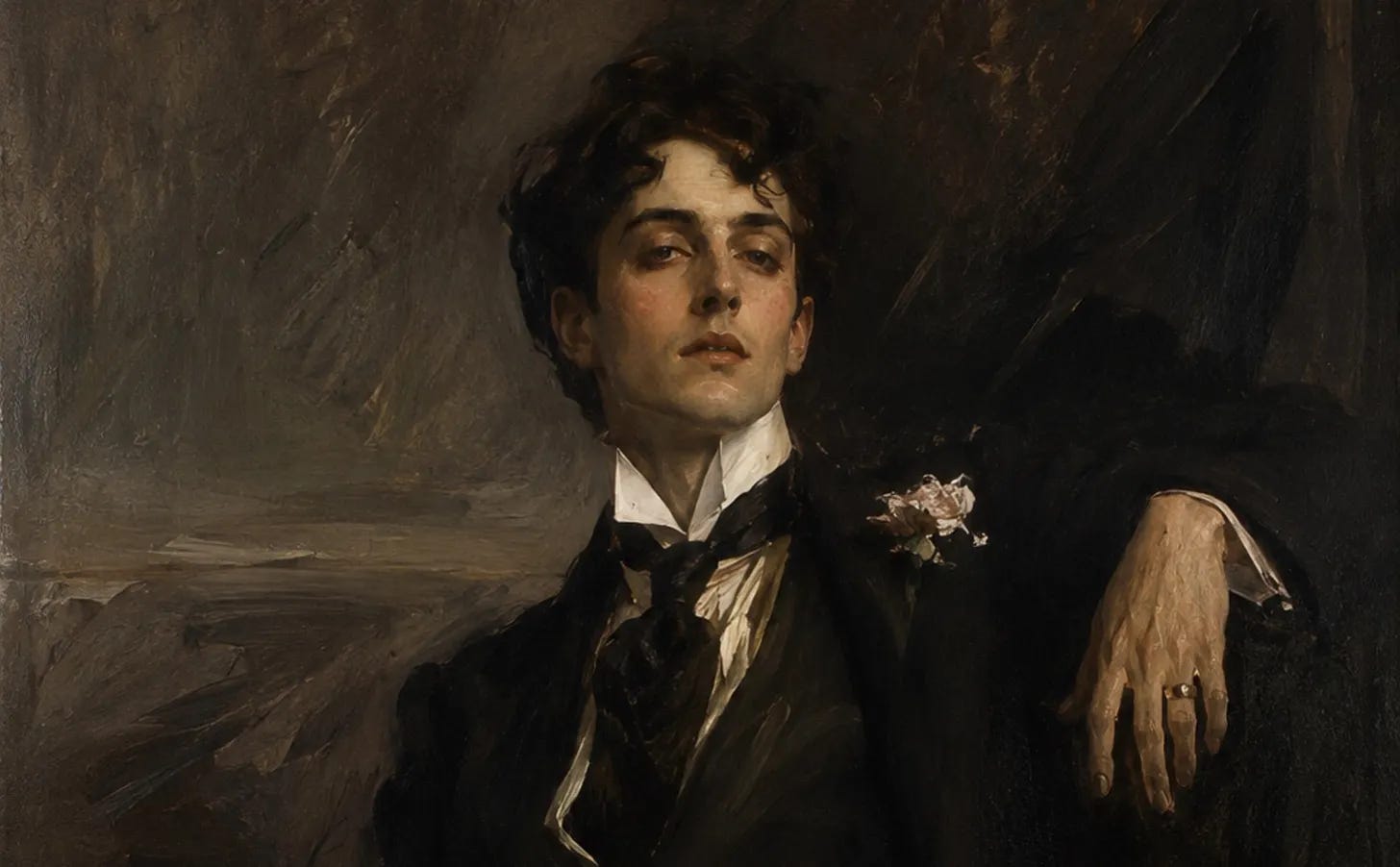
The studio was filled with the rich smell of roses.
Whenever the warm summer breeze moved through the trees outside, the scent of lilac drifted through the open door, mixed with the softer perfume of pink-flowering hawthorn.
Lord Henry Wotton lay comfortably on a sofa covered with Persian saddle-bags, smoking one cigarette after another, as he often did.
From where he was lying, he could see the golden-yellow flowers of a laburnum tree outside. Its thin branches seemed almost unable to support the weight of so much brilliant color.
Every now and then, the shadows of birds flying past crossed the long silk curtains in front of the enormous window. For a moment, the effect reminded Lord Henry of Japanese paintings, in which artists somehow managed to suggest movement even though the images themselves were still.
Outside, bees moved heavily through the long, uncut grass and circled around the dusty golden flowers of the climbing plants.
Their constant buzzing somehow made the silence feel even deeper.
Far away, London could be heard as a low, continuous roar, almost like the deep background note of a distant organ.
In the center of the studio stood a full-length portrait on an easel.
It showed an extraordinarily handsome young man.
A short distance away sat the artist who had painted it, Basil Hallward.
Years later, Basil’s sudden disappearance would cause enormous public interest and endless speculation.
Now, however, Basil simply sat looking at his finished work.
As he studied the beautiful figure he had painted, a smile of satisfaction appeared on his face.
For a moment, it seemed as though the smile would remain.
Then suddenly Basil stood.
He closed his eyes and pressed his fingers against his eyelids, almost as though he were trying to trap some beautiful dream inside his mind before it disappeared.
“It’s your best work, Basil,” Lord Henry said lazily.
“The best thing you’ve ever painted.”
He looked at the portrait again.
“You absolutely must send it to the Grosvenor Gallery next year.
“The Royal Academy is far too large and vulgar.
“Whenever I go there, either there are so many people that I can’t see the paintings, which is terrible, or there are so many paintings that I can’t see the people, which is even worse.
“The Grosvenor is really the only place for it.”
“I don’t think I’ll send it anywhere,” Basil replied.
He threw his head back in the strange way that had amused his friends when he was at Oxford.
“No.
“I’m not going to exhibit it.”
Lord Henry raised his eyebrows.
Blue smoke from his cigarette curled slowly around him.
“Not exhibit it?
“My dear Basil, why not?
“Do you actually have a reason?”
He looked amused.
“You painters are extraordinary.
“You spend your entire lives trying to become famous, and the moment you become famous, you start trying to destroy your reputation.”
Harry smiled.
“It’s very foolish.
“There is only one thing worse than people talking about you.
“And that is people not talking about you.”
He pointed toward the portrait.
“A painting like that would put you far above every young painter in England.
“And it would make all the older painters terribly jealous—assuming old men are still capable of feeling anything.”
“I know you’re going to laugh at me,” Basil replied.
“But I really can’t exhibit it.
“I’ve put too much of myself into it.”
Lord Henry stretched out on the sofa and laughed.
“Yes, I knew you would laugh.
“But it’s true.”
“Too much of yourself?”
Harry looked at the painting.
“Honestly, Basil, I had no idea you were so vain.”
He glanced between Basil and the portrait.
“I can’t see the slightest resemblance.”
Basil had a strong, rough face and dark hair.
The young man in the portrait looked delicate and beautiful, almost as though he had been made from ivory and rose petals.
“My dear Basil, this young man looks like Adonis.
“Or Narcissus.”
Harry smiled.
“You, on the other hand, have an intelligent-looking face.
“Which is quite different.”
Then he began one of his theories.
“True beauty ends where an intellectual expression begins.
“Thinking exaggerates the face.
“The moment a person begins seriously thinking, he becomes all forehead or all nose or something equally unattractive.”
Lord Henry continued:
“Look at successful men in any intellectual profession.
“They’re usually horribly ugly.”
He paused.
“Except clergymen, of course.
“But clergymen don’t think.”
A bishop, Harry explained, often continued repeating at eighty exactly what he had been taught to say at eighteen.
“Naturally, that keeps him looking charming.”
Harry looked again at the portrait.
“Your mysterious young friend—whose name you still haven’t told me—clearly never thinks.
“I’m absolutely certain of that.”
He smiled.
“He’s simply a beautiful creature without a brain.
“You should keep him here during the winter when there are no flowers to look at.
“And you should keep him here in summer when you need something to cool your intelligence.”
Then he added:
“But don’t flatter yourself, Basil.
“You don’t look anything like him.”
“You don’t understand me, Harry,” Basil replied.
“Of course I don’t look like him.
“I know that perfectly well.”
In fact, Basil said, he would not want to possess Dorian’s extraordinary beauty.
Harry shrugged.
“I’m serious,” Basil continued.
“There is something dangerous about being exceptional—whether physically or intellectually.”
Throughout history, Basil said, people who were unusually gifted or unusually beautiful often seemed to suffer because of it.
“It’s better not to be too different from everyone else.”
He believed ugly and stupid people had certain advantages.
“They can sit comfortably and watch life happen.”
They might never experience great victory.
But they also avoided the pain of great defeat.
“They live the way perhaps all of us should live.
“Calmly.
“Indifferently.
“Without anxiety.”
They did not destroy others, Basil said, and others usually did not destroy them.
Then he looked at Harry.
“Your rank and money, Harry.
“My intelligence, if I have any.
“My art, whatever it may be worth.
“And Dorian Gray’s beauty.
“We will all suffer because of whatever gifts life has given us.
“And we may suffer terribly.”
Lord Henry immediately looked toward Basil.
“Dorian Gray?
“So that’s his name?”
“Yes.
“That’s his name.
“I didn’t mean to tell you.”
“Why not?”
Basil hesitated.
“I can’t really explain it.”
When Basil truly liked someone, he said, he avoided telling other people their name.
“It feels like giving part of them away.”
He had become strangely fond of secrecy.
“Secrecy may be the only thing left that can make modern life mysterious.”
Even an ordinary thing could become interesting if one kept it secret.
“When I leave London now, I never tell my servants where I’m going.
“If I told them, half the pleasure would disappear.”
Basil admitted the habit was probably foolish.
“But somehow it makes life feel more romantic.”
He looked at Harry.
“You probably think I’m ridiculous.”
“Not at all,” Lord Henry replied.
“You’re forgetting that I’m married.”
Harry smiled.
“The great advantage of marriage is that it makes deception absolutely necessary for both husband and wife.”
He said he never knew where his wife was.
And she never knew what he was doing.
“When we happen to meet—which occasionally happens at dinner parties or country houses—we tell each other the most absurd lies with completely serious expressions.”
His wife was much better at lying than he was.
“She never gets confused about dates.
“I always do.”
But even when she caught Harry lying, she never became angry.
“Sometimes I wish she would.
“She only laughs.”
“I hate the way you talk about your marriage, Harry,” Basil said.
He walked toward the garden door.
“I actually believe you’re a very good husband.
“You’re simply ashamed of your own virtues.”
Basil smiled.
“You’re a strange man.
“You never say anything moral.
“And yet you never seem to do anything truly wrong.
“Your cynicism is mostly an act.”
“Being natural is also an act,” Lord Henry replied, laughing.
“And it is the most irritating act I know.”
The two men walked out into the garden.
They sat together on a long bamboo bench beneath a tall laurel bush.
Sunlight moved across the shining leaves.
Small white daisies trembled in the grass.
After a short silence, Lord Henry looked at his watch.
“I’m afraid I should leave soon, Basil.”
Then he added:
“But before I go, I insist that you answer a question I asked you earlier.”
“What question?” Basil asked, staring at the ground.
“You know perfectly well.”
“I don’t.”
“Fine.
“I’ll tell you.”
Lord Henry looked directly at him.
“I want you to explain why you refuse to exhibit Dorian Gray’s portrait.
“I want the real reason.”
“I already gave you the real reason.”
“No.
“You told me there was too much of yourself in the painting.
“That’s childish.”
Basil finally looked Harry directly in the face.
“Every portrait painted with real feeling is actually a portrait of the artist.
“Not the person sitting for it.”
The sitter, Basil explained, merely gives the artist an opportunity.
“The painter is the person who is truly revealed.”
The face on the canvas may belong to someone else.
But the emotions behind the painting belong to the artist.
“The reason I refuse to exhibit this portrait is that I’m afraid I’ve revealed the secret of my own soul in it.”
Lord Henry laughed.
“And what secret is that?”
“I’ll tell you,” Basil replied.
But his face suddenly looked uncertain.
Harry watched him with interest.
“I’m waiting.”
“There really isn’t much to tell.
“And I’m not sure you’ll understand.”
Basil hesitated.
“Perhaps you won’t even believe me.”
Lord Henry smiled and bent down.
He picked a small daisy from the grass and began studying it.
“I’m sure I’ll understand.
“And as for believing you, I can believe almost anything as long as it’s completely unbelievable.”
A breeze shook some of the flowers from the trees.
Large clusters of lilac moved slowly in the warm air.
A grasshopper began chirping near the wall.
A thin blue dragonfly floated past on delicate wings.
Harry almost felt as though he could hear Basil’s heart beating.
He waited.
Finally, Basil began.
“The story is simple.
“About two months ago, I went to a crowded party at Lady Brandon’s.”
He explained that artists occasionally had to appear in fashionable society simply to remind people that they were civilized.
“As you once told me, Harry, an evening suit and a white tie can make almost anyone look civilized.
“Even a stockbroker.”
Basil had been at the party for about ten minutes.
He was speaking with heavily dressed older women and boring members of the Royal Academy.
“Then suddenly I became aware that someone was watching me.”
Basil turned.
And that was the first time he saw Dorian Gray.
“The moment our eyes met, I felt myself becoming pale.”
A strange fear came over him.
He immediately sensed that Dorian possessed an extraordinarily powerful personality.
“If I allowed him to influence me, I felt that he could absorb my whole nature.
“My soul.
“My art.”
Basil did not want anyone else to have that kind of power over his life.
“You know how independent I’ve always been, Harry.”
Until he met Dorian, Basil believed he had always been in control of himself.
“Then I met him.”
Basil struggled to explain.
“I felt as though I were standing at the beginning of some enormous crisis in my life.”
Some instinct told him that fate was preparing both extraordinary happiness and extraordinary suffering for him.
“I became frightened.”
So Basil decided to leave the party.
“It wasn’t conscience.
“It was probably cowardice.”
Lord Henry interrupted.
“Conscience and cowardice are basically the same thing, Basil.
“Conscience is simply the official business name.”
“I don’t believe that.
“And I don’t believe you really believe it either.”
Whatever his reason, Basil tried to reach the door.
Perhaps pride was part of it.
He had always been proud.
But just as he was about to escape, he ran directly into Lady Brandon.
“‘You aren’t leaving already, Mr. Hallward?’ she practically screamed.”
Basil asked Harry whether he remembered Lady Brandon’s strange, high voice.
“Yes,” Harry replied.
“She is like a peacock in every respect except beauty.”
He pulled petals from the daisy as he spoke.
Basil continued.
Lady Brandon refused to let him leave.
She dragged him around the room and introduced him to royalty, decorated officials, and elderly women wearing enormous jewels.
“She called me one of her closest friends.
“I had only met her once before.”
At that time, one of Basil’s paintings had recently become successful.
At least, newspapers were talking about it.
“And newspaper attention is apparently the modern version of immortality.”
Then suddenly Lady Brandon brought Basil face to face with Dorian Gray.
They stood very close together.
Their eyes met again.
Basil could not resist.
He asked Lady Brandon to introduce them.
“Perhaps it wasn’t really a choice.
“I think it was inevitable.”
Basil believed that even without an introduction, he and Dorian would eventually have spoken.
“Dorian later told me he felt the same thing.
“He believed we were somehow meant to meet.”
Lord Henry looked amused.
“And how did Lady Brandon describe this extraordinary young man?
“She always gives people a quick summary of every guest.”
Harry remembered Lady Brandon once introducing him to an angry-looking older man covered with medals.
She had whispered extremely personal information about the man in a voice loud enough for half the room to hear.
“I escaped immediately.”
Harry preferred discovering people himself.
“Lady Brandon treats human beings the way auctioneers treat objects.
“She either explains them so completely that there’s nothing left to discover, or she tells you everything except the one thing you actually want to know.”
“You’re too hard on her, Harry,” Basil said.
“My dear Basil, she tried to create a fashionable intellectual salon.
“She ended up creating a restaurant.
“How could I admire her?”
Harry returned to the subject.
“So what did she say about Dorian Gray?”
Basil tried to imitate Lady Brandon:
“Something like, ‘Charming boy—his poor mother and I were inseparable—can’t remember what he does—probably nothing—oh yes, he plays the piano—or perhaps the violin, Mr. Gray?’”
Basil smiled.
“Dorian and I both started laughing.
“And that’s how we became friends.”
“Laughter is a very good beginning for a friendship,” Lord Henry said.
“And probably the best possible ending.”
Basil shook his head.
“You don’t understand friendship, Harry.
“Or hatred either.”
Then he added:
“You like everyone.
“Which really means you care about no one.”
“How terribly unfair!”
Lord Henry leaned back and looked at the small white clouds moving through the blue summer sky.
“I make enormous distinctions between people.”
He explained his system.
“I choose my friends because they’re beautiful.
“I choose my acquaintances because they’re respectable.
“And I choose my enemies because they’re intelligent.”
A person could not be too careful when choosing enemies.
“I don’t have a single stupid enemy.
“They’re all intelligent enough to understand me.”
Harry smiled.
“That sounds terribly vain, doesn’t it?
“I think it probably is.”
“According to your system, I’m only an acquaintance.”
“My dear Basil, you’re much more than an acquaintance.”
“And much less than a friend.
“Perhaps I’m like a brother?”
“Oh, brothers.”
Harry looked disappointed.
“I don’t particularly care for brothers.
“My older brother refuses to die.
“And my younger brothers seem to do practically nothing else.”
“Harry!” Basil protested.
“My dear fellow, I’m not completely serious.”
But Harry admitted that he disliked relatives.
“Perhaps it’s because none of us can stand seeing our own faults in someone else.”
He then joked about society and class, saying ordinary people often became angry when aristocrats behaved badly because they wanted certain faults to belong exclusively to themselves.
Basil frowned.
“I don’t agree with a single thing you’ve said.
“And I’m certain you don’t believe it either.”
Lord Henry stroked his beard.
“How English you are, Basil.”
This was already the second time Basil had said Harry did not believe his own ideas.
“When someone gives an Englishman an idea—which is always dangerous—the Englishman never asks whether the idea is true.”
Instead, he asks whether the speaker sincerely believes it.
“But the truth of an idea has nothing to do with the sincerity of whoever says it.”
In fact, Harry argued, an idea might be more intellectually pure when the person expressing it did not personally believe it.
Then Harry waved the subject away.
“I don’t want to discuss politics or philosophy with you.
“I prefer people to principles.
“And I prefer people with no principles most of all.”
He returned to Dorian.
“Tell me more about him.
“How often do you see him?”
“Every day.”
Basil answered without hesitation.
“I wouldn’t be happy if I didn’t see him every day.
“He has become necessary to me.”
“How extraordinary.
“I thought the only thing you would ever truly care about was your art.”
“He is my art now,” Basil said seriously.
Then he tried to explain what Dorian had done to his creativity.
“There are perhaps only two truly important moments in the history of art.
“One is when artists discover a new material or technique.
“The other is when they discover a new personality.”
The invention of oil paint had transformed Venetian painting.
Certain beautiful human faces had transformed Greek sculpture.
“And Dorian Gray’s face may do something similar for my work.”
Basil did not mean merely that he painted and sketched Dorian.
He had certainly done that.
“But he is much more than a model.”
Basil did not believe Dorian’s beauty was beyond art.
Nothing was beyond art.
And Basil knew that the paintings he had made since meeting Dorian were the best work of his career.
“But somehow his personality gave me an entirely new way of seeing things.”
He saw shape differently.
He saw color differently.
He thought differently.
“I can recreate life in a way I never could before.”
Dorian’s simple presence gave Basil artistic inspiration.
“Even when he does nothing.”
Basil remembered one particular landscape painting.
A dealer had offered him a large amount of money for it, but Basil refused to sell.
“It is one of the best things I have ever painted.”
And the reason, Basil believed, was that Dorian had simply been sitting beside him while he worked.
“Something passed from him into me.”
For the first time, Basil saw something extraordinary in an ordinary landscape that he had always been searching for but had never found.
Lord Henry became even more interested.
“Basil, this is extraordinary.
“I absolutely have to meet Dorian Gray.”
Basil stood and began walking slowly through the garden.
After a while, he returned.
“Harry, Dorian Gray is simply an artistic inspiration to me.
“You might meet him and see nothing unusual.
“I see everything.”
Basil said Dorian was often most strongly present in his paintings when Basil had not painted Dorian at all.
His influence appeared in the curve of a line.
In a particular color.
In a particular feeling.
“That’s all.”
“Then why won’t you exhibit his portrait?”
“Because without meaning to, I put something of this worship into the painting.”
Basil had never told Dorian about his feelings.
“Dorian knows nothing about it.
“And he never will.”
But Basil feared that other people might look at the portrait and understand.
“I won’t expose my soul to strangers.”
He did not want the public examining his private emotions.
“There is too much of me in that portrait, Harry.
“Far too much.”
“Poets aren’t as careful as you are,” Lord Henry replied.
“They understand how useful emotion is when trying to sell books.
“A broken heart can produce several successful editions.”
“I hate that,” Basil said.
“An artist should create beautiful things.
“But he should not put his own personal life directly into them.”
Basil believed modern people treated art too much like autobiography.
“We have forgotten pure beauty.”
One day Basil hoped to show the world what beauty could be.
“And that is exactly why the world will never see my portrait of Dorian Gray.”
“I think you’re wrong.
“But I won’t argue.
“Only intellectually lost people argue.”
Harry then asked:
“Does Dorian care about you as much as you care about him?”
Basil hesitated.
“He likes me.
“I know he does.”
Basil admitted that he constantly praised Dorian.
Sometimes he even enjoyed saying things that he later regretted saying.
“Usually, he’s charming.
“We sit together in the studio and talk about everything.”
But sometimes Dorian could be thoughtless.
He could even seem to enjoy hurting Basil.
“At those moments, I feel as though I have given my entire soul to someone who treats it like a flower to wear in his coat.
“Something decorative.
“Something that exists only to satisfy his vanity for an afternoon.”
“Summer afternoons can last a surprisingly long time, Basil,” Lord Henry replied.
“Perhaps you’ll become tired of him before he becomes tired of you.”
Harry said intelligence or artistic talent often lasted longer than physical beauty.
That was why modern people tried so hard to educate themselves.
They wanted something about themselves that might survive.
“But the perfectly informed modern person is a terrible thing.”
Harry compared such a mind to a cluttered antique shop filled with dust and ugly objects, all valued much too highly.
Still, he believed Basil would eventually become tired of Dorian.
“One day you’ll look at him and think something about him is slightly wrong.
“Perhaps his face won’t seem quite as perfect.
“Perhaps you’ll dislike the way he speaks.”
Basil would secretly resent Dorian.
The next time Dorian came to visit, Basil would be colder.
“That would be unfortunate.
“It would change you.”
Harry described Basil’s attachment to Dorian as a romance.
“A romance of art.”
And the worst thing about romance, he said, was that once it ended, it left people much less romantic than before.
“Don’t say that, Harry.”
Basil was serious.
“As long as I live, Dorian Gray’s personality will dominate me.”
Then he accused Harry:
“You could never understand.
“You change too often.”
“My dear Basil, that is exactly why I understand.”
Harry smiled.
“Faithful people only understand the ordinary part of love.
“Unfaithful people are the ones who understand its tragedies.”
Lord Henry lit another cigarette.
He looked extremely pleased with his own sentence.
Sparrows moved noisily through the ivy.
Blue shadows from clouds moved over the grass.
Harry thought about how pleasant the garden was.
And how much more interesting other people’s emotions were than their opinions.
A person’s own soul and the passions of one’s friends—that was what made life worth studying.
Harry remembered that he had skipped lunch with his aunt to stay with Basil.
He was delighted.
If he had gone to his aunt’s house, the conversation would probably have been about helping poor people and improving housing.
Rich people would have spoken about the importance of saving money.
Lazy people would have praised hard work.
Everyone would have recommended virtues they had no need to practice themselves.
Harry was pleased he had escaped.
Then suddenly he remembered something.
“My dear Basil, I’ve just remembered.”
“Remembered what?”
“Where I heard Dorian Gray’s name before.”
Basil frowned slightly.
“Where?”
“Don’t look so worried.”
Harry explained that his aunt, Lady Agatha, had mentioned Dorian.
She had recently discovered a wonderful young man who wanted to help her with charity work in the East End.
“And his name was Dorian Gray.”
Harry admitted that his aunt had never mentioned Dorian’s beauty.
“Good women have almost no understanding of beauty.”
Lady Agatha had said Dorian was very serious and possessed an excellent nature.
From that description, Harry had imagined a completely different person.
“I pictured someone with glasses, long untidy hair, freckles, and enormous feet.”
He smiled.
“I wish I had known she meant your friend.”
“I’m very glad you didn’t.”
“Why?”
“I don’t want you to meet him.”
Lord Henry stared at him.
“You don’t want me to meet Dorian Gray?”
“No.”
At that exact moment, Basil’s servant entered the garden.
“Mr. Dorian Gray is in the studio, sir.”
Lord Henry laughed.
“Well, now you have to introduce us.”
Basil turned toward the servant.
“Ask Mr. Gray to wait, Parker.
“I’ll be there in a moment.”
The servant walked away.
Then Basil looked seriously at Lord Henry.
“Dorian Gray is my dearest friend.”
He spoke slowly.
“He has a simple and beautiful nature.
“Your aunt was right about him.”
Then Basil made Harry promise something.
“Don’t spoil him.
“Don’t try to influence him.
“Your influence would be bad for him.”
Basil reminded Harry that the world was enormous.
There were countless fascinating people he could meet.
“So don’t take away the one person who gives my art whatever beauty it has.”
Basil’s voice became emotional.
“My life as an artist depends on him.”
Then he looked directly at Lord Henry.
“Harry, remember this.
“I trust you.”
The words seemed difficult for Basil to say.
Lord Henry only smiled.
“What nonsense you talk.”
He took Basil by the arm.
Then the two men walked back toward the house to meet Dorian Gray.