


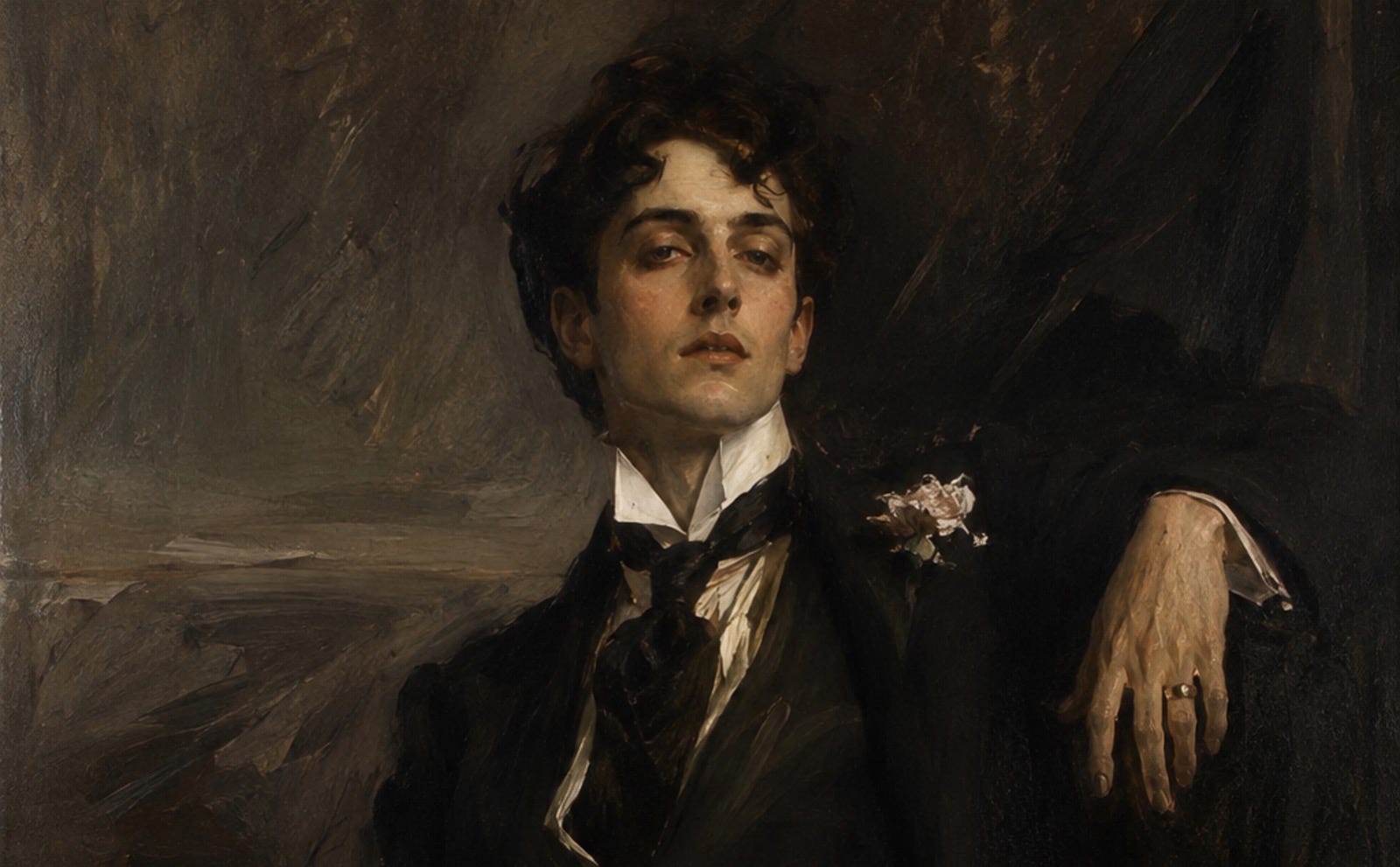
“There’s no point telling me you’re going to become good,” cried Lord Henry, dipping his pale fingers into a red copper bowl filled with rose water. “You’re already perfect. Please don’t change.”
Dorian Gray shook his head. “No, Harry. I’ve done too many terrible things in my life. I’m not going to do any more. I started doing good yesterday.”
“Where were you yesterday?”
“In the country, Harry. I was staying alone at a little inn.”
“My dear boy,” said Lord Henry with a smile, “anyone can be good in the country. There are no temptations there. That’s exactly why people who live outside the city are so completely uncivilized. Civilization isn’t at all easy to achieve. There are only two ways a person can reach it: through culture or through corruption. Country people have no opportunity for either, so they simply stagnate.”
“Culture and corruption,” Dorian repeated. “I’ve known something of both. It seems terrible to me now that the two should ever exist together. I have a new ideal, Harry. I’m going to change. In fact, I think I already have.”
“You still haven’t told me what your good deed was. Or did you say there was more than one?” his companion asked, tipping a small crimson pyramid of hulled strawberries onto his plate and dusting them with white sugar through a perforated spoon shaped like a shell.
“I can tell you, Harry. It isn’t a story I could tell anyone else. I spared someone. That sounds conceited, but you know what I mean. She was very beautiful, and she looked remarkably like Sibyl Vane. I think that was what first attracted me to her. You remember Sibyl, don’t you? How long ago all that seems now.
“Well, Hetty wasn’t from our social class, of course. She was simply a village girl. But I really loved her. I’m certain I did. During this wonderful May we’ve been having, I used to go down and see her two or three times a week. Yesterday she met me in a little orchard. Apple blossoms kept falling into her hair, and she was laughing. We were supposed to run away together at dawn this morning. Then suddenly I decided to leave her as innocent and untouched as I had found her.”
“I imagine the novelty of feeling something like that must have given you a genuine thrill, Dorian,” Lord Henry interrupted. “But I can finish your little romance for you. You gave her some good advice and broke her heart. And that was the beginning of your moral reform.”
“Harry, you’re horrible! You mustn’t say things like that. Hetty’s heart isn’t broken. Of course she cried and all that, but she hasn’t been disgraced. She can go on living like Perdita in her garden of mint and marigolds.”
“And crying over an unfaithful Florizel,” said Lord Henry, laughing as he leaned back in his chair. “My dear Dorian, you have the strangest boyish moods. Do you really think that girl will ever be satisfied now with someone from her own class? I suppose one day she’ll marry some rough cart driver or grinning farmhand.
“But because she met you and loved you, she’ll learn to look down on her husband, and she’ll be miserable. From a moral point of view, I can’t say I’m very impressed by your great act of self-denial. Even as a beginning, it’s rather poor. Besides, how do you know Hetty isn’t floating right now in some moonlit millpond, surrounded by beautiful water lilies, like Ophelia?”
“I can’t stand this, Harry! You make fun of everything, and then you suggest the most awful tragedies. I’m sorry I told you. I don’t care what you say to me. I know I did the right thing. Poor Hetty! When I rode past the farm this morning, I saw her pale face at the window, like a spray of jasmine.
“Please, let’s not talk about it anymore. And don’t try to convince me that the first good thing I’ve done in years—the first small act of self-sacrifice I’ve ever made—is actually some kind of sin. I want to be better. I’m going to be better.
“Tell me something about yourself. What’s happening in town? I haven’t been to the club for days.”
“People are still talking about poor Basil’s disappearance.”
“I would have thought they’d be tired of that by now,” said Dorian, pouring himself some wine and frowning slightly.
“My dear boy, they’ve only been talking about it for six weeks, and the British public simply isn’t capable of the mental effort required to think about more than one subject every three months.
“They’ve been very fortunate lately, though. They’ve had my divorce case and Alan Campbell’s suicide. Now they have the mysterious disappearance of an artist.
“Scotland Yard still insists that the man in the gray overcoat who took the midnight train to Paris on the ninth of November was poor Basil, while the French police insist that Basil never arrived in Paris at all. I suppose that in another two weeks we’ll be told he’s been spotted in San Francisco.
“It’s strange, but everyone who disappears is eventually reported to have been seen in San Francisco. It must be a delightful city. Apparently it has all the attractions of the next world.”
“What do you think happened to Basil?” Dorian asked, holding his glass of Burgundy up to the light and wondering how he could discuss the subject so calmly.
“I haven’t the slightest idea. If Basil decided to disappear, it’s none of my business. If he’s dead, I don’t want to think about him. Death is the only thing that truly terrifies me. I hate it.”
“Why?” the younger man asked wearily.
“Because,” said Lord Henry, lifting a small gilt vinaigrette box beneath his nose, “these days one can survive almost anything except death. Death and vulgarity are the only two realities of the nineteenth century that no one can explain away.
“Let’s have our coffee in the music room, Dorian. You must play Chopin for me. The man my wife ran away with played Chopin beautifully.
“Poor Victoria! I was very fond of her. The house feels rather lonely without her. Of course, married life is really nothing more than a habit—a bad habit. But one misses even one’s worst habits when they’re gone. Perhaps one misses those most of all. They become such an essential part of who we are.”
Dorian said nothing. He got up from the table, walked into the next room, sat down at the piano, and let his fingers wander over the black and white keys.
When the coffee had been brought in, he stopped playing and looked across at Lord Henry.
“Harry, did you ever consider that Basil might have been murdered?”
Lord Henry yawned. “Basil was very popular, and he always wore a Waterbury watch. Why would anyone murder him? He wasn’t clever enough to have enemies.
“Of course, he had an extraordinary gift for painting. But a man can paint like Velázquez and still be terribly boring. And Basil really was rather boring.
“He only truly interested me once, years ago, when he told me that he worshipped you with a kind of wild devotion and that you were the central inspiration behind his art.”
“I was very fond of Basil,” said Dorian, sadness entering his voice. “But don’t people say he was murdered?”
“Oh, some of the newspapers do. It doesn’t seem very likely to me. I know there are dreadful places in Paris, but Basil wasn’t the sort of man who would have gone to them. He had no curiosity. That was his greatest flaw.”
“What would you say, Harry, if I told you that I murdered Basil?” the younger man asked.
After saying it, he watched Lord Henry closely.
“I would say, my dear fellow, that you were trying to play a role that doesn’t suit you. Crime is vulgar, just as vulgarity is a kind of crime.
“You simply aren’t capable of murder, Dorian. I’m sorry if that wounds your vanity, but I assure you it’s true.
“Crime belongs entirely to the lower classes. I don’t blame them in the slightest. I imagine crime is to them what art is to us: simply a way of experiencing extraordinary sensations.”
“A way of experiencing sensations? Do you really think that a man who had committed murder once could commit the same crime again? Don’t tell me that.”
“Oh, anything becomes enjoyable if you do it often enough,” cried Lord Henry, laughing. “That’s one of the great secrets of life.
“Still, I imagine murder is always a mistake. One should never do anything one can’t talk about afterward over dinner.
“But let’s stop talking about poor Basil. I wish I could believe he had met such a wonderfully romantic end as the one you’re suggesting, but I can’t.
“I expect he fell into the Seine from an omnibus and the conductor covered the whole thing up to avoid a scandal. Yes, that’s probably how he ended.
“I can picture him now, lying on his back beneath that dull green water, with heavy barges drifting above him and long weeds tangled in his hair.
“You know, I don’t think he would have produced much more good work anyway. His painting had declined terribly over the last ten years.”
Dorian sighed.
Lord Henry wandered across the room and began stroking the head of an unusual Java parrot, a large gray-feathered bird with a pink crest and tail, balancing on a bamboo perch. As his narrow fingers touched it, the bird lowered its pale, wrinkled eyelids over its dark, glassy eyes and began swaying backward and forward.
“Yes,” Lord Henry continued, turning around and taking a handkerchief from his pocket. “His painting had definitely declined. It seemed to me that something had disappeared from it. He had lost his ideal.
“When you and he stopped being close friends, he stopped being a great artist.
“What came between the two of you? I suppose he bored you. If he did, I’m sure he never forgave you. Boring people never forgive anyone for being bored by them.
“By the way, whatever happened to that wonderful portrait he painted of you? I don’t think I’ve seen it since he finished it.
“Oh, yes! I remember you telling me years ago that you’d sent it down to Selby and that it had been lost or stolen on the way. You never got it back?
“What a shame. It really was a masterpiece. I remember wanting to buy it. I wish I had.
“It belonged to Basil’s best period. After that, his work became that strange mixture of bad painting and good intentions that always qualifies a man to be called a representative British artist.
“Did you advertise for it? You should have.”
“I don’t remember,” said Dorian. “I suppose I did. But I never really liked it. I regret sitting for it. Even the memory of it is hateful to me.
“Why are you talking about it?
“It used to remind me of those strange lines from some play—Hamlet, I think. How do they go?
“Like a portrait of sorrow,
A face without a heart.”
“Yes. That’s what it was like.”
Lord Henry laughed. “If a man turns his life into a work of art, then his mind becomes his heart,” he replied, sinking into an armchair.
Dorian Gray shook his head and played a few soft chords on the piano.
“‘Like a portrait of sorrow,’” he repeated, “‘a face without a heart.’”
The older man leaned back and studied him through half-closed eyes.
“By the way, Dorian,” he said after a pause, “what good is it for a man to gain the whole world and lose—how does that quotation go?—his own soul?”
The music broke harshly.
Dorian Gray jumped and stared at his friend.
“Why are you asking me that, Harry?”
“My dear fellow,” said Lord Henry, raising his eyebrows in surprise, “I asked because I thought you might be able to answer it. That’s all.
“I was walking through the park last Sunday, and near Marble Arch there was a little crowd of shabby-looking people gathered around some crude street preacher.
“As I passed, I heard the man shouting that question at his audience. I thought it was rather dramatic.
“London is full of strange scenes like that. A wet Sunday. An uncultured Christian in a raincoat. A circle of pale, unhealthy faces beneath a broken roof of dripping umbrellas. And then this magnificent phrase hurled into the air by a shrill, hysterical voice.
“In its own way, it was really very effective. Quite suggestive.
“I thought about telling the prophet that art has a soul, but mankind doesn’t. I’m afraid he wouldn’t have understood me, though.”
“Don’t, Harry. The soul is a terrifying reality. It can be bought and sold and traded away. It can be poisoned, or it can be perfected. Every one of us has a soul. I know we do.”
“Are you completely sure of that, Dorian?”
“Completely.”
“Ah! Then it must be an illusion. The things we feel absolutely certain about are never true. That’s the tragedy of faith and the lesson of romance.
“How serious you’ve become! Don’t be so solemn. What do you or I have to do with the superstitions of our age? No, we’ve given up believing in the soul.
“Play something for me. Play a nocturne, Dorian. And while you’re playing, tell me quietly how you’ve managed to stay young.
“You must have some secret. I’m only ten years older than you, and I’m wrinkled, exhausted, and yellow. You’re extraordinary, Dorian. You’ve never looked more beautiful than you do tonight.
“You remind me of the first day I saw you. You were a little insolent, terribly shy, and absolutely remarkable.
“You’ve changed, of course—but not in appearance.
“I wish you’d tell me your secret. I would do anything in the world to get my youth back—except exercise, get up early, or behave respectably.
“Youth! There’s nothing else like it.
“It’s ridiculous when people talk about the ignorance of the young. These days, the only people whose opinions I listen to with any respect are people much younger than I am. They seem to be ahead of me. Life has already shown them its newest wonder.
“As for old people, I always disagree with them. I make a point of it. Ask them what they think about something that happened yesterday and they’ll solemnly repeat opinions from 1820, when people wore stiff high neckcloths, believed everything, and knew absolutely nothing.
“How beautiful that piece you’re playing is!
“I wonder whether Chopin wrote it in Majorca, with the sea crying around the villa and salt spray striking the windows. It’s wonderfully romantic.
“What a blessing that we still have one art form that doesn’t imitate anything!
“Don’t stop. I want music tonight.
“It seems to me that you are the young Apollo and I am Marsyas listening to you.
“I have sorrows of my own, Dorian—sorrows even you know nothing about.
“The tragedy of growing old isn’t that one becomes old. It’s that one remains young inside.
“Sometimes I astonish myself with my own sincerity.
“Ah, Dorian, how fortunate you are! What an exquisite life you’ve had. You’ve tasted everything deeply. You’ve crushed the grapes against your own palate. Nothing has been kept from you.
“And yet it has all affected you no more than music does. None of it has damaged you.
“You’re still exactly the same.”
“I am not the same, Harry.”
“Yes, you are.
“I wonder what the rest of your life will be like. Don’t ruin it with acts of self-denial. Right now, you are a perfect example of what you are. Don’t make yourself incomplete. You’re flawless as you are.
“There’s no point shaking your head. You know it’s true.
“And besides, Dorian, don’t fool yourself. Life isn’t ruled by willpower or good intentions.
“Life is a matter of nerves and fibers and slowly formed cells where thoughts hide and passions dream.
“You may imagine you’re safe. You may believe you’re strong.
“But then a particular shade of color in a room or in the morning sky, a perfume you once loved that suddenly brings back half-forgotten memories, a line from a poem you’d forgotten and happen to read again, a phrase from a piece of music you haven’t played in years—I tell you, Dorian, our lives depend on things like these.
“Browning writes about it somewhere. But even if he didn’t, our senses would invent such things for us.
“There are moments when the scent of lilas blanc suddenly drifts past me, and I’m forced to relive the strangest month of my life.
“I wish I could trade places with you, Dorian.
“The world has condemned both of us, but it has always worshipped you. And it always will.
“You are exactly what this age is searching for—and what it’s terrified it may already have found.
“I’m so glad you’ve never actually created anything. You’ve never carved a statue, painted a picture, or produced anything outside yourself.
“Your life has been your art.
“You’ve turned yourself into music.
“Your days are your sonnets.”
Dorian got up from the piano and ran a hand through his hair.
“Yes, life has been exquisite,” he murmured. “But I’m not going to live the same way anymore, Harry.
“And you must stop saying these extravagant things to me.
“You don’t know everything about me. I think that if you did, even you would turn away from me.
“You’re laughing.
“Don’t laugh.”
“Why have you stopped playing, Dorian? Go back and play the nocturne for me again.
“Look at that huge honey-colored moon hanging in the darkening sky. She’s waiting for you to enchant her. If you play, she’ll come closer to the earth.
“No?
“Then let’s go to the club.
“It’s been a charming evening, and we ought to end it charmingly.
“There’s someone at White’s who desperately wants to meet you—young Lord Poole, Bournemouth’s eldest son. He’s already started copying your neckties, and he’s begged me to introduce him to you.
“He’s quite delightful, actually. He reminds me a little of you.”
“I hope not,” said Dorian, sadness in his eyes. “But I’m tired tonight, Harry. I’m not going to the club. It’s almost eleven, and I want to go to bed early.”
“Do stay. You’ve never played as beautifully as you have tonight. There was something extraordinary in your touch. I’ve never heard so much expression in it before.”
“That’s because I’m going to be good,” he replied with a smile. “I’ve already changed a little.”
“You can never change for me, Dorian,” said Lord Henry. “You and I will always be friends.”
“And yet you poisoned me once with a book. I shouldn’t forgive you for that.
“Harry, promise me you’ll never lend that book to anyone else. It does harm.”
“My dear boy, you really are becoming a moralist.
“Soon you’ll be wandering around like some newly converted preacher or revivalist, warning people about all the sins you’ve finally become tired of committing.
“You’re far too delightful for that.
“Besides, it’s pointless. You and I are what we are, and we’ll become whatever we become.
“And as for being poisoned by a book, there’s no such thing.
“Art doesn’t influence action. It destroys the desire to act. It is magnificently sterile.
“The books the world calls immoral are simply books that show the world its own shame. That’s all.
“But we won’t argue about literature.
“Come by tomorrow. I’m going riding at eleven. We could go together, and afterward I’ll take you to lunch with Lady Branksome. She’s a charming woman, and she wants your advice about some tapestries she’s thinking of buying.
“Make sure you come.
“Or perhaps we should have lunch with our little duchess? She says she never sees you anymore.
“Maybe you’ve grown tired of Gladys? I thought you would. That clever tongue of hers can get on one’s nerves.
“Well, whatever we decide, be here at eleven.”
“Do I really have to come, Harry?”
“Of course. The park is beautiful at the moment. I don’t think the lilacs have been this magnificent since the year I first met you.”
“All right. I’ll be here at eleven,” said Dorian. “Good night, Harry.”
When he reached the door, he paused for a moment, as though there were still something he wanted to say.
Then he sighed and left.