


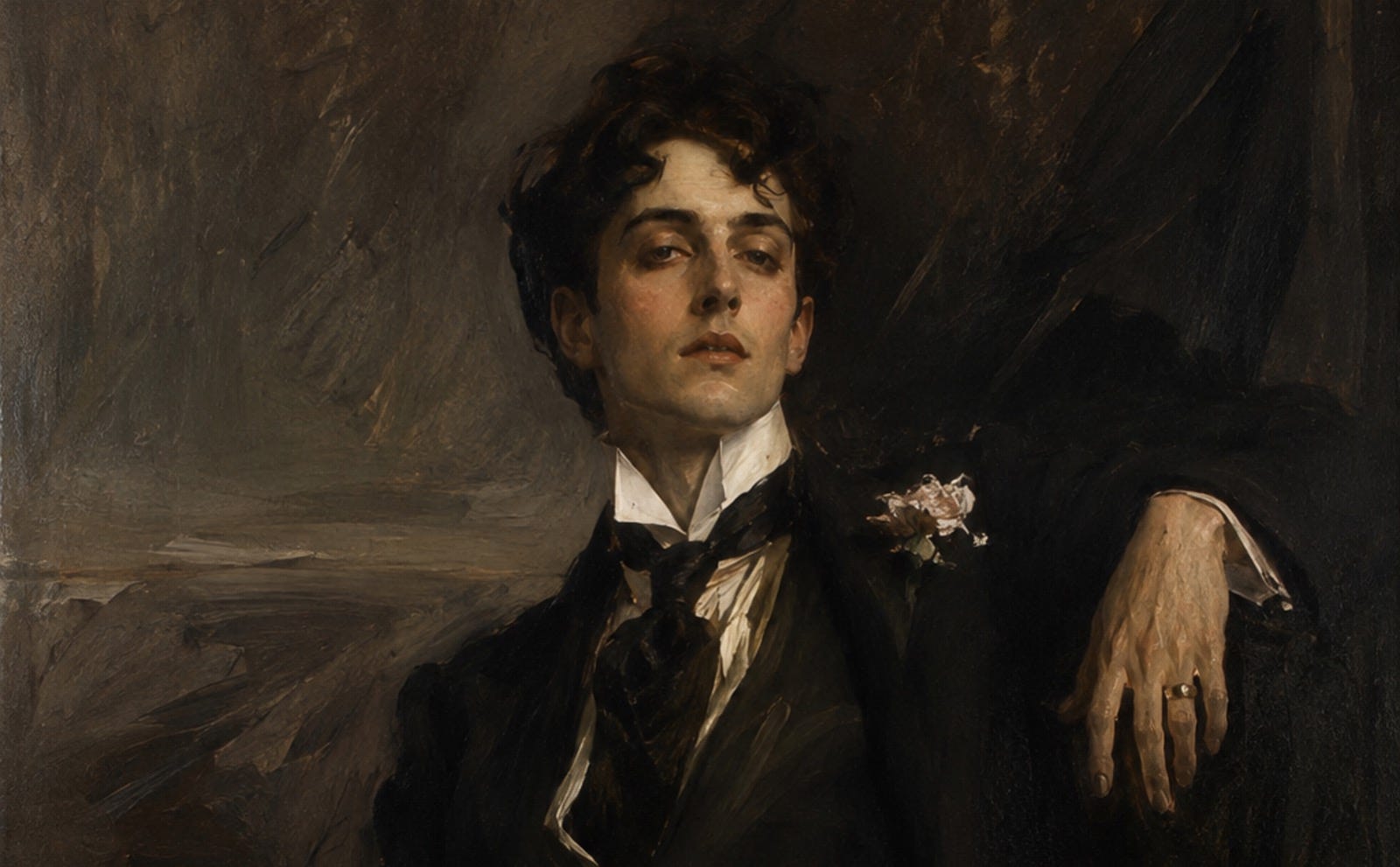
It was a beautiful night, so warm that Dorian carried his coat over one arm and did not even bother wrapping his silk scarf around his neck.
As he walked home, smoking a cigarette, two young men in evening clothes passed him. He heard one whisper to the other, “That’s Dorian Gray.”
He remembered how much he had once enjoyed being recognized—being pointed at, stared at, and talked about. Now he was tired of hearing his own name.
Part of what had made the little village he had visited so often lately so appealing was that no one there knew who he was. He had often told the girl he had persuaded to fall in love with him that he was poor, and she had believed him.
Once, he had told her that he was wicked. She had laughed and said that wicked people were always old and ugly.
What a laugh she had had—like a thrush singing.
And how pretty she had looked in her simple cotton dresses and wide-brimmed hats.
She knew nothing of the world, and yet she possessed everything he had lost.
When he reached home, he found his servant waiting up for him. Dorian sent him to bed, then threw himself onto the sofa in the library and began thinking about some of the things Lord Henry had said.
Was it really true that a person could never change?
He felt an intense longing for the untouched innocence of his childhood—for his “rose-white youth,” as Lord Henry had once called it.
He knew what he had done to himself. He had corrupted his mind and filled his imagination with terrible things. He had been a destructive influence on others, and worse, he had taken a dreadful pleasure in being one.
Of all the people whose lives had crossed his, it was the most beautiful and promising whom he had ruined.
But was everything truly beyond repair?
Was there no hope left for him?
How terrible that moment of pride and passion had been when he had wished that the portrait would carry the burden of age and sin while he himself kept the flawless beauty of eternal youth.
Everything that had gone wrong had begun with that wish.
It would have been better if every sin he committed had immediately brought its own punishment.
There was something cleansing in punishment.
Perhaps mankind’s prayer to a perfectly just God should not be, “Forgive us our sins,” but, “Punish us for what we have done.”
The strangely carved mirror Lord Henry had given him many years before stood on the table. The pale little Cupids surrounding it seemed to laugh just as they always had.
Dorian picked it up, just as he had on that terrible night when he had first noticed the change in the fatal portrait.
With wild eyes blurred by tears, he stared at his reflection in the polished glass.
Once, someone who had loved him desperately had written him a passionate letter ending with the words:
“The world is different because you are made of ivory and gold. The shape of your lips changes history.”
The words returned to him now, and he repeated them over and over in his mind.
Then suddenly he hated his own beauty.
He threw the mirror onto the floor and crushed it beneath his heel until it broke into glittering silver fragments.
His beauty had destroyed him.
His beauty, and the youth he had begged to keep forever.
Without those two things, perhaps his life might have remained clean.
His beauty had been nothing but a mask.
His youth had become a cruel joke.
And what was youth, really?
An immature, unfinished stage of life. A time of shallow emotions and unhealthy thoughts.
Why had he worn youth like a uniform for so long?
Youth had ruined him.
There was no point thinking about the past.
Nothing could change what had already happened.
He had to think about himself now, and about his future.
James Vane lay buried in an unmarked grave in the churchyard at Selby.
Alan Campbell had shot himself one night in his laboratory without ever revealing the terrible secret Dorian had forced him to learn.
The public excitement over Basil Hallward’s disappearance would soon die away completely. It was already fading.
Dorian was perfectly safe.
And strangely enough, it was not Basil Hallward’s death that weighed most heavily on his mind.
What troubled him was the living death of his own soul.
Basil had painted the portrait that had destroyed his life.
Dorian could not forgive him for that.
It was the portrait that had caused everything.
Basil had said things to him that night that had been unbearable, yet Dorian had endured them for a long time.
The murder itself had simply been a moment of madness.
And as for Alan Campbell, his suicide had been his own decision.
Alan had chosen to kill himself.
That had nothing to do with Dorian.
A new life.
That was what he wanted.
That was what he was waiting for.
Surely he had already begun.
He had spared one innocent person, at least.
He would never again corrupt someone innocent.
He would be good.
As he thought about Hetty Merton, he suddenly wondered whether the portrait in the locked room had changed.
Surely it could not still be as horrible as it had been before.
Perhaps if he made his life pure, every sign of corruption would gradually disappear from the painted face.
Perhaps some of the evil had already vanished.
He would go and see.
Dorian took the lamp from the table and quietly went upstairs.
As he unbolted the door, a joyful smile passed across his strangely youthful face and remained for a moment on his lips.
Yes.
He would be good.
And the hideous thing he had hidden away would no longer terrify him.
He already felt as though a great weight had been lifted from him.
He entered the room quietly and locked the door behind him, as he always did.
Then he pulled the purple curtain away from the portrait.
A cry of pain and anger escaped him.
Nothing had improved.
If anything, the face was worse.
There was now something sly and calculating in the eyes, while the mouth carried the twisted expression of a hypocrite.
The portrait was still disgusting—more disgusting, perhaps, than ever before.
And the red drops staining one of its hands seemed brighter now, more like freshly spilled blood.
Dorian began to tremble.
Had his one supposedly good action really been nothing more than vanity?
Had he spared Hetty simply because he wanted to feel virtuous?
Or had he done it because he wanted to experience a new sensation, just as Lord Henry had suggested with his mocking laugh?
Or perhaps he had simply wanted to play a role—to act like a better person than he truly was?
Was that strange desire to perform goodness what had made him do something that appeared noble?
Perhaps all of those things had played a part.
And why had the red stain grown larger?
It seemed to have spread like some horrible disease across the portrait’s wrinkled fingers.
There was blood on the painted feet now, as if it had dripped down onto them.
There was even blood on the hand that had never held the knife.
Was the portrait telling him to confess?
Was that what it meant?
Was he supposed to turn himself in and be sentenced to death?
He laughed.
The idea seemed absurd.
Besides, even if he confessed, who would believe him?
There was no trace of Basil’s body anywhere.
Everything connected with the murder had been destroyed.
Dorian himself had burned what had been left downstairs.
People would simply think he was insane.
If he continued insisting that he was a murderer, they would lock him away.
And yet...
Wasn’t it his duty to confess?
Shouldn’t he accept public disgrace and publicly atone for what he had done?
There was a God who demanded that people confess their sins not only to heaven, but also to the world.
Nothing he did could truly cleanse him until he admitted what he had done.
His sin?
Dorian shrugged.
Basil Hallward’s death seemed almost unimportant to him now.
He was thinking about Hetty Merton.
The portrait was an unfair mirror of his soul.
Vanity?
Curiosity?
Hypocrisy?
Had there really been nothing more behind his decision to leave Hetty alone?
Surely there had been something else.
At least, he thought there had.
But how could he know?
No.
There had been nothing else.
Vanity had made him spare her.
Hypocrisy had allowed him to wear the mask of goodness.
Curiosity had made him experiment with self-denial.
He understood that now.
But what about the murder?
Was it going to follow him for the rest of his life?
Would he always have to live under the weight of his past?
Was he really going to confess?
Never.
There was only one piece of evidence left against him.
The portrait itself.
That was the evidence.
He would destroy it.
Why had he kept it for so long?
Once, he had enjoyed watching it change and grow old.
But lately, it had given him no pleasure at all.
It had kept him awake at night.
Whenever he was away from home, he had been terrified that someone else might discover it.
Its existence had cast a shadow over even his strongest pleasures.
The memory of it alone had ruined countless moments of happiness.
The portrait had become his conscience.
Yes.
That was exactly what it was.
His conscience.
And now he would destroy it.
Dorian looked around the room and saw the knife that had killed Basil Hallward.
He had cleaned it many times until not a single stain remained.
Its blade was bright and shining.
The knife had killed the painter.
Now it would kill the painter’s work—and everything that work represented.
It would kill the past.
And once the past was dead, Dorian would be free.
It would destroy the monstrous life of his soul that existed inside the portrait.
Without its hideous warnings, he would finally be at peace.
He seized the knife.
Then he drove it into the portrait.
A terrible scream rang through the house, followed by a loud crash.
The scream was so full of agony that the terrified servants woke and crept out of their rooms.
Two gentlemen walking through the square below stopped and looked up at the large house.
They continued down the street until they found a policeman, then brought him back with them.
The policeman rang the bell several times.
No one answered.
Apart from a light burning in one of the upper windows, the entire house was dark.
After a while, the policeman stepped away and stood beneath a nearby doorway, watching the house.
“Whose house is that, officer?” asked the older of the two gentlemen.
“Mr. Dorian Gray’s, sir,” the policeman replied.
The two men looked at each other as they walked away and smiled contemptuously.
One of them was Sir Henry Ashton’s uncle.
Inside the house, in the servants’ quarters, the half-dressed staff spoke to one another in frightened whispers.
Old Mrs. Leaf was crying and twisting her hands in distress.
Francis was as pale as a corpse.
After about fifteen minutes, Francis brought the coachman and one of the footmen with him and quietly went upstairs.
They knocked on the door.
There was no answer.
They called Dorian’s name.
Nothing.
The entire room beyond the door was silent.
Finally, after several unsuccessful attempts to force the door open, they climbed onto the roof and lowered themselves down onto the balcony.
The windows opened easily.
Their old bolts were weak.
When they entered the room, they saw a magnificent portrait hanging on the wall.
It showed their master exactly as they had last seen him, in all the extraordinary beauty and perfection of his youth.
On the floor lay the body of a dead man dressed in formal evening clothes.
A knife was buried in his heart.
The man was old, shriveled, deeply wrinkled, and hideous to look at.
Only after they examined the rings on his fingers did they realize who he was.