

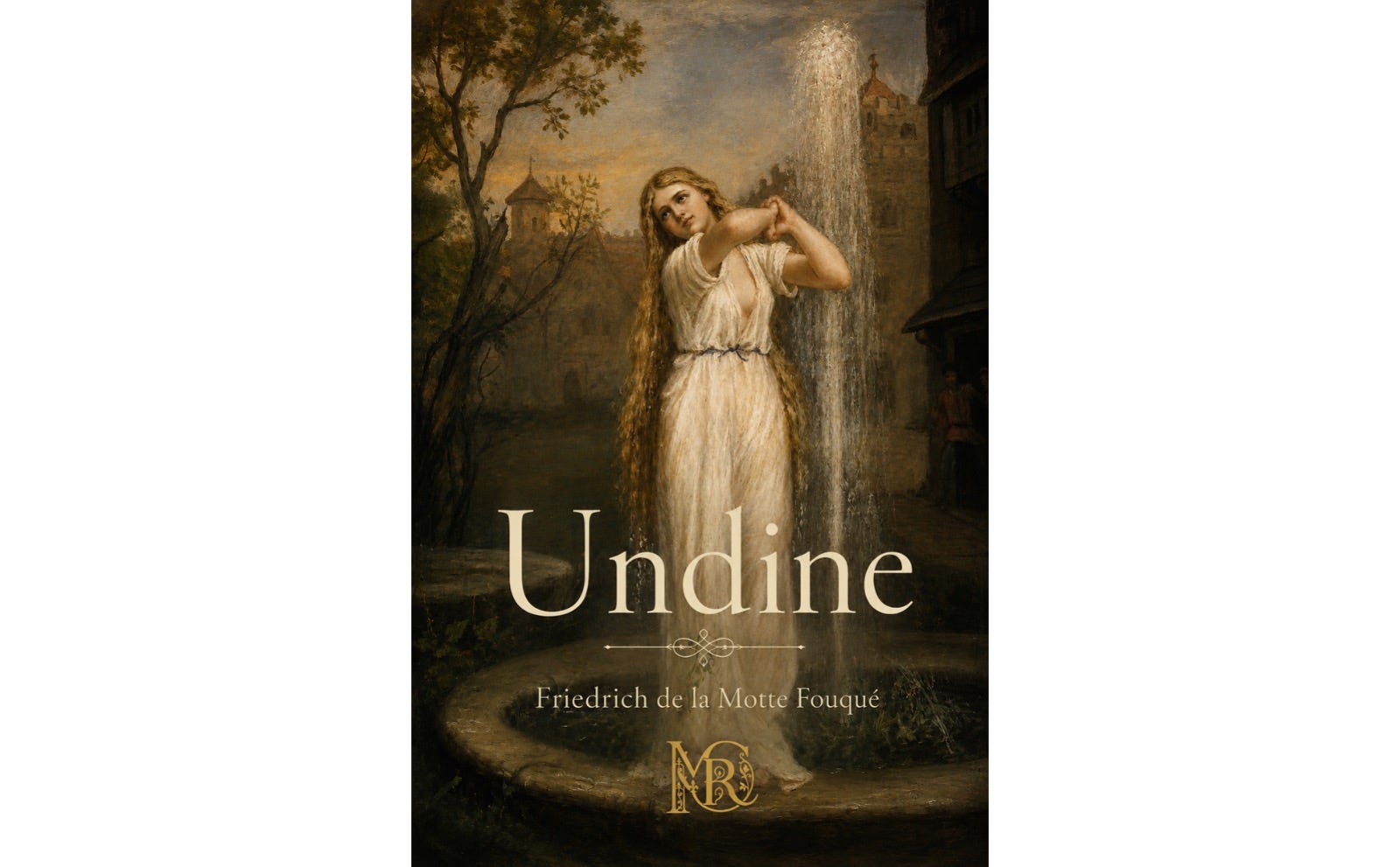
Undine by Friedrich de la Motte Fouqué
A timeless Romantic fairy tale of love, sacrifice, and the mysterious bond between a water spirit and a mortal knight.

Chapter I: How the Knight Came to the Fisherman
Many hundreds of years ago, there lived a kind old fisherman who, one lovely evening, sat outside his door mending his nets. He lived in an exceptionally beautiful place. The green land on which his cottage stood reached far out into a broad inland lake. It seemed equally possible that the point of land had pushed itself into the wonderfully bright, blue-clear water out of love for it, or that the water had reached out with loving arms toward the beautiful meadow, its tall, swaying grasses and flowers, and the refreshing shade of its trees. Land and water seemed to visit each other as guests, and that was what made both of them so beautiful.
Few people, or perhaps none at all, were to be found in that lovely place apart from the fisherman and his family. Behind the point of land lay a very wild forest. Most people were far too frightened to enter it unless they had to, because it was dark and almost impossible to cross, and because of the strange creatures and supernatural apparitions said to be found there.
The old, devout fisherman, however, had passed through it many times without being troubled. He did so whenever he carried the excellent fish he caught from his beautiful peninsula to a large city not far beyond the forest. Perhaps he found it so easy to travel through the woods because his thoughts were almost always pious. In addition, whenever he entered those notorious shadows, he would sing a hymn in a clear voice and with a sincere heart.
That evening, as he sat peacefully beside his nets, he was suddenly seized by fear when he heard something moving through the darkness of the forest. It sounded like a horse and rider, and the noise came steadily closer to the peninsula.
All the things he had dreamed on stormy nights about the forest’s secrets now flashed through his mind. Above all, he remembered the image of an enormously tall, snow-white man who kept nodding his head in a strange and unnatural way. When the fisherman raised his eyes toward the forest, it truly seemed to him that he could see the nodding man emerging through the lattice of leaves.
But he soon mastered his fear. He reminded himself that nothing dangerous had ever happened to him even inside the forest, and that an evil spirit should have still less power over him here on the open peninsula. At the same time, he fervently recited a verse from the Bible aloud and from the heart. His courage returned, and he almost laughed when he saw how badly he had been mistaken.
The white, nodding man suddenly turned out to be a little stream the fisherman had known for years. It came foaming out of the forest and emptied into the lake.
The sound itself had been made by a splendidly dressed knight who came riding through the shadows of the trees toward the cottage. A scarlet cloak hung over his violet-blue doublet, which was embroidered with gold. Red and violet-blue feathers flowed from his golden cap, and a remarkably beautiful, richly decorated sword flashed at his golden sword belt.
The white stallion carrying the knight was more slenderly built than ordinary warhorses. It stepped so lightly across the grass that the green, flower-speckled carpet seemed not to suffer the slightest harm beneath its hooves.
The old fisherman still felt somewhat uneasy, although he believed that nothing so fair and noble in appearance could mean him any harm. He therefore removed his hat politely as the stranger approached and remained calmly beside his nets.
The knight stopped and asked whether he and his horse might find shelter and care there for the night.
“As for your horse, dear sir,” the fisherman replied, “I know of no better stable for it than this shaded meadow, and no better food than the grass that grows here. As for you, I will gladly give you supper and a bed in my little house, as well as our means allow.”
The knight was perfectly satisfied. He dismounted, and together the two men unsaddled and unbridled the horse. They then let it run freely across the flower-filled meadow.
The knight said to his host, “Even had I found you less hospitable and kind, my dear old fisherman, you would probably not have been rid of me tonight. As I can see, a broad lake lies before us, and may God preserve me from riding back into that uncanny forest with night coming on!”
“Let us not speak too much about it,” said the fisherman, leading his guest into the cottage.
Inside, the fisherman’s elderly wife sat in a large chair beside the hearth. A small fire cast a dim light over the neat and tidy room. When the distinguished guest entered, she stood and greeted him kindly, but then sat down again in her place of honor without offering it to the stranger.
The fisherman smiled and said, “You must not be offended, young sir, because she has not given you the most comfortable chair in the house. Among poor people, it is the custom for that chair to belong entirely to the old.”
“Oh, husband,” the woman said with a calm smile, “whatever are you thinking? Our guest is surely a Christian gentleman. How could such a dear young man ever think of driving old people out of their seats?”
Then, turning to the knight, she continued, “Sit down, young sir. There is a perfectly nice little chair over there. Only you must not shift about too roughly in it, because one of its legs is no longer very secure.”
The knight carefully brought the chair closer and sat down pleasantly. He felt as though he belonged to this little household and had only just returned to it after a long absence.
The three of them began to talk warmly and comfortably together. The old man did not care to say much about the forest, although the knight asked about it several times. In his opinion, the approach of night was the worst possible time to discuss such a subject.
Instead, the husband and wife spoke at length about their household and their daily lives. They also listened eagerly as the knight told them about his travels. He explained that he owned a castle near the headwaters of the Danube and that his name was Sir Huldbrand of Ringstetten.
During the conversation, the stranger several times heard water splashing against the low window, as though someone were spraying it there. Each time, the old man frowned. At last, an entire shower of water struck the panes and sprayed into the room through the poorly sealed frame.
The fisherman rose angrily and called threateningly toward the window, “Undine! Will you stop these childish games at last? And today, of all days, when we have a strange gentleman staying in our cottage!”
Everything outside became quiet, although a faint giggle could still be heard.
Returning to his seat, the fisherman said, “You must forgive this, my honored guest, and perhaps a few more acts of mischief as well. She does not mean any harm. Undine is our foster daughter. She cannot seem to outgrow her childish ways, although she is nearly eighteen. But as I said, underneath it all she is truly good-hearted.”
“That is easy for you to say!” the old woman replied, shaking her head. “When you come home from fishing or return from a journey, her teasing may seem charming enough. But having her on your hands all day, never hearing one sensible word from her, and, instead of receiving more help around the house as she grows older, constantly having to make sure that her foolishness does not ruin us completely—that is a very different matter. Even a saint’s patience would eventually run out.”
“Well, well,” the master of the house said with a smile. “You have Undine to deal with, and I have the lake. It often breaks through my dams and tears my nets, but I love it all the same. And despite all the trouble and distress she causes, you love the pretty child too. Don’t you?”
“One cannot stay truly angry with her,” the old woman admitted, smiling in agreement.
At that moment, the door flew open and a beautiful blonde girl slipped inside, laughing.
“You were only teasing me, Father,” she said. “Where is your guest, then?”
At that very moment, however, she noticed the knight and stopped in amazement before the handsome young man.
Huldbrand delighted in her lovely appearance and tried to study her beautiful features carefully. He thought that only her surprise was giving him time to do so and that she would soon become doubly shy and turn away from his gaze.
But matters unfolded very differently.
After looking at him for a long time, she came trustingly closer, knelt before him, and began playing with a golden medallion he wore on a heavy chain across his chest.
“Oh, you handsome, friendly guest,” she said, “how did you finally come to our poor cottage? Did you have to wander around the world for years before finding your way to us at last? Have you come from the wild forest, my handsome friend?”
The old woman began scolding her before Huldbrand had time to answer. She told the girl to stand up properly and get on with her work.
Without replying, Undine pulled a small footstool over beside Huldbrand’s chair, sat down on it with her weaving, and said pleasantly, “I’ll work here.”
The old man behaved as parents often do with spoiled children. He pretended not to notice Undine’s bad manners and tried to begin a different subject.
But the girl would not allow it.
“I asked our lovely guest where he came from,” she said, “and he still has not answered me.”
“I came from the forest, you pretty little creature,” Huldbrand replied.
“Then you must tell me how you got into it,” she continued, “because everyone else is afraid of it. You must also tell me what strange adventures you had there, since people say that no one passes through without having some.”
Huldbrand shuddered slightly at the memory and looked involuntarily toward the window. He felt as though one of the strange figures he had encountered in the forest must be grinning in at him from outside. But he saw nothing except the deep black night that now lay beyond the panes.
He gathered his courage and was just about to begin his story when the old man interrupted him.
“No, Sir Knight. This is not a good time for stories of that kind.”
Undine sprang angrily from her stool, placed her beautiful hands on her hips, and stood directly in front of the fisherman.
“He is not to tell his story, Father?” she cried. “He is not? But I want him to! He shall tell it! He must!”
She stamped her delicate foot hard against the floor. Yet she did everything with such amusing and graceful charm that Huldbrand found it even harder to take his eyes off her in anger than he had when she was being friendly.
The old man’s restrained annoyance, however, now burst into full flame. He scolded Undine severely for her disobedience and for behaving so improperly in front of their guest. The good old woman joined him.
Undine responded, “Since you are going to scold me and refuse to do what I want, you can sleep alone in your old smoky cottage!”
Then, as swiftly as an arrow, she shot through the door and ran out into the dark night.
Chapter II: How Undine Came to the Fisherman
Huldbrand and the fisherman leapt from their seats and hurried after the angry girl. But before they could reach the cottage door, Undine had already vanished into the cloudy darkness outside. Not even the sound of her light footsteps revealed which way she had gone.
Huldbrand looked questioningly at his host. He almost began to wonder whether the lovely figure that had disappeared so quickly into the night had been nothing more than another of the strange apparitions that had played their tricks on him in the forest.
But the old man muttered into his beard, “This is not the first time she has done this to us. Now our hearts will be full of worry and we will not sleep all night. Who knows whether she may not come to harm one day, wandering alone in the darkness until dawn?”
“Then for God’s sake, Father, let us go after her!” Huldbrand cried anxiously.
“What would be the use?” the old man replied. “It would be wrong of me to let you follow that foolish girl alone into the night and wilderness. And my old legs could never catch the little madcap, even if we knew which way she had run.”
“Then at least we must call after her and beg her to come back,” said Huldbrand.
He began calling out with great urgency, “Undine! Oh, Undine! Please come back!”
The old man shook his head and said that all the shouting would probably accomplish nothing. The knight did not yet understand how stubborn the girl could be. Nevertheless, he could not stop himself from repeatedly calling into the dark night as well.
“Undine! Dear Undine! Please, just this once, come back!”
But events unfolded exactly as the fisherman had predicted. Undine could neither be heard nor seen. Since the old man absolutely refused to allow Huldbrand to search for her, the two men were eventually forced to return to the cottage.
There they found the fire on the hearth almost completely extinguished. The fisherman’s wife, who was far less troubled than her husband by Undine’s disappearance and possible danger, had already gone to bed.
The old man blew on the coals, placed dry wood over them and, when the flames had risen again, brought out a jug of wine. He set it between himself and his guest.
“You are worried about the foolish girl too, Sir Knight,” he said. “We would be better off spending part of the night talking and drinking than tossing uselessly on our rush mats, unable to sleep. Don’t you agree?”
Huldbrand readily agreed. The fisherman invited him to take the place of honor that his sleeping wife had left vacant, and the two men drank and talked together as honest, open-hearted companions should.
Of course, whenever the slightest sound came from outside the windows—and sometimes even when there was no sound at all—one of them would look up and say, “There she is.”
Then they would fall silent for a few moments. When no one appeared, they would shake their heads, sigh and continue their conversation.
Since neither of them could think of much besides Undine, the knight could imagine nothing he would rather hear than the story of how she had come to the old fisherman. The fisherman, for his part, could think of nothing he would rather tell. And so he began:
“It must be about fifteen years ago now. I was travelling through the wild forest to the city with my goods. My wife had remained at home, as usual, and at that time she had an especially good reason for doing so. God had blessed us, although we were already quite old, with a beautiful little child.
“She was a girl, and we had already begun discussing whether, for the child’s sake, we ought to leave our lovely peninsula and move somewhere more populated, where we could bring up this precious gift from heaven more properly.
“Poor people cannot arrange such things as easily as you may imagine, Sir Knight. But, dear God, everyone must do whatever lies within their power.
“The matter occupied my thoughts throughout the journey. This peninsula was very dear to my heart, and whenever I found myself surrounded by all the noise and quarrelling in the city, I almost shuddered at the thought: ‘Soon you too will make your home in surroundings like these—or at least somewhere that is not much quieter.’
“Still, I did not complain against our dear Lord. On the contrary, I silently thanked Him for the newborn child. And I would be lying if I said that anything more troubling happened to me than usual on either my outward or return journey through the forest. Indeed, I have never seen anything uncanny there. The Lord was always with me among those strange shadows.”
The fisherman removed his cap from his bald head and sat for a while, absorbed in prayer. Then he covered his head again and continued:
“On this side of the forest—ah, it was on this side that misery came to meet me.
“My wife came walking toward me with tears pouring from her eyes like two streams. She had dressed herself in mourning clothes.
“‘Dear God!’ I groaned. ‘Where is our beloved child? Tell me!’
“‘With the One you have just called upon, dear husband,’ she replied.
“We went into the cottage together, silently weeping. I looked for the little body, and only then did I learn what had happened.
“My wife had been sitting beside the lake with the child. She was playing with her, happy and completely free from worry, when the little girl suddenly leaned forward as though she had seen something wonderfully beautiful in the water.
“My wife saw the dear angel laughing and reaching toward it with her little hands. But in that same instant, the sudden movement carried her out of her mother’s arms and down into the shining water.
“I searched and searched for the little body, but it was useless. Not a trace of her could be found.
“That very evening, we sat together in the cottage, two parents left without a child. Neither of us wanted to speak, even if our tears had allowed us to do so. We simply stared into the fire on the hearth.
“Then something rustled outside the door. The door flew open, and a wonderfully beautiful little girl, perhaps three or four years old and dressed in fine clothes, stood smiling at us from the threshold.
“We were struck completely speechless. At first, I could not tell whether she was a real human child or merely some deceptive apparition.
“Then I saw water dripping from her golden hair and her rich clothing, and I understood that the beautiful child had been in the water and needed help.
“‘Wife,’ I said, ‘no one was able to save our dear child. But let us at least do for someone else what would have made us blessed on earth, had anyone been able to do it for us.’
“We removed the little girl’s wet clothing, put her to bed and gave her warm drinks. She did not say a single word. She merely stared at us, smiling all the while out of two eyes as blue as the lake.
“By the following morning, it was clear that she had suffered no lasting harm. I asked about her parents and how she had come to be there.
“But the answer was a confused and astonishing story. She must originally have come from very far away, for during all these fifteen years I have never been able to discover anything about her origins. Even now, she sometimes says such strange things that ordinary people like us cannot help wondering whether she might have fallen from the moon.
“She speaks of golden castles, crystal roofs and God knows what else.
“The clearest account she gave was that she had been sailing across the great lake with her mother, had fallen from the boat into the water and had not regained consciousness until she found herself beneath the trees here. She said that she had felt very happy and comfortable on this bright, pleasant shore.
“But another serious concern now weighed on our hearts. We had quickly decided that we would keep the child we had found and raise her in place of the beloved daughter we had lost. But how could we know whether she had been baptized?
“She herself could give us no clear answer. She generally told us that she knew she was one of God’s creatures, created to honor and delight Him, and that she was willing to undergo anything that would honor and please God.
“My wife and I reasoned like this: if she had not been baptized, then there was no reason to delay. And if she had already been baptized, too little of a good thing was more likely to cause harm than too much.
“So we began thinking of a proper name for the child, since until then we had not even known what to call her. At last, we decided that Dorothea would suit her best. I had once heard that the name meant ‘gift of God,’ and she had certainly been sent to us by God as a gift and a comfort in our grief.
“But she would hear nothing of it. She said that her parents had named her Undine, and Undine was the name she intended to keep.
“To me, it sounded like a pagan name that did not appear in any church calendar, so I went to ask a priest in the city for advice.
“He wanted nothing to do with the name Undine either. But after I pleaded with him repeatedly, he travelled back with me through the strange forest to perform the baptism here in my cottage.
“The little girl stood before us, so beautifully dressed and so charming that the priest’s heart immediately warmed to her. She knew how to flatter him so sweetly and, at other moments, defy him so comically that in the end he could no longer remember any of the objections he had once raised against the name.
“And so she was baptized Undine.
“Throughout the sacred ceremony, she behaved with extraordinary modesty and grace, although at every other time she was wild and restless. My wife is quite right about that: we have had a difficult time with her. If I were to tell you everything—”
The knight interrupted the fisherman and drew his attention to a sound like the roar of enormous floods. Huldbrand had heard it earlier during the old man’s story, but now the noise was rushing past the cottage windows with rapidly increasing violence.
Both men sprang toward the door.
Outside, beneath the newly risen moon, they saw that the stream flowing from the forest had burst wildly over its banks. It swept stones and tree trunks away in violent, spinning currents.
The storm, as though awakened by the roar of the water, burst from the massive clouds and drove them like arrows across the moon. The lake howled beneath the beating wings of the wind. The trees on the peninsula groaned from their roots to their highest branches and bent as though dizzy over the racing waters.
“Undine! For God’s sake, Undine!” the two frightened men shouted.
No answer came.
Forgetting every other concern, they rushed out of the cottage, searching and calling—one running in one direction, the other in another.
Chapter III: How They Found Undine Again
Huldbrand grew more anxious and confused the longer he searched through the shadows of the night without finding her. The thought that Undine might have been nothing more than an apparition of the forest began to take hold of him again. With the waves and wind howling, the trees crashing, and the whole landscape—so peaceful only a short time before—now completely transformed, he almost began to believe that the entire peninsula, together with the cottage and everyone in it, had been a deceptive illusion created to mock him.
Yet in the distance he could still hear the fisherman calling anxiously for Undine, while the old woman’s loud prayers and hymns rose through the uproar.
At last he reached the very edge of the overflowing stream. In the moonlight he saw that its wild current had forced its way directly across the land in front of the sinister forest, turning the tip of the peninsula into an island.
Dear God, he thought, what if Undine dared to take a few steps into that terrible forest—perhaps simply out of her charming stubbornness, because I was forbidden to tell her about it? And now the stream has come rushing between us, and she is over there alone, weeping among the ghosts!
A cry of horror escaped him. He climbed down over stones and fallen fir trunks, intending to enter the raging stream and search for the lost girl on the other side, whether he had to wade or swim.
He remembered all the frightening and mysterious things he had encountered during the day beneath the branches that were now roaring and groaning in the storm. Above all, he imagined that the tall white man he knew only too well was standing on the opposite bank, grinning and nodding at him.
But those dreadful images only drew him onward more powerfully, because he believed that Undine was among them, terrified and alone.
He had already taken hold of a strong fir branch and was standing in the swirling water, leaning against it for support. He could barely remain upright against the current, but he courageously stepped farther in.
Then a sweet voice called from close beside him:
“Do not trust him! Do not trust him! The old stream is treacherous!”
He recognized the lovely voice. He stood as though enchanted while dark clouds passed over the moon. The rushing water made him dizzy as he watched it shoot past his thighs like arrows.
Even so, he refused to turn back.
“If you are not truly here,” he cried aloud, “if you are only a misty illusion fluttering around me, then I do not wish to live either! I will become a shadow like you, my dear, dear Undine!”
He stepped still deeper into the stream.
“Just look around!” the voice called again, very near him. “Oh, do look around, you handsome, foolish young man!”
He turned to one side. The moon had just emerged from behind the clouds, and beneath the interwoven branches of tall trees, on a little island created by the flood, he saw Undine. She was smiling sweetly, nestled among the flowering grasses.
How much more joyfully the young man now used his fir branch as a staff! In only a few steps he crossed the current that rushed between him and the girl. Soon he was standing beside her on the little patch of grass, hidden and protected beneath the murmuring ancient trees.
Undine raised herself slightly and wound her arms around his neck. She pulled him down beside her onto the soft grass.
“You must tell me your story here, handsome friend,” she whispered. “The grumpy old people cannot hear us here. And surely our leafy shelter is worth at least as much as their poor little cottage.”
“It is heaven!” said Huldbrand.
He wrapped his arms around the affectionate beauty and kissed her passionately.
Meanwhile, the old fisherman had reached the bank of the stream. He called across to the two young people:
“Well, Sir Knight, I welcomed you as one honest man welcomes another, and now you are secretly caressing my foster daughter while leaving me to wander through the night in terror, searching for her!”
“I only just found her myself, Father,” the knight called back.
“So much the better,” replied the fisherman. “But now bring her back across to solid ground without any further delay.”
Undine would hear nothing of it. She declared that she would sooner go all the way into the wild forest with the handsome stranger than return to the cottage, where no one would do as she wished and where, sooner or later, the handsome knight would leave her anyway.
With indescribable grace, she put her arms around Huldbrand and sang:
Out of the misty valley
The wave went seeking bliss.
At last she reached the ocean
And never flowed back again.
The old fisherman wept bitterly as she sang, but his tears did not appear to affect her very much. She continued kissing and caressing her beloved until Huldbrand finally said:
“Undine, even if the old man’s grief does not touch your heart, it touches mine. We must go back to him.”
Surprised, she raised her large blue eyes toward him. At last she spoke slowly and hesitantly:
“If that is what you wish—very well. Whatever you wish is right with me. But the old man over there must promise to let you tell me, without interrupting or objecting, what you saw in the forest. And then—well, the rest will work itself out.”
“Only come back! Please, come!” the fisherman called, unable to say anything more.
At the same time, he stretched his arms toward her across the water and nodded his head to show that he agreed to her demand. His white hair fell strangely across his face as he did so, reminding Huldbrand of the nodding white man in the forest.
Without allowing himself to be disturbed by the resemblance, the young knight took the beautiful girl in his arms and carried her across the narrow stretch of water roaring between her little island and the solid bank.
The old man threw his arms around Undine’s neck. He could not stop rejoicing over her return or kissing her. The old woman also came running and welcomed the recovered girl with the deepest affection.
No one spoke of scolding or punishment. There was even less thought of reproaching her because Undine, forgetting all her earlier defiance, showered both foster parents with loving words and caresses.
By the time they had finally recovered from the joy of having her back, the red light of dawn was already shining across the lake. The storm had fallen silent, and the little birds sang cheerfully among the rain-soaked branches.
Undine continued to insist that the knight tell the story he had promised. The two old people smiled and willingly gave in to her request.
They carried breakfast outside and placed it beneath the trees that stood behind the cottage, overlooking the lake. Everyone sat down in heartfelt happiness. Undine, because she absolutely refused to sit anywhere else, settled on the grass at the knight’s feet.
Then Huldbrand began his story.
Chapter IV: What Happened to the Knight in the Forest
“It must have been about eight days ago,” Huldbrand began, “when I rode into the free imperial city that lies beyond the forest. Soon afterward, a splendid tournament and ring-tilting contest was held there, and I spared neither my horse nor my lance.
“At one point, I stopped beside the lists to rest from the lively exertion and handed my helmet back to one of my squires. As I did so, I caught sight of an extraordinarily beautiful young woman standing on one of the balconies, dressed in the most magnificent finery and watching the tournament.
“I asked the knight beside me who she was and learned that the lovely maiden was called Bertalda. She was the foster daughter of one of the powerful dukes who lived in that region.
“I noticed that she was looking at me too. And then what so often happens to young knights happened to me: if I had ridden bravely before, I rode with twice as much daring after that. That evening, I was Bertalda’s partner at the dance, and I remained so on every day of the festival.”
A sharp pain in Huldbrand’s left hand, which was hanging at his side, suddenly interrupted his story. He looked down at the place that hurt and discovered that Undine had sunk her pearly teeth firmly into his fingers. She was staring at him with a dark and angry expression.
But then she looked up into his eyes with tender sadness and whispered very softly:
“You bring it on yourself.”
She covered her face, and the knight continued his story, strangely confused and thoughtful.
“Bertalda is a proud and capricious girl. By the second day, I liked her much less than I had on the first, and by the third day, less still. Yet I remained near her because she treated me more kindly than she treated the other knights.
“That was how I came to ask her jokingly for one of her gloves.
“‘You may have it,’ she said, ‘when you return with news of what the notorious forest is really like—and when you have gone there entirely alone.’
“I did not care very much about her glove, but once the words had been spoken, they could not be taken back. A knight who values his honor does not need to be challenged twice to such a test.”
“I think she was in love with you,” Undine interrupted.
“It certainly looked that way,” Huldbrand replied.
“Well,” the girl cried with a laugh, “then she must be very foolish. To send away someone she loved—and into a notorious forest, of all places! The forest and its secrets could have waited a very long time for me.”
“I set out yesterday morning,” the knight continued, smiling affectionately at Undine.
“The tree trunks gleamed red and slender in the morning light, which stretched brightly across the green grass. The leaves whispered so cheerfully to one another that I could not help laughing inwardly at the people who believed anything frightening could be found in such a pleasant place.
“‘I will soon have ridden through the forest and back again!’ I said to myself in high spirits.
“Before I knew it, however, I was deep among the green shadows and could no longer see the open plain behind me. Only then did it occur to me that it would be very easy to lose my way in such a vast forest, and that perhaps this was the only real danger threatening travellers there.
“I stopped and looked up to judge my direction from the sun, which had risen somewhat higher by then.
“As I raised my eyes, I saw a black shape among the branches of a tall oak tree. At first I thought it was a bear, and I reached for my sword.
“Then it spoke down to me in a human voice, though the voice was rough and hideous:
“‘If I were not up here gnawing off these branches, what would they roast you over at midnight, Master Know-It-All?’
“It grinned and shook the branches so violently that my horse went mad with fear and bolted before I had time to see what sort of devilish creature it really was.”
“You must not speak of that creature,” said the old fisherman, crossing himself.
His wife silently did the same.
Undine looked at her beloved with bright eyes and said:
“The best part of the story is that they did not actually roast him. Go on, handsome young man.”
The knight continued:
“My terrified horse nearly ran headlong into trees and branches. It was dripping with sweat from fear and exertion, yet it still refused to obey me.
“At last, it raced directly toward a rocky precipice. Suddenly, it seemed to me that a tall white man threw himself across the maddened stallion’s path.
“The horse recoiled in terror and stopped. I managed to regain control of it, and only then did I see that my rescuer was not a white man at all, but a silver-bright stream rushing down a hill beside me. It had crossed my horse’s path with such force that it stopped him.”
“Thank you, dear stream!” Undine cried, clapping her little hands.
The old fisherman, however, shook his head and stared thoughtfully at the ground.
“I had barely settled myself properly in the saddle and gathered the reins again,” Huldbrand continued, “when a strange little man appeared beside me.
“He was tiny and hideous beyond description, yellowish brown from head to foot, with a nose that was almost as large as the whole rest of his body. He grinned at me with foolish politeness through an enormously wide mouth and scraped and bowed to me again and again.
“I strongly disliked his ridiculous performance, so I gave him only the briefest acknowledgment. I turned my still-trembling horse around and decided to seek another adventure—or, if I found none, to look for the way home. During my wild ride, the sun had already passed its midday height and begun moving westward.
“But the little fellow spun around with lightning speed and once again stood directly in front of my stallion.
“‘Out of the way!’ I said irritably. ‘The animal is still wild and may easily run you down.’
“‘Oh!’ the little creature croaked, laughing even more horribly and foolishly than before. ‘First give me a reward! After all, I was the one who stopped your little horse. Without me, you and your horse would both be lying in the rocky chasm down there. Ugh!’
“‘Stop making those faces,’ I said, ‘and take your money, even though you are lying. It was the good stream over there that saved me, not you, you miserable little creature.’
“I dropped a gold coin into the strange cap he had removed and was holding out to me like a beggar. Then I rode on.
“But he shouted after me and suddenly appeared beside me again with unbelievable speed.
“I urged my horse into a gallop. The creature galloped alongside us, though the effort appeared to cause him great difficulty. As he ran, he twisted his body into the most extraordinary contortions, which were half ridiculous and half horrifying.
“All the while, he held the gold coin high in the air. At every stride he cried:
“‘False money! Counterfeit coin! Counterfeit coin! False money!’
“He croaked the words from such a hollow chest that it seemed he must collapse and die after every cry. His ugly red tongue hung far out of his mouth.
“Deeply disturbed, I stopped.
“‘What do you want with all this shouting?’ I asked. ‘Take another gold coin—take two more—but then leave me alone.’
“He began bowing and scraping with hideous politeness again.
“‘Gold? No, it must not be gold, my young master,’ he croaked. ‘I have far too much of that stuff myself. I will show you.’
“Suddenly, it seemed that I could see through the solid green ground as though it were made of green glass. Beneath it, the earth appeared round like a great globe, and inside it a multitude of goblins were playing with silver and gold.
“They tumbled around head over heels, throwing the precious metals at one another for amusement and blowing gold dust mockingly into one another’s faces.
“My hideous companion stood half inside the earth and half outside it. The others passed enormous quantities of gold up to him. Laughing, he showed it to me and then threw it back with a ringing sound into immeasurably deep chasms.
“Then he held up the gold coin I had given him and showed it to the goblins below. They nearly died laughing at it and hissed mockingly at me.
“At last, they all stretched their sharp, metal-stained fingers toward me. Wilder and wilder, thicker and thicker, madder and madder, the swarming creatures climbed toward me.
“Then I was seized by the same terror that had possessed my horse earlier. I drove both spurs into its sides, and I have no idea how far I galloped wildly into the forest for the second time.
“When I finally stopped again, the coolness of evening had settled around me. Through the branches, I saw a white footpath shining, and I believed it must lead out of the forest and back toward the city.
“I tried to force my way toward it, but a completely white, indistinct face appeared between the leaves, its features constantly changing as it stared at me.
“I tried to avoid it, but wherever I went, it appeared again.
“At last, in anger, I decided to drive my horse directly at it. But it sprayed white foam into both my face and the horse’s eyes, blinding us and forcing us to turn away.
“Step by step, it drove us farther from the path and left only one direction open to us. Whenever we followed that route, it remained close behind us, although it did not do us the slightest harm.
“Sometimes, when I looked back, I could see that the white, foaming face sat upon an equally white and enormously tall body. At other times, I thought it might be a walking fountain, but I could never be certain what it truly was.
“At last, both horse and rider were exhausted and gave in to the white man who was driving us onward. He continually nodded his head at us as though saying:
“‘That is right! That is right!’
“And so we finally emerged here at the edge of the forest. I saw the grass, the waters of the lake and your little cottage—and at that moment, the tall white man disappeared.”
“It is a good thing that he is gone,” said the old fisherman.
He then began discussing the best way for his guest to return to his companions in the city.
At this, Undine began giggling very quietly to herself.
Huldbrand noticed and said:
“I thought you liked having me here. Why are you so pleased now that they are talking about my departure?”
“Because you cannot leave,” Undine replied.
“Just try crossing the forest stream now that it has burst its banks—by boat, on horseback or alone, whichever you prefer. Or rather, do not try it, because the tree trunks and stones racing through the water like lightning would smash you to pieces.
“And as for the lake, I know that Father cannot take his boat far enough out onto it.”
Huldbrand rose with a smile to see whether Undine was right. The old fisherman accompanied him, while the girl skipped playfully beside them.
They found everything exactly as Undine had described it. The knight was forced to accept that he must remain on the peninsula—which had now become an island—until the floodwaters subsided.
As the three of them walked back toward the cottage, the knight bent down and whispered into the girl’s ear:
“Well, my little Undine? Are you angry that I am staying?”
“Oh, leave me alone,” she replied sulkily. “Had I not bitten you, who knows how much more you would have had to say about Bertalda!”
Chapter V: How the Knight Lived on the Peninsula
Perhaps, dear reader, after being driven up and down by the many changes of the world, you have sometimes arrived at a place where you felt completely at ease. The love that is born in every person for a home of one’s own and for quiet peace awakened in you again. It seemed as though your lost homeland, with all the flowers of childhood and of the purest, deepest love, were blooming once more from cherished graves, and you thought that this must be a good place to settle and build a home.
Whether you were mistaken and later paid painfully for that mistake is beside the point. You probably have no wish to trouble yourself voluntarily with its bitter aftertaste. Instead, call back that indescribably sweet feeling, that angelic greeting of peace, and you will have some idea of how Sir Huldbrand felt while he lived on the peninsula.
He often watched with deep satisfaction as the stream from the forest grew wilder every day, tearing its channel wider and wider and prolonging their isolation on the island.
For part of each day, he roamed about with an old crossbow that he had found in a corner of the cottage and repaired. He watched for birds flying overhead and brought whatever he managed to shoot back to the kitchen for roasting.
Whenever he returned with his prey, Undine almost always scolded him for cruelly robbing the dear, cheerful little creatures of their happy lives in the blue sea of the air. Indeed, she often wept bitterly at the sight of the dead birds.
But when he came home on another occasion without having shot anything, she scolded him just as severely. Because of his clumsiness and carelessness, she complained, they would now have to make do with fish and crayfish.
Huldbrand always looked forward with all his heart to her charming anger, especially because she usually tried afterward to make up for her bad temper with the sweetest caresses.
The old couple had grown accustomed to the closeness between the two young people. They seemed to them like an engaged couple—or even like husband and wife—who had come to live with them on the cut-off island and support them in their old age.
That same isolation made young Huldbrand feel quite certain that he was already Undine’s promised husband. It seemed to him that no world existed beyond the waters surrounding them, or at least that they could never cross those waters again and rejoin other human beings.
Sometimes his grazing horse neighed to him as though asking about knightly adventures and reminding him of his duties. Sometimes his coat of arms shone gravely at him from the embroidered saddle and horse blanket. At other times, his beautiful sword unexpectedly fell from the peg on which it hung inside the cottage and slipped from its sheath as it fell.
Whenever such things made him doubt himself, he calmed his mind with the thought that Undine was no fisherman’s daughter. In all likelihood, she had been born into some mysterious and exalted princely family in a foreign land.
There was only one thing he deeply disliked: hearing the old woman scold Undine in his presence. The temperamental girl usually laughed openly and wildly at the rebukes, without attempting to hide her amusement. But Huldbrand felt as though his own honor were being insulted.
Even so, he could not honestly say that the fisherman’s wife was wrong, since Undine always deserved at least ten times as much scolding as she actually received. Huldbrand therefore remained fond of the old woman, and life continued along its quiet and pleasant course.
At last, however, something disturbed their peaceful existence.
The fisherman and the knight had grown accustomed to enjoying a jug of wine together at midday and again in the evening, when the wind howled outside, as it did almost every night.
But now the fisherman’s entire supply—the wine he had gradually brought home from the city—had run out. Both men became thoroughly bad-tempered about it.
Undine mocked them heartily throughout the day, but neither man joined in her jokes with his usual cheerfulness.
Toward evening, she left the cottage, saying that she wanted to escape from their two long and boring faces.
As twilight approached, the weather once again began to look stormy. The water was already howling and rushing, and the knight and the fisherman sprang anxiously through the door to bring the girl home. They remembered the terror of the night when Huldbrand had first arrived at the cottage.
But Undine came toward them, cheerfully clapping her little hands.
“What will you give me if I provide you with wine?” she asked. “Or rather, you need not give me anything,” she continued. “I will be satisfied merely to see you looking happier and hear you saying more amusing things than you have throughout this long, dull day.
“Just come with me. The forest stream has washed a barrel onto the bank, and may I be condemned to sleep for a whole week if it is not a barrel of wine!”
The men followed her. In a small, bush-lined cove beside the shore, they really did find a barrel that gave them every reason to hope that it contained the noble drink they desired.
Their first concern was to roll it into the cottage as quickly as possible, for another heavy storm was gathering in the evening sky. Even in the fading light, they could see the waves of the lake raising their white, foaming heads as though looking out for the rain that would soon come rushing down upon them.
Undine helped the two men with all her strength. When the storm suddenly approached with a loud howl, she called up into the heavy clouds with playful menace:
“You! You had better be careful not to get us wet! We are still a long way from shelter.”
The old man rebuked her for such sinful arrogance, but she merely giggled quietly to herself. No harm came to any of them because of her words.
On the contrary, all three reached the warm and comfortable hearth with their prize, unexpectedly dry.
Only after they had opened the barrel and discovered that it contained wonderfully excellent wine did the rain finally break loose from the dark clouds. The storm roared through the treetops and swept across the lake’s furious waves.
They soon filled several bottles from the great barrel, which promised to provide them with wine for many days.
Safe and comfortable beside the glowing hearth, they sat together drinking and joking while the storm raged outside.
Then the old fisherman suddenly became very serious.
“Ah, great God,” he said, “here we are enjoying this noble gift, while the man to whom it first belonged, and from whom the stream carried it away, may perhaps have lost his dear life because of it.”
“That does not necessarily follow,” said Undine, smiling as she filled the knight’s glass.
But Huldbrand said, “On my highest honor, Father, if I knew where to find that man and save him, no journey into the darkness and no danger would deter me. At the very least, I can promise you this: if I ever return to inhabited country, I will find him or his heirs and repay them two or three times the value of this wine.”
The old man was pleased. He nodded approvingly to the knight and emptied his cup with an easier conscience and greater enjoyment.
Undine, however, said to Huldbrand, “As for the compensation and your gold, do whatever you like. But that talk about running after the man and searching for him was foolish. I would cry my eyes out if you were lost because of it. And surely you would rather stay here with me and the good wine. Wouldn’t you?”
“Of course,” Huldbrand replied with a smile.
“Well, then,” said Undine, “you spoke foolishly. Everyone must look after themselves first. What do other people matter to us?”
The fisherman’s wife turned away from her, sighing and shaking her head. The fisherman forgot his usual fondness for the graceful girl and began to scold her.
“You sound as though you had been raised by heathens and Turks,” he concluded. “God forgive both me and you, you wayward child.”
“Yes, but that is simply how I feel,” Undine replied. “Whoever may have raised me, what good can all your words do?”
“Be quiet!” the fisherman shouted at her.
Despite all her boldness, Undine was very easily frightened. She flinched, pressed herself trembling against Huldbrand and asked him very quietly:
“Are you angry with me too, handsome friend?”
The knight squeezed her delicate hand and stroked her curls.
He could say nothing. His anger at the old man’s harshness toward Undine sealed his lips.
And so the two pairs suddenly sat facing one another, resentful and awkwardly silent.
Chapter VI: The Wedding
A soft knock at the door broke the silence and startled everyone sitting inside the cottage. Sometimes even a small thing, when it happens completely unexpectedly, can fill a person with terrible fear. In this case, there was even more reason to be alarmed: the notorious forest lay very close by, and the peninsula now seemed impossible for any human visitor to reach.
They looked uncertainly at one another. The knocking came again, accompanied by a deep groan. The knight reached for his sword.
But the old fisherman said quietly, “If it is what I fear, no weapon will help us.”
Meanwhile, Undine approached the door and called out boldly and impatiently:
“If you earth spirits have come here to make trouble, Kühleborn will soon teach you better manners!”
Her strange words only increased everyone else’s terror. They looked uneasily at the girl, and Huldbrand was just gathering the courage to question her when a voice outside said:
“I am no earth spirit, although I am a spirit who still lives in an earthly body. If you fear God and are willing to help me, you people inside the cottage, then open the door.”
Undine had already opened it. Holding a lamp, she shone its light out into the stormy night. There stood an elderly priest, who stepped back in alarm at the unexpected sight of the wonderfully beautiful girl.
He may well have thought that witchcraft or some supernatural trick was involved when so glorious a figure appeared in the doorway of such a humble cottage. He therefore began to pray:
“All good spirits praise the Lord God!”
“I am not a ghost,” Undine said with a smile. “Do I really look so ugly? Besides, you can surely see that a holy prayer does not frighten me. I know about God too, and I know how to praise Him—although each of us does so in our own way. That is why He created us. Come inside, reverend Father. You have found good people here.”
The priest entered, bowing and looking about him. He had a gentle and venerable appearance, but water poured from every fold of his dark clothing, from his long white beard and from the white curls upon his head.
The fisherman and the knight led him into another room and gave him dry clothes, while they passed the priest’s wet garments to the women to hang up and dry.
The old stranger thanked them with the greatest humility and kindness. Huldbrand offered him his own magnificent cloak, but the priest absolutely refused to wear it. Instead, he chose an old gray coat belonging to the fisherman.
When they returned to the main room, the fisherman’s wife immediately gave the priest her large chair and would not rest until he had sat down in it.
“You are old and exhausted,” she said, “and a clergyman besides.”
Undine placed her little footstool beneath the stranger’s feet—the same stool on which she usually sat beside Huldbrand. In every way, she cared for the good old man with remarkable modesty and grace.
Huldbrand whispered a teasing remark about this into her ear, but she replied very seriously:
“He serves the One who created us all. That is not something to joke about.”
The knight and the fisherman then refreshed the priest with food and wine. After he had recovered somewhat, he began telling them his story.
The previous day, he said, he had left his monastery, which lay far beyond the great lake, intending to travel to the bishop’s residence. He had been sent to report the hardship that the strange floods had brought upon the monastery and the villages belonging to it.
After making many long detours because of those same floods, he had nevertheless been forced, toward evening that day, to cross an overflowed arm of the lake with the help of two capable boatmen.
“But scarcely had our little boat touched the water,” he continued, “when the tremendous storm that still rages above our heads suddenly broke loose. It seemed as though the waters had only been waiting for us before beginning their wildest, most violent dance.
“The oars were soon torn from the boatmen’s hands. Broken to pieces, they floated farther and farther ahead of us across the waves.
“We ourselves, completely helpless and at the mercy of the unfeeling forces of nature, were driven out across the open lake toward your distant shore. We could already see it rising through the mist and flying spray.
“At last, the boat began spinning more and more violently until everything made me dizzy. I do not know whether it overturned or whether I fell from it.
“In the dark terror of approaching death, I was swept onward until a wave threw me beneath the trees here on your island.”
“Yes, an island!” said the fisherman. “Not long ago, it was still a peninsula. But since the forest stream and the lake have both nearly gone mad, everything has changed.”
“I noticed something of the kind,” replied the priest. “I crept along beside the water in the darkness, finding nothing around me but wild roaring and rushing. At last, I saw that a path which could have been walked upon disappeared directly into the raging water.
“Then I saw the light in your cottage and dared to make my way here. I cannot thank my heavenly Father enough for leading me, after rescuing me from the water, to such godly people as you.
“I am all the more grateful because I cannot know whether, apart from the four of you, I shall ever see another human being in this life.”
“What do you mean?” asked the fisherman.
“Do any of you know how long this raging of the elements will continue?” the priest replied. “I am already an old man. The stream of my own life may easily dry up and disappear into the earth before the floodwaters of the forest stream subside.
“And it is not impossible that more and more foaming water may force its way between you and the forest on the opposite side, until you are cut off so completely from the rest of the world that your little fishing boat can no longer cross the distance.
“The people on the mainland, occupied with their own affairs, might eventually forget you entirely in your old age.”
The old woman shuddered, crossed herself and said:
“May God prevent it!”
But the fisherman looked at her with a smile.
“That is human nature for you,” he said. “At least as far as you are concerned, dear wife, it would be no different from the way things are now. Have you travelled any farther than the edge of the forest during all these years? Have you seen anyone besides Undine and me?
“Now the knight and the priest have come to us as well. If ours became a forgotten island, they would remain here with us. You would gain the most from it of anyone.”
“I do not know,” said the old woman. “The thought still makes me uneasy. It is frightening to imagine being separated forever from all other people, even when one neither knows nor sees them.”
“Then you would stay with us—you would stay with us,” Undine whispered softly, almost singing the words as she nestled more closely against Huldbrand’s side.
The knight, however, had become lost in deep and strange visions. Since the priest’s last words, the land beyond the forest stream seemed to withdraw farther and farther from him, becoming darker and more distant. Meanwhile, the flowering island on which he lived seemed to grow greener and brighter within his heart.
His bride glowed before him like the loveliest rose on that little piece of earth—and, indeed, in the entire world. The priest was already there.
At that moment, the old woman gave Undine an angry look because she was leaning so closely against her beloved in the presence of a clergyman. It appeared that a flood of unpleasant scolding was about to follow.
Before she could speak, the knight turned to the priest and suddenly declared:
“Reverend Father, you see a bride and groom before you. If this girl and the good old fisherman and his wife have no objection, you shall marry us this very evening.”
The elderly couple were greatly astonished. They had often thought that something of the kind might happen, but they had never spoken of it. Now that the knight had said it aloud, the idea seemed completely new and unheard-of to them.
Undine suddenly became serious and gazed thoughtfully down at the floor.
The priest asked about the circumstances and questioned the old couple to make certain that they gave their consent. After a great deal of discussion, everything was settled.
The fisherman’s wife went to prepare the bridal chamber for the young couple and to find two consecrated candles that she had kept for many years, so they could be used in the wedding ceremony.
Meanwhile, the knight began working at his golden chain, intending to remove two rings from it so that he and his bride could exchange them.
When Undine noticed what he was doing, she abruptly emerged from her deep thoughts.
“Not like that!” she said. “My parents did not send me into the world completely penniless. They must have foreseen long ago that an evening like this would one day arrive.”
She hurried out through the door and soon returned with two precious rings. She gave one to her bridegroom and kept the other for herself.
The old fisherman was greatly astonished, and his wife—who had just returned to the room—was even more amazed. Neither of them had ever seen the jewels in the girl’s possession.
“My parents had these little things sewn into the beautiful dress I was wearing when I first came to you,” Undine explained. “They also forbade me to tell anyone about them before my wedding night. So I secretly cut them from the dress and kept them hidden until today.”
The priest brought their questions and expressions of wonder to an end by lighting the consecrated candles and placing them on a table. He instructed the bride and groom to stand facing one another.
Then, with a few brief and solemn words, he joined them in marriage.
The old husband and wife blessed the young couple, and the bride leaned against the knight, trembling softly and lost in thought.
Suddenly, the priest said:
“You people are very strange! Why did you tell me that you were the only human beings on this island? Throughout the entire wedding ceremony, a tall, imposing man in a white cloak was looking in through the window opposite me. He must still be standing outside the door, should you care to invite him into the house.”
“God preserve us!” cried the old woman, shuddering.
The fisherman silently shook his head, and Huldbrand sprang toward the window. He himself thought he could still see a streak of white outside, but it quickly vanished completely into the darkness.
He assured the priest that he must have been mistaken.
Then they all sat down together companionably around the hearth.
Chapter VII: What Happened Next on the Wedding Night
Undine had behaved with perfect modesty and calm before and during the wedding ceremony. Now, however, it seemed as though all the strange whims living inside her were bubbling to the surface more boldly and recklessly than ever.
She teased her bridegroom, her foster parents and even the priest whom she had treated with such reverence only a short time before, playing all kinds of childish tricks on them. When the fisherman’s wife tried to object, a few stern words from the knight silenced her. With particular emphasis, he referred to Undine as his wife.
Yet Huldbrand himself did not like his bride’s childish behavior either. No meaningful look, warning cough or word of disapproval had any effect on her.
Whenever Undine noticed her beloved’s displeasure—and this happened several times—she would become quieter, sit down beside him, caress him and whisper something into his ear with a smile. In this way she smoothed the gathering lines from his forehead.
But almost immediately, some new mad idea would sweep her back into her playful behavior, and she would carry on even more wildly than before.
At last, the priest spoke to her very seriously, though also very kindly.
“My charming young lady,” he said, “it is impossible to look at you without delight. But you must begin, while there is still time, to tune your soul so that it will always sound in harmony with the soul of the husband you have married.”
“My soul!” Undine replied with a laugh. “That sounds very pretty, and for most people it may be an excellent and useful piece of advice. But what is someone supposed to tune if she has no soul at all? That is how it is with me.”
Deeply offended and filled with righteous anger, the priest fell silent and sorrowfully turned his face away from her.
But Undine went over to him coaxingly.
“No, you must hear me out properly before you look so angry,” she said. “It hurts me when you look angry, and you must not hurt any creature that has done you no harm. Just be patient with me, and I will explain exactly what I mean.”
She appeared to be preparing herself to tell them a long and detailed story. Suddenly, however, she stopped as though seized by an inward shudder and burst into a flood of sorrowful tears.
None of them knew what to make of her. Each filled with a different fear, they stared at her in silence.
At last, she wiped away her tears and looked gravely at the priest.
“A soul must be something very lovely,” she said, “but also something terribly frightening. For God’s sake, holy man, would it not be better never to receive one at all?”
She fell silent again, as though waiting for an answer, and her tears stopped.
Everyone in the cottage rose from their seats and drew back from her in horror. Undine, however, seemed to have eyes only for the priest. Her face showed a mixture of fear and curiosity, and it was precisely this expression that the others found so terrifying.
“A soul must weigh heavily,” she continued when no one answered her. “Very heavily! Even the mere shadow of its approach fills me with fear and sadness. And oh, I used to be so light and happy!”
She burst into tears again and drew her dress up over her face.
The priest approached her with a solemn expression. Calling upon the holiest names, he commanded her to cast off her beautiful disguise if any evil being was concealed within it.
But Undine sank to her knees before him. She repeated every sacred word he spoke, praised God and solemnly declared that she wished nothing but good for the entire world.
At last, the priest turned to the knight.
“Lord Bridegroom,” he said, “I leave you alone with the woman whom I have joined to you in marriage. As far as I can determine, there is nothing evil in her, though there is much that is mysterious. I urge you to treat her with caution, love and faithfulness.”
With that, he left the room. The fisherman and his wife followed him, crossing themselves as they went.
Undine remained on her knees. She uncovered her face and looked timidly toward Huldbrand.
“Ah, now you surely will not keep me,” she said. “And yet I have done nothing wrong—I am only a poor, poor child!”
She looked so infinitely lovely and moving that her bridegroom forgot all his horror and all the mysteries surrounding her. He hurried to her and lifted her into his arms.
She smiled through her tears. It was like the light of dawn playing upon little streams.
“You cannot leave me,” she whispered with intimate certainty, caressing the knight’s cheeks with her delicate hands.
Huldbrand turned away from the terrible thoughts that still lurked at the back of his mind—thoughts that tried to persuade him that he had married a fairy or some other malicious, deceptive creature from the spirit world.
Only one question slipped almost involuntarily from his lips.
“My dear little Undine, tell me just one thing. What did you mean when you spoke of earth spirits as the priest knocked at the door? And who is Kühleborn?”
“Fairy tales! Children’s stories!” Undine replied with a laugh, once again entirely restored to her usual cheerfulness. “At first I frightened all of you with them, and in the end you frightened me. That is the end of the story—and of the whole wedding night.”
“No, it is not,” said the knight, intoxicated with love.
He extinguished the candles and, with the moon shining brightly through the windows and lighting his beautiful beloved, carried her into the bridal chamber amid a thousand kisses.
Chapter VIII: The Day After the Wedding
Fresh morning light awakened the young married couple. Undine shyly hid beneath the covers, while Huldbrand lay still, lost in thought.
Each time he had fallen asleep during the night, strange and terrifying dreams had disturbed him. He dreamed of ghosts that secretly grinned as they tried to disguise themselves as beautiful women, and of beautiful women whose faces suddenly changed into the faces of dragons.
Whenever he started awake from these hideous visions, the moonlight stood pale and cold outside the windows. In terror, he would look toward Undine, at whose breast he had fallen asleep, and find her resting beside him in the same unchanging beauty and grace. Then he would press a gentle kiss upon her rosy lips and fall asleep again, only to be awakened by fresh horrors.
Now that he was fully awake and had carefully considered everything, he scolded himself for every doubt that had caused him to mistrust his beautiful wife. He plainly asked her forgiveness for having wronged her.
Undine merely held out her lovely hand to him, sighed from the depths of her heart and remained silent. But there was such infinite tenderness in her eyes—something he had never seen there before—that he could not doubt that she felt no anger toward him.
He rose cheerfully and went into the main room to join the others.
The priest, the fisherman and his wife were sitting around the hearth with worried expressions. None of them seemed to dare speak above a whisper. The priest appeared to be praying silently that all evil might be kept away.
But when they saw the young husband enter so happily, the lines of worry disappeared from their faces. The old fisherman even began joking with the knight in a perfectly modest and respectable manner, and the old woman smiled warmly at them both.
At last, Undine was ready and appeared in the doorway.
They all began to go toward her, but then stopped in amazement. The young woman seemed so strange to them, and yet so familiar.
The priest was the first to approach her, his bright eyes filled with fatherly affection. As he raised his hand to bless her, the beautiful woman sank reverently to her knees before him, trembling with emotion.
In a few gentle and humble words, she asked him to forgive whatever foolish things she might have said the day before. Then, deeply moved, she begged him to pray for the salvation of her soul.
She rose, kissed her foster parents and thanked them for all the goodness they had shown her.
“Oh, now I feel in the deepest part of my heart how much—how infinitely much—you have done for me, my dear, dear parents!”
For a long time, she could not stop embracing and caressing them. But the moment she noticed the old woman looking toward the place where breakfast was to be prepared, Undine was already at the hearth. She began cooking and arranging everything and refused to allow the good old woman to perform even the smallest task.
Undine remained like this throughout the entire day: quiet, friendly and attentive, at once a capable young housewife and a tender, modest maiden.
The three people who had known her longest expected at every moment to see some strange new change in her capricious nature. But they waited in vain. Undine remained angelically gentle and mild.
The priest could hardly take his eyes from her. Several times he said to the bridegroom:
“My lord, yesterday heavenly grace, acting through me though I am unworthy, entrusted a treasure to your care. Guard it as it deserves, and it will bring you happiness and salvation both in this life and in eternity.”
Toward evening, Undine took the knight’s arm with humble tenderness and gently led him outside. The setting sun shone pleasantly across the fresh grass and around the tall, slender tree trunks.
Something like the dew of sorrow and love glistened in the young woman’s eyes. A tender and anxious secret seemed to hover upon her lips, revealing itself only through scarcely audible sighs.
Silently, she led her beloved farther and farther away. Whatever he said, she answered only with her eyes. They gave him no direct response to his questions, but they contained an entire heaven of love and shy devotion.
At last, she brought him to the bank of the forest stream.
The knight was astonished to see it flowing away in soft, gentle ripples. No trace remained of its former violence or fullness.
“By tomorrow it will have dried up completely,” the beautiful woman said tearfully. “Then you will be free to travel wherever you wish, and no one will be able to object.”
“Not without you, my little Undine,” the knight replied with a laugh. “Even supposing I wished to leave, the Church, the clergy, the emperor and the entire realm would intervene and bring your runaway husband back to you.”
“Everything depends upon you—everything depends upon you,” she whispered, half weeping and half smiling. “But I do believe that you will keep me. I love you far too deeply.
“Now carry me across to the little island before us. There the matter will be decided. I could easily slip through these little waves myself, but it is so pleasant to rest in your arms. And should you cast me away, at least I will have rested sweetly in them one final time.”
Filled with a strange anxiety and tenderness, Huldbrand could find no answer.
He took her in his arms and carried her across. Only then did he realize that this was the same little island from which he had carried her back to the old fisherman on that first night.
On the other side, he placed her gently upon the soft grass and was about to sit affectionately beside his beautiful burden.
But she said:
“No. Sit over there, opposite me. I want to read your answer in your eyes before your lips speak. Now listen very carefully to what I am going to tell you.”
And she began:
“You must understand, my sweet beloved, that beings live within the elements who look almost like you, though they rarely allow themselves to be seen by human beings.
“Strange salamanders glitter and play within the flames. Deep beneath the earth live the thin and treacherous gnomes. Forest spirits, who belong to the air, wander through the woods. And in lakes, rivers and streams lives the vast race of water spirits.
“It is beautiful to live in ringing vaults of crystal, through which heaven looks down with the sun and stars. Tall coral trees bearing blue and red fruit shine in the gardens. We walk across pure sea sand and over lovely, many-colored shells.
“And all the beauty possessed by the ancient world, which the present age is no longer worthy to enjoy, has been covered by the waters with their mysterious silver veils. Far below, those noble monuments now stand in splendor, tall and solemn, gently covered with the dew of the loving water, which draws delicate moss flowers and wreaths of reeds from them.
“The beings who live there are lovely to look upon—most of them more beautiful than human beings.
“Many a fisherman has been fortunate enough to glimpse a gentle water maiden rising above the waves and singing. He later told others of her beauty, and human beings call such wondrous women undines.
“But you, dear friend, are now truly looking at an Undine.”
The knight tried to persuade himself that one of his beautiful wife’s strange moods had returned and that she was amusing herself by teasing him with colorful, invented stories.
Yet no matter how often he repeated this to himself, he could not believe it for even a moment.
A strange shudder passed through him. Unable to speak, he stared fixedly at the lovely storyteller.
She sadly shook her head, sighed deeply and continued:
“In many ways, we are better off than you other human beings—for we call ourselves human too, since we possess human form and human bodies. But there is one terrible thing about our existence.
“We, and those like us who belong to the other elements, scatter and vanish in both body and spirit, leaving no trace behind. When you awaken one day to a purer life, we will have been left behind as nothing more than sand, sparks, wind and waves.
“That is why we have no souls.
“Our element gives us life and often obeys us while we live, but it always scatters us when we die. We are merry and never trouble ourselves with sorrow, just like nightingales, goldfish and the other lovely children of nature.
“But everything longs to rise above the state in which it exists.
“My father, who is a mighty prince of the waters in the Mediterranean Sea, wished his only daughter to receive a soul, even though she would therefore have to endure many of the sufferings experienced by people who possess souls.
“But one of our kind can gain a soul only through the deepest union of love with one of your race.
“Now I have a soul. I owe it to you, my indescribably beloved husband, and I will thank you for it so long as you do not make me miserable throughout my life.
“For what will become of me if you fear me and cast me away?
“But I could not keep you through deception.
“If you wish to reject me, do it now. Go back to the shore alone. I will plunge into this stream, who is my uncle and lives his strange hermit’s life here in the forest, far from the rest of his companions.
“He is powerful, and many great rivers honor and love him. Just as he brought me here to the fishermen—a lighthearted, laughing child—he will carry me home again to my parents, now a loving and suffering woman who possesses a soul.”
She was about to say more, but Huldbrand embraced her with the deepest love and emotion and carried her back to the shore.
There, amid tears and kisses, he swore that he would never leave his beloved wife.
He declared himself happier than Pygmalion, the Greek sculptor whose beautiful stone statue the goddess Venus had brought to life as his beloved.
Filled with sweet trust, Undine walked back to the cottage upon his arm. Only now did she understand with all her heart how little reason she had to mourn the crystal palaces of her mysterious father that she had left behind.
Chapter IX: How the Knight Took His Young Wife Away
When Huldbrand awoke the following morning, his beautiful companion was no longer beside him. He was already beginning to surrender once more to the strange thoughts that tried to persuade him that his marriage—and lovely Undine herself—had been nothing but a fleeting illusion and an enchanted trick.
Just then, however, she came in through the door, kissed him, sat down beside him on the bed and said:
“I went out rather early to see whether Uncle had kept his word. He has already guided all the floodwaters back into their quiet bed, and now he flows through the forest just as before, solitary and thoughtful. His friends in the water and air have settled down as well. Everything in this region will be peaceful and orderly again, and you may travel home without getting your feet wet whenever you please.”
Huldbrand felt as though he were continuing to dream while wide awake. He could scarcely make sense of his wife’s strange family connections. Nevertheless, he did not allow her to notice his uneasiness, and the beautiful woman’s infinite grace soon lulled every disturbing suspicion to rest.
A little later, he stood outside with her and looked across the green peninsula, clearly bordered by the water. He felt so contented there, in the cradle of his love, that he said:
“Why should we leave today? We shall hardly find happier days anywhere in the world than those we have spent in this quiet refuge. Let us watch the sun set here two or three more times.”
“As my lord commands,” Undine replied with gentle humility. “It is only that the old people will already find it painful enough to part from me. If they first come to feel the faithful soul within me and discover how deeply I can now love and honor them, they may weep their poor old eyes blind.
“For the moment, they believe my quietness and devotion mean no more than they used to mean in me—the calm of the lake when the air happens to be still. They will learn to grow fond of a little tree or flower just as easily as they did of me.
“Do not let me reveal this newly given heart, now overflowing with love, at the very moment when they must lose it. And how could I hide it from them if we remained together any longer?”
Huldbrand admitted that she was right. He went to the old couple and discussed the journey with them, which was to begin that very hour.
The priest offered to accompany the young married couple. After a brief farewell, he and the knight helped the beautiful woman onto the horse. They then crossed the dried-up bed of the forest stream and hurried toward the woods.
Undine wept quietly but bitterly, while the old people called after her in loud sorrow. It seemed that they had suddenly sensed what they were losing in their lovely foster daughter.
The three travellers entered the deepest shadows of the forest in silence.
They must have made a beautiful picture beneath that green roof of leaves: the lovely young woman seated upon the noble, richly decorated horse; on one side, the venerable priest in the white habit of his order; and on the other, the handsome young knight in bright, colorful clothing, his magnificent sword at his side, walking attentively beside her.
Huldbrand had eyes only for his beautiful wife. Undine, having dried her loving tears, had eyes only for him. Before long, they had fallen into a silent conversation of glances and gestures.
Only after some time were they awakened from it by the sound of the priest speaking quietly with a fourth traveller, who had joined them unnoticed.
The stranger wore white clothing, almost like the priest’s monastic habit. His hood, however, hung very low over his face, and the entire garment billowed around him in such enormous folds that he was constantly gathering them up, throwing them over his arm or making some similar adjustment. Yet none of this seemed to hinder his walking in the least.
When the young couple first noticed him, he was saying:
“And so I have lived here in the forest for many years, reverend Father, although you could not call me a hermit in the sense that you mean. As I said, I know nothing of penance, nor do I believe I particularly need it.
“I simply love the forest because it has its own peculiar beauty. It amuses me to walk through the dark shadows and leaves in my fluttering white clothes, and then, every now and again, to have a gentle ray of sunlight unexpectedly flash down upon me.”
“You are an exceedingly strange man,” replied the priest, “and I should like to know more about you.”
“And while we are asking questions, who are you?” the stranger asked.
“They call me Father Heilmann,” said the priest, “and I come from Mariagruß Monastery, on the far side of the lake.”
“I see, I see,” replied the stranger. “My name is Kühleborn. When courtesy is required, I might just as properly be addressed as Lord Kühleborn, or even Baron Kühleborn, for I am as free as a bird in the forest—and perhaps a little freer.
“For example, I now have something to tell that young lady over there.”
Before anyone realized what was happening, he had moved to the other side of the priest and was standing close beside Undine. He stretched himself to a great height so that he could whisper something into her ear.
She turned away in alarm.
“I have nothing more to do with you,” she said.
“Ho, ho!” the stranger laughed. “What extraordinarily grand marriage have you made that you no longer recognize your own relatives? Have you forgotten Uncle Kühleborn, who so faithfully carried you into this region upon his back?”
“But I beg you,” Undine replied, “never let me see you again. I am afraid of you now. And must my husband learn to fear me too, when he sees the strange company I keep and the strange family to which I belong?”
“My dear niece,” said Kühleborn, “you must not forget that I am here to serve as your escort. Otherwise, the haunting earth spirits might play some foolish trick on you. So allow me to continue peacefully beside you.
“Besides, that old priest remembered me better than you appear to. He assured me a little while ago that I looked very familiar and that I must have been in the boat from which he fell into the water.
“And so I was. I was the waterspout that tore him from it, and afterward I washed him all the way to shore in time for your wedding.”
Undine and the knight looked toward Father Heilmann. But he seemed to be walking in a dream and no longer heard anything that was being said.
Then Undine said to Kühleborn:
“I can already see the edge of the forest. We no longer need your help, and nothing frightens us except you. So I ask you kindly and sincerely: disappear, and allow us to continue our journey in peace.”
Kühleborn appeared to grow angry. He pulled a hideous face and grinned at Undine.
She screamed loudly and called for her husband’s help.
In a flash, the knight had run around the horse and was swinging his sharp blade at Kühleborn’s head.
But his sword struck only a waterfall.
It came foaming down from a high cliff beside them and suddenly showered the travellers with splashing water. The sound was almost like laughter, and all three were soaked to the skin.
The priest spoke as though he had suddenly awakened.
“I suspected something of the kind for some time,” he said, “because the stream was flowing so close beside us along the high ground. At first, I almost thought it was a man and could speak.”
Within the rushing of the waterfall, Huldbrand could clearly hear these words:
Dashing knight, courageous knight,
I bear no anger and seek no fight.
Only guard your lovely wife so well,
You gallant knight, you fiery heart!
After only a few more steps, they emerged into the open country.
The free imperial city shone before them. The evening sun gilded its towers and kindly dried the clothing of the drenched travellers.