


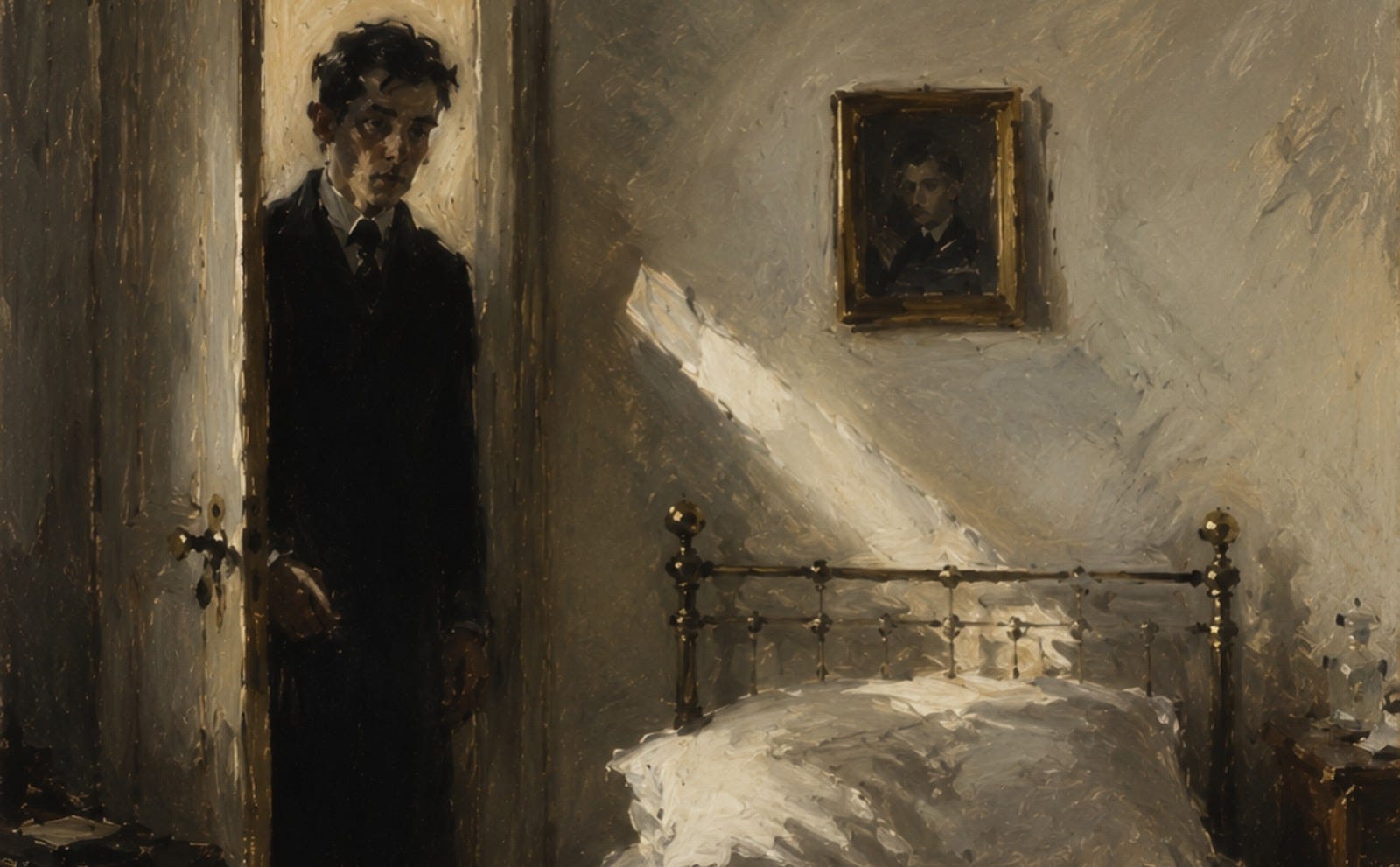
A man wakes one morning and discovers that his body has become something impossible.
For most writers, that would be enough of a crisis to occupy the next hundred pages. Franz Kafka does something stranger: Gregor Samsa’s immediate concern is work.
He has missed his train. His employer will be angry. Someone from the office may come looking for him. His samples are not packed. He has bills to pay, parents to support, and a schedule he is already failing to keep.
The grotesque transformation is almost secondary.
That may be the most revealing joke in The Metamorphosis. Gregor wakes in a body that should make every ordinary rule of life meaningless, yet those rules continue to govern him. He still thinks like an employee. He still worries like a provider. He still measures himself by whether he can get out of bed and perform the duties expected of him.
More than a century after the story first appeared, this remains one of the reasons The Metamorphosis feels so unsettling. Kafka does not simply ask what it would mean to become nonhuman.
He asks what made Gregor feel human in the first place.
And the answer is not especially comforting.
Gregor Has Already Been Transformed
The physical metamorphosis happens in the first sentence. But in another sense, Gregor’s transformation began long before the story opens.
Before he becomes a monstrous creature, he is already living largely as a function. He is a traveling salesman, the family’s main source of income, and the son responsible for paying off his parents’ debts. He catches trains, visits clients, eats badly, sleeps badly, and spends most of his life away from home.
He hates the work, but he continues because he believes he has no real choice. Once his parents’ debt has finally been repaid, he tells himself, he will quit. Until then, his own wishes barely matter.
That makes Kafka’s opening more than a surreal shock. Gregor’s new body gives physical form to a condition that already existed.
He has been useful rather than free.
Even after waking transformed, he does not begin by asking what his new existence means. He asks how he can get to work.
Soon the office manager arrives at the family apartment, suspicious because Gregor has missed a single train. Gregor can barely control his body and can no longer make himself understood, yet he still tries desperately to reassure the man. He insists that he will recover, dress, pack his samples, and leave.
The scene is horrible, but it is also very funny.
Kafka’s comedy often works through this collision between the impossible and the bureaucratic. A man has become something beyond explanation, yet the company still expects an explanation. Gregor’s body has escaped every familiar category, while his employer remains concerned with punctuality, performance, and suspicion.
The absurdity exposes how deeply the habits of work have entered Gregor’s mind. He no longer needs the boss in the room to discipline him. He carries the boss inside himself.
Kafka’s Creature Has No Simple Name
Readers often call Gregor a cockroach.
Kafka does not.
The German word in the opening is Ungeziefer, a deliberately unpleasant and imprecise term. It suggests vermin or some unclean crawling creature, but it does not identify a species. English translators have rendered it in different ways, including “vermin,” “insect,” and “bug.”
That uncertainty matters.
Kafka also resisted the idea that Gregor’s transformed body should be directly illustrated on the cover of the book. He did not want the reader given a neat visual answer.
So perhaps the wrong question is: What kind of creature has Gregor become?
The more disturbing question is: What happens when everyone stops recognizing Gregor as Gregor?
At first, his family knows perfectly well that the creature in the bedroom is their son and brother. His mother worries about him. Grete brings him food. His father, though frightened and aggressive, understands that something terrible has happened to a member of his household.
Gradually, that recognition weakens.
Gregor remains mentally connected to his human past. He remembers his job, worries about money, thinks about his parents, and loves his sister. But his family increasingly experiences him through his body.
The less human he looks, the harder it becomes for them to treat him as human.
Kafka never gives the reader the comfort of a simple dividing line between person and animal. Gregor’s body changes instantly. The judgment of everyone around him changes more slowly.
That second transformation is the one that destroys him.
The Other Metamorphosis
Before Gregor’s disaster, the Samsa household appears to depend on him. Or at least Gregor believes it does.
His father seems tired, defeated, and largely inactive. His mother is physically fragile. Seventeen-year-old Grete has been allowed the comfortable life of a daughter who is not yet expected to support herself.
Gregor carries the financial burden.
Then he becomes incapable of working.
And the family does not collapse.
Instead, everyone else begins to change. His father finds employment. His mother takes in sewing. Grete becomes a sales clerk and studies shorthand and French in the evenings in the hope of eventually finding a better position.
One of the most painful discoveries Gregor makes is that the family also has some savings. He had believed his exhausting work was the only thing standing between them and ruin. In reality, the situation is more complicated.
His sacrifice was real, but his indispensability was partly an illusion.
That is a devastating discovery because Gregor has built so much of his identity around being needed. Once he can no longer provide, the family is forced to develop abilities that had remained unused while he supported them.
The father undergoes the most visible change.
Earlier, Gregor remembers him as an exhausted, heavy man who could barely rise from his chair. Later, he sees his father standing upright in a blue work uniform with shining gold buttons, newly alert and energetic.
Gregor becomes weaker as his father becomes stronger.
One life contracts while another expands.
The family’s tragedy is therefore also a story of adaptation. The very crisis that destroys Gregor forces the others to become more capable.
Kafka lets that uncomfortable fact stand without explaining it away.
Grete’s Transformation
If The Metamorphosis belongs to anyone besides Gregor, it belongs to Grete.
At the beginning, she is the person closest to him. Gregor loves her deeply and has secretly planned to pay for her to attend a conservatory because of her talent for the violin.
After his transformation, Grete becomes his primary caregiver.
She notices that he no longer likes milk. She experiments with different foods. She cleans his room. She learns when to enter and when to leave him alone. For a while, she is the only member of the family willing to deal directly with what Gregor has become.
But care is work.
Grete is not only looking after Gregor. She eventually has a job outside the home. She studies at night. The family has lost its former security. Everyone is exhausted.
Her sympathy gradually becomes routine, and routine becomes neglect. Eventually Grete is the one who says openly what the others have been moving toward without admitting:
They must get rid of him.
It would be easy to say that Grete simply becomes cruel. She does become cruel. But Kafka makes the process more difficult than that.
She also becomes tired.
The affectionate younger sister has been pushed into the roles of worker, caregiver, housekeeper, and adult almost at once. What begins as devotion becomes obligation, and obligation becomes resentment.
Kafka shows how love can be damaged not only by hatred, but by exhaustion.
That distinction matters because it keeps the novella from becoming a simple story in which Gregor is good and his family is monstrous.
The Samsas are frightened, overworked, financially insecure, and increasingly trapped by a situation they do not understand.
Their suffering does not excuse their cruelty.
But it helps explain how that cruelty grows.
When Care Becomes a Burden
This is one reason The Metamorphosis can feel remarkably contemporary.
Without turning the novella into an allegory of any single condition, it can be read through the experiences of illness, disability, dependence, and caregiving.
Gregor understands the people around him.
They gradually stop believing that he can understand them.
His family talks about money, food, work, his room, and eventually whether he should continue to exist, all while Gregor listens from the other side of a door.
He cannot meaningfully participate in decisions about his own life.
The more dependent he becomes, the less authority he has over what happens to him.
The changing condition of his room makes this particularly visible.
At first, it is still Gregor’s bedroom: familiar furniture, personal possessions, the remains of a human life.
Then Grete decides that the furniture should be removed so that he can crawl more freely.
Gregor initially welcomes the idea, but when he hears his mother argue that the furniture should remain in case he becomes himself again, he suddenly understands what its removal would mean.
An empty room would not simply give him more space.
It would erase his past.
Later, the room deteriorates even further. It becomes a place where the family stores unwanted furniture, rubbish, and whatever else has no proper place in the apartment.
Gregor’s room tracks his position in the household.
He begins as a son who happens to be trapped behind a door.
He ends as something unwanted that happens to occupy a room.
The uncomfortable question Kafka leaves us with is not whether caregiving is difficult. Clearly it is.
The question is when exhaustion becomes dehumanization.
Kafka refuses to draw an easy line.
The Apple in Gregor’s Back
The father’s attack on Gregor is one of the novella’s most violent scenes.
He throws apples at his son.
One becomes lodged in Gregor’s back and remains there. The wound never properly heals.
By this point, Gregor’s father is no longer the passive man his son once supported. He has regained strength, employment, and authority. That renewed power is now directed against Gregor.
The scene naturally invites comparison with Kafka’s own troubled relationship with his father, Hermann Kafka. Kafka later wrote about feelings of fear, humiliation, and inadequacy in relation to paternal authority.
But reducing Gregor’s father to a portrait of Kafka’s father would make the story smaller.
The attack also belongs to the novella’s larger pattern of reversed power.
Gregor once held economic authority in the family because everyone depended on his income.
Now his father works, stands upright, wears a uniform, and physically drives Gregor back into his room.
The hierarchy has changed.
So has the definition of who belongs.
The apple remains in Gregor’s body as a permanent wound, but it also marks a point from which his decline becomes increasingly difficult to reverse.
The family has not merely failed to understand him.
His own father has injured him so badly that the injury becomes part of his new body.
Music and the Question of Humanity
Near the end of the novella, Grete plays the violin.
The three lodgers who now live with the Samsas hear her and ask her to perform in the living room.
Gregor hears the music too.
By this point, he is weak, filthy, injured, and increasingly accustomed to his transformed body. Many of his human habits have disappeared. His appetite has changed. His room has become almost unrecognizable. His family no longer treats him as a person.
Yet the music draws him forward.
Grete’s playing awakens something in Gregor that neither food nor memory has been able to reach.
He wants to move closer to her. He remembers his secret plan to send her to the conservatory. He imagines drawing her into his room and finally revealing what he had intended to do for her.
The moment produces one of the novella’s most important questions.
If music can move Gregor so deeply, what exactly makes him an animal?
His body?
His inability to speak?
His dependence on others?
Or simply the judgment of the people around him?
Kafka gives Gregor an inner life that no one else can see.
That may be the deepest tragedy in The Metamorphosis.
Gregor has not simply lost his human body.
He has lost the ability to prove his humanity to anyone else.
And the one scene in which his emotional life becomes most intensely human is also the scene that finally exposes him to the lodgers and helps bring the family’s tolerance to an end.
“We Have to Get Rid of It”
After the lodgers discover Gregor, Grete finally reaches her limit.
She refuses even to call the creature her brother.
If it were really Gregor, she argues, he would understand that the family cannot continue living this way. He would leave voluntarily.
The reasoning is brutal because it creates an impossible standard.
To prove that he is truly Gregor, Gregor must disappear.
And Gregor agrees.
This is the final stage of his transformation. He no longer merely accepts that he cannot work or provide. He accepts the belief that his continued existence is harming the people he loves.
He returns to his room.
He thinks about his family with tenderness.
Then he dies.
The family’s reaction is one of the novella’s coldest shocks.
There is sorrow, but there is also unmistakable relief.
Gregor believed himself essential to the family’s survival.
His death reveals that the family now experiences him as the final obstacle preventing them from moving forward.
And they begin moving forward almost immediately.
The Final Transformation
The ending of The Metamorphosis is often overshadowed by its opening.
It should not be.
After Gregor’s death, the Samsas leave the apartment together for the first time in months. They take a streetcar out of the city, and warm sunlight fills the carriage.
They discuss their jobs and realize that their prospects are not actually bad. They decide they can move into a smaller, cheaper, more practical apartment.
Then Mr. and Mrs. Samsa look at Grete.
They notice that their daughter has grown into a beautiful young woman.
They begin thinking about her future.
Perhaps, they decide, it is time for her to marry.
At the end of the journey, Grete stands and stretches her young body.
Kafka begins the novella with one transformed body and ends it with another.
Gregor’s body becomes a prison.
Grete’s body seems to promise a future.
The contrast is difficult to ignore.
The family that appeared doomed at the beginning has survived.
The person who believed himself essential to its survival has vanished.
And Grete, who once depended on Gregor’s generosity, now appears ready to enter a life of her own.
The title therefore belongs to more than Gregor.
The father changes.
Grete changes.
The balance of power inside the household changes.
The family changes economically and emotionally.
Even the meaning of Gregor changes in the minds of the people who once loved him.
So What Does The Metamorphosis Mean?
There is a reason readers have spent more than a century trying to decode Kafka’s story.
Gregor can be read as an alienated worker. The novella can be approached through family obligation, illness, disability, shame, capitalism, bureaucracy, paternal authority, isolation, or the absurdity of existence.
All of those readings can reveal something.
None fully contains the story.
Perhaps the mistake is assuming that Gregor’s creature form must be a symbol with one correct translation.
Kafka’s story becomes more disturbing when the metamorphosis is not treated as a code to be solved.
Gregor wakes up changed.
Then the world around him reveals itself.
His employer reveals how conditional professional respect can be.
His family reveals how love, money, dependence, resentment, and duty can become entangled.
Gregor discovers how completely he has built his identity around being useful to other people.
And Grete discovers that care can become a form of captivity too.
This is why the novella still feels modern.
Many people know what it is like to answer the question “Who are you?” with a job title.
Many know what it means to feel responsible for other people.
Many know the fear of becoming dependent, unwanted, or burdensome.
Kafka takes those ordinary anxieties and gives them an impossible body.
The nightmare is not simply that Gregor Samsa wakes up as something monstrous.
The nightmare is that, once he can no longer work, speak, earn, or care for everyone else, the people around him gradually learn to imagine a world without him.
And then they discover that the world goes on.